Clear Sky Science · en
Heterologous expression, structural analysis, and functional characterization of Ostrinia nubilalis pheromone-binding protein 2 (OnubPBP2)
Smelling Love in a Cornfield
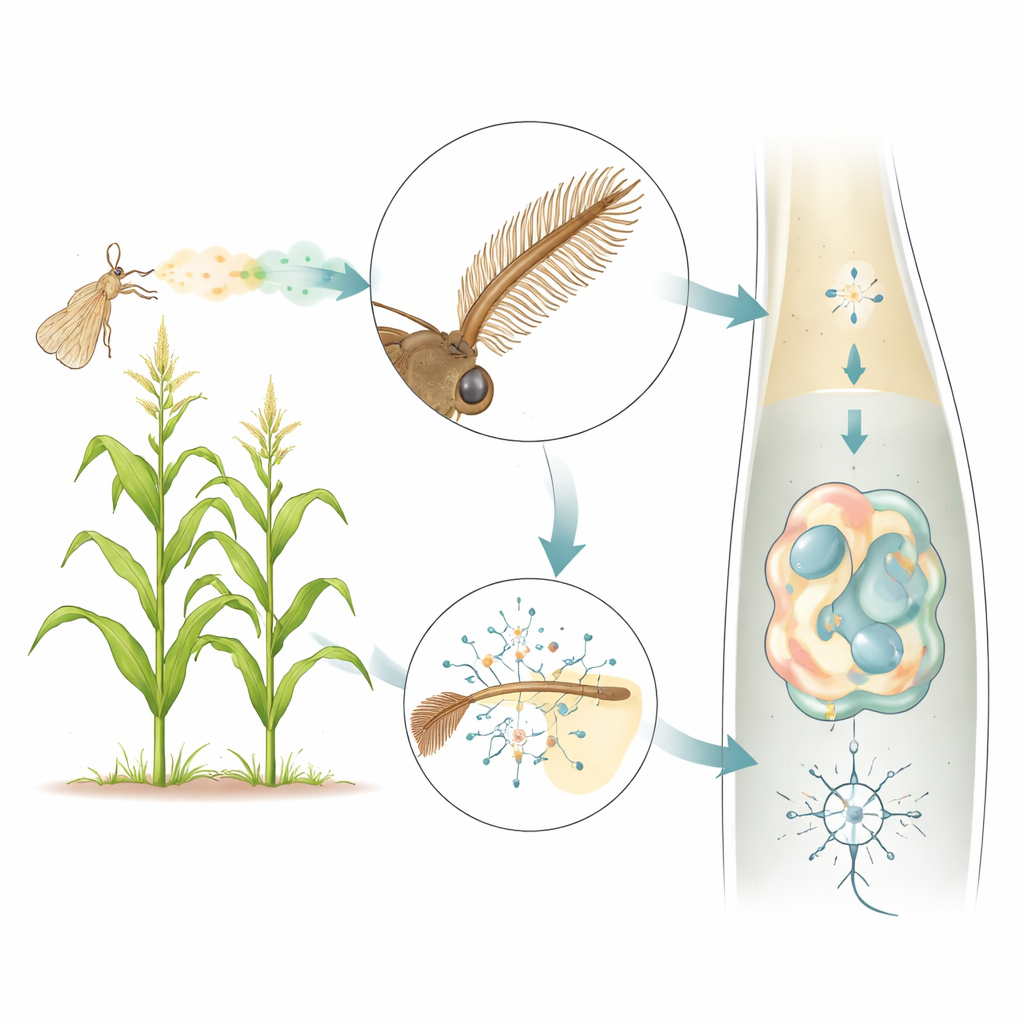
Farmers and gardeners may not see it, but a chemical love story is constantly unfolding over their fields. Male European corn borer moths can detect the scent of a distant female among acres of corn, guided by wisps of sex perfume drifting through the air. This paper digs deep into one small but crucial part of that story: a tiny “carrier” protein in the male’s antenna that catches the female’s scent and helps deliver it to the moth’s smell sensors. Understanding how this carrier works could open new ways to monitor or even disrupt this major crop pest without heavy reliance on traditional insecticides.
The Pest and Its Hidden Perfume System
The European corn borer is a serious agricultural threat, damaging more than 200 plant species and causing corn losses of millions of tons each year worldwide. Like many moths, these insects rely on smell to find mates. Females release specific scent molecules, or pheromones, into the air, and males detect them with feathery antennae packed with microscopic hairs. Inside the liquid that bathes these hairs, water-hating (oily) pheromone molecules face a challenge: they must travel through a watery environment to reach deep-lying smell receptors. This is where pheromone-binding proteins, such as the one studied here, step in as molecular shuttles that grab and carry the scent molecules safely to their destination.
A Closer Look at a Key Scent Carrier
The study focuses on one particular carrier called OnubPBP2, found in male European corn borer antennae and thought to play a key role in recognizing the female’s sex perfume. The authors first had to coax bacteria to produce large amounts of this moth protein, a common but often tricky strategy that lets scientists study insect proteins in the lab. Most of the protein ended up stuck in dense clumps inside the bacterial cells, so the team dissolved these clumps, carefully refolded the protein into its correct shape, and then purified it. They verified its identity and quality using methods that weigh the protein very precisely and measure its overall folded structure.
How Strongly the Protein Holds the Scent
To see whether the lab-made protein really works as a scent carrier, the researchers used a fluorescent dye that shines more brightly when tucked into oily pockets. When mixed with OnubPBP2, the dye’s glow increased sharply, showing that the protein has a well-formed internal pocket. The team then challenged the dye by adding the two natural pheromone molecules produced by female moths—mirror-like E and Z forms of the same carbon chain. As these pheromones slipped into the pocket, they pushed the dye out, dimming the fluorescence. By tracking how much pheromone it took to dislodge the dye, the scientists showed that OnubPBP2 binds both scent forms very tightly, at concentrations far lower than a millionth of a gram per milliliter, with a slightly stronger preference for the E form.
A Shape-Shifting Carrier Tuned by Acidity
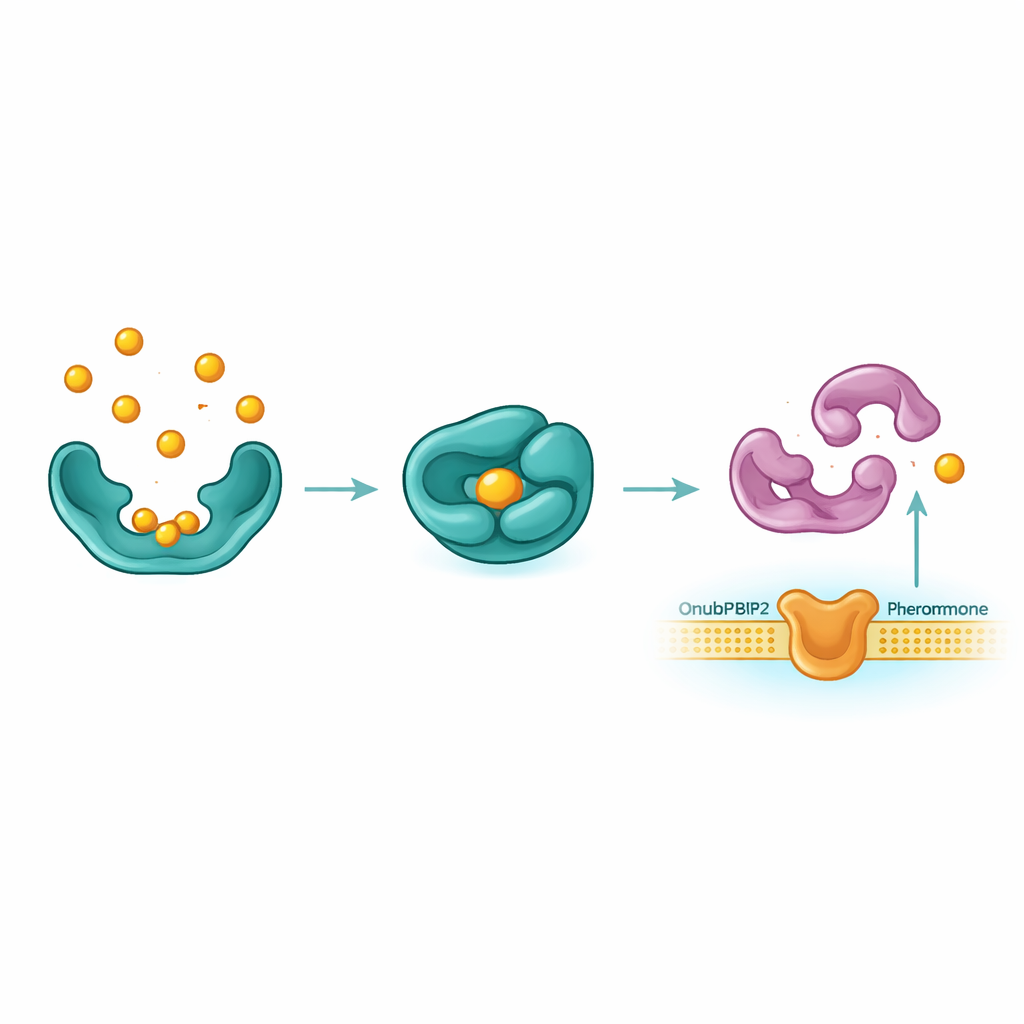
The antenna environment is not constant: its acidity can change along the path from the outside air to the smell receptor. The team used two sensitive techniques—light-based circular dichroism and high-resolution nuclear magnetic resonance—to see how OnubPBP2’s shape responds to changes in acidity. At near-neutral conditions, similar to the surface of the antenna, the protein appears well folded and mostly helical, forming a stable pocket for the pheromone. As the solution becomes more acidic, resembling deeper regions near the receptor, the protein partly loosens into a “molten globule” state—still structured, but more flexible and dynamic. Importantly, this change is reversible: when the acidity is shifted back, the protein snaps into its original, tidy form.
Peeking into the Pocket with Computer Models
Because no crystal structure of OnubPBP2 yet exists, the authors built a detailed 3D model using the closely related protein from a sister species as a template. This model shows a snug, oily pocket where pheromone molecules can nestle. Computer docking experiments, in which virtual pheromones are slipped into the modeled pocket, produced binding energies that match the strong attraction measured in the lab. Both E and Z pheromones make many hydrophobic contacts with the surrounding amino acids, explaining why OnubPBP2 can bind them so well. Subtle differences in these contacts likely underlie the slightly higher affinity for the E form, in line with the moth’s natural scent preferences.
Why This Tiny Protein Matters
Seen from afar, this work reveals how a single shape-shifting protein helps a destructive moth species follow faint scent trails across a field. OnubPBP2 is not just a passive carrier: its ability to tighten around pheromone molecules under some conditions and loosen under others appears to make scent pick-up and release highly efficient. That built-in flexibility sets it apart from related proteins in other moths and may represent an evolutionary twist unique to this group. In practical terms, such detailed knowledge can guide the design of biosensors that mimic the moth’s nose or new strategies to jam its chemical communication, offering more targeted, environmentally friendly tools to manage a costly crop pest.
Citation: Nukala, V., Al-Danoon, O. & Mohanty, S. Heterologous expression, structural analysis, and functional characterization of Ostrinia nubilalis pheromone-binding protein 2 (OnubPBP2). Sci Rep 16, 13084 (2026). https://doi.org/10.1038/s41598-026-43384-0
Keywords: pheromone-binding protein, European corn borer, insect olfaction, moth pheromones, pest control