Clear Sky Science · en
Predictive modeling for early diagnosis of dementia using sequential data analysis and data mining
Why catching memory decline early matters
Dementia often creeps in so slowly that by the time symptoms are obvious, precious years for treatment and planning have already slipped away. Families usually notice only scattered signs—forgetfulness here, confusion there—while doctors see brief snapshots during clinic visits. This study asks a simple but powerful question: what if we could follow the full story of a person’s health over time and teach a computer to spot the earliest, hidden bend in the curve toward dementia?
Following patients over time, not just in snapshots
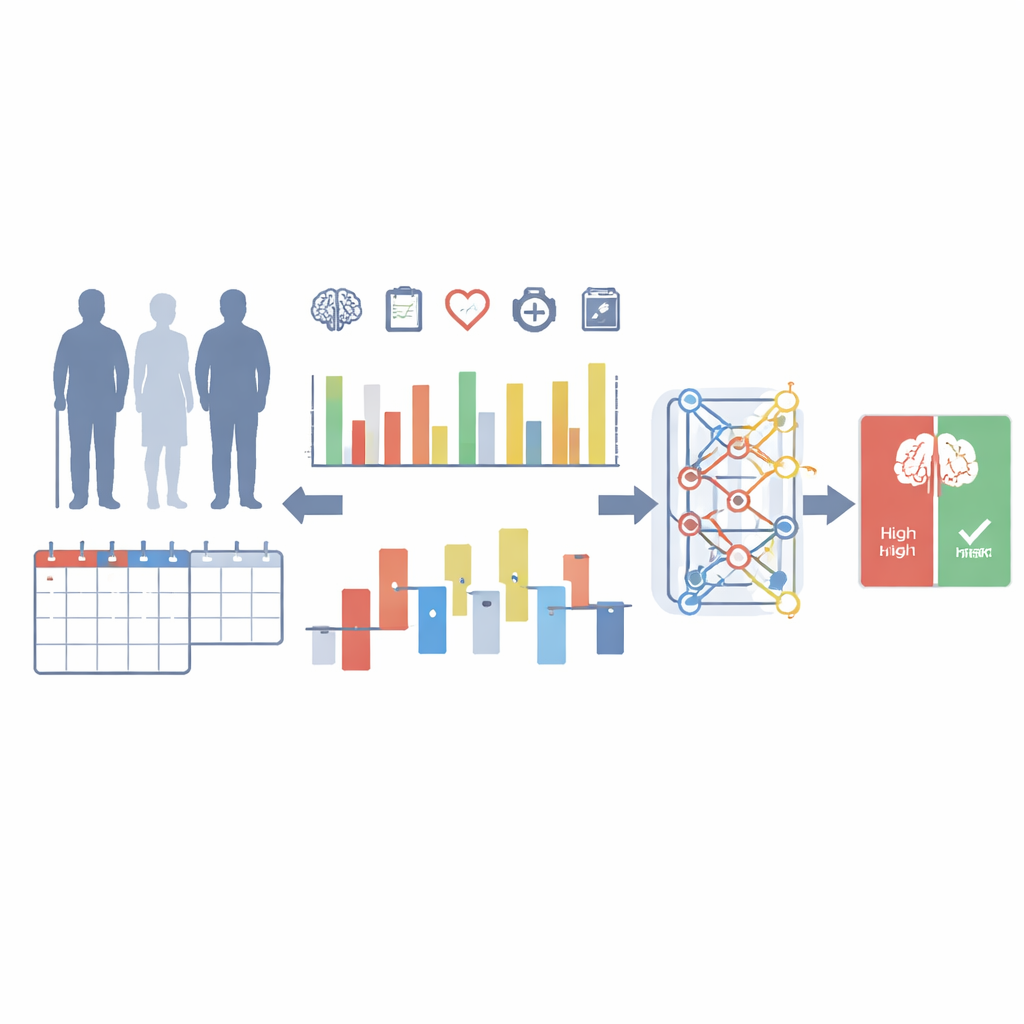
Most computer tools that try to predict dementia look at static data: a single brain scan, one cognitive test, or a checklist taken during a visit. The researchers behind this work argue that dementia is better understood as a moving picture than as a still photograph. They use a rich dataset from more than 2,100 adults aged 60–90 that includes repeated measures of memory scores, daily functioning, mood, lifestyle factors, and medical history. These records are reorganized into 30-day slices so that the computer model can “watch” how each person’s thinking and daily abilities change month by month instead of just comparing isolated numbers.
Cleaning and balancing real-world health records
Real medical records are messy. People miss appointments, some answers are left blank, and far fewer patients have dementia than do not. Before building their predictor, the team carefully repaired gaps in the data by filling in missing numeric values with typical values from similar patients and choosing the most common value for yes/no items like memory complaints. They then turned each person’s history into overlapping 30-day sequences to preserve the order of events. To prevent the model from learning mainly from the majority of healthy cases, they used a technique that gently “copies and blends” existing dementia cases, creating realistic additional examples so that both groups are represented more evenly during training.
How the new model reads the timeline of decline
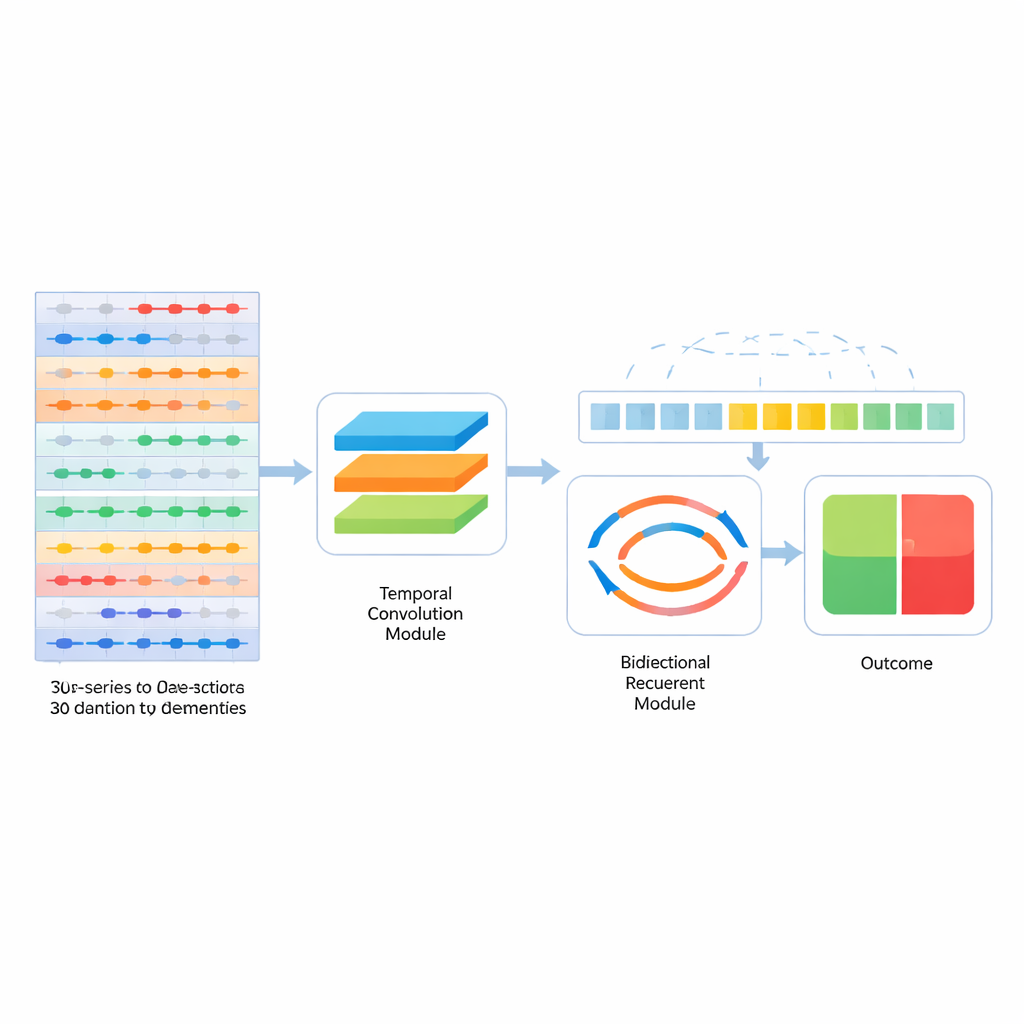
The heart of the study is a new hybrid deep-learning system called TCBiNet, designed specifically to read health information as a timeline. First, a temporal convolution stage scans through each 30-day sequence, spotting short bursts and local trends—like a sudden dip in a memory score or a brief change in daily functioning. Next, a bidirectional memory stage looks both forward and backward along the sequence, capturing slow, long-term drifts that unfold over months, such as a steady slide in thinking ability. Finally, an attention stage learns which specific time intervals matter most for flagging early dementia, automatically giving extra weight to periods where, for example, forgetfulness and confusion begin to co-occur or daily activities start to slip.
What the model learned about early warning signs
When tested against several advanced alternatives—including convolutional and recurrent neural networks and reinforcement-learning-based methods—TCBiNet proved to be the most accurate and reliable. It correctly distinguished dementia from non-dementia cases more than 99% of the time and showed excellent ability to separate high-risk from low-risk patients across a range of thresholds. The model’s behavior also aligned with clinical intuition: changes in standard memory tests, day-to-day functioning, and self-reported memory problems emerged as the strongest predictors, while symptom pairings such as forgetfulness plus confusion frequently appeared together in patients on the dementia track. The attention maps revealed that a few key stretches in a person’s history can carry outsized importance, even when the overall pattern looks noisy.
What this could mean for patients and clinicians
To a lay reader, the bottom line is straightforward: by treating health data as a story unfolding over time rather than a series of isolated checkups, this approach can spot dementia earlier and with greater confidence. The proposed system turns routine clinical measurements into a kind of early warning radar, highlighting subtle, sustained shifts in thinking and daily life that may otherwise go unnoticed. While the model still needs to be tested in different hospitals and among more diverse populations, it offers a promising path toward more proactive care—giving patients, families, and clinicians a longer runway to plan, intervene, and potentially slow the course of a devastating disease.
Citation: G, S.K., R, D. Predictive modeling for early diagnosis of dementia using sequential data analysis and data mining. Sci Rep 16, 13226 (2026). https://doi.org/10.1038/s41598-026-43382-2
Keywords: early dementia prediction, longitudinal health data, deep learning in healthcare, Alzheimer’s risk assessment, cognitive decline monitoring