Clear Sky Science · en
Impact of climate change on the suitable niches of an ornithophilous neotropical orchid (Elleanthus brasiliensis) and its pollen vectors
Why this story of a single orchid matters
Across the tropics, many plants depend on animals to move pollen from flower to flower. This study zooms in on one such partnership: a showy Brazilian orchid and the hummingbirds that carry its pollen. By following how their suitable habitats may shift under climate change, the research offers a concrete glimpse of what global warming means for real species, real forests, and the future of pollination that underpins much of the world’s plant life.
A fragile bond between flowers and birds
The orchid at the heart of this work, Elleanthus brasiliensis, grows mainly in Brazil’s Atlantic Forest, a biodiversity hotspot already heavily fragmented by agriculture and urban growth. Unlike plants that can fertilize themselves, this orchid relies on visiting hummingbirds to set seed. Its flowers are built for birds: tubular, with no landing platform for insects, and arranged in sticky, jelly-coated clusters that both protect the buds and control access to nectar. Four hummingbird species are known pollen carriers, zipping between plants and using their slender bills to trigger a tiny lever that loads pollen onto their beaks.
Mapping today’s and tomorrow’s safe places
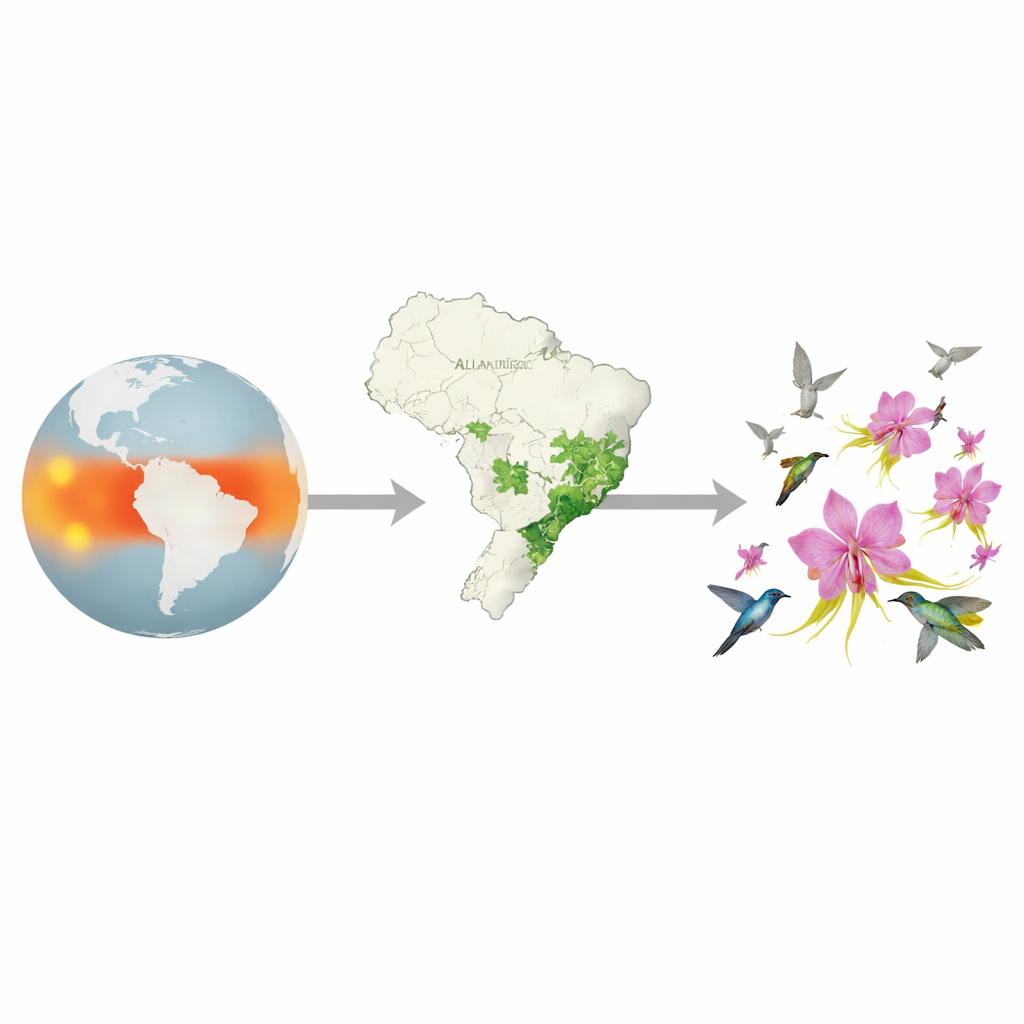
To see how climate change may reshape this relationship, the researcher assembled thousands of location records for the orchid and each of its four bird partners. Using climate-based computer models, she identified where temperature and rainfall patterns are suitable for each species today, and how those “climate niches” might expand, shrink, or shift by the late twenty‑first century under several greenhouse gas scenarios. The models, which performed well against current distributions, show that all five species face overall loss of suitable climate space, though the amount and pattern of change differs among them.
Winners, losers, and broken ranges
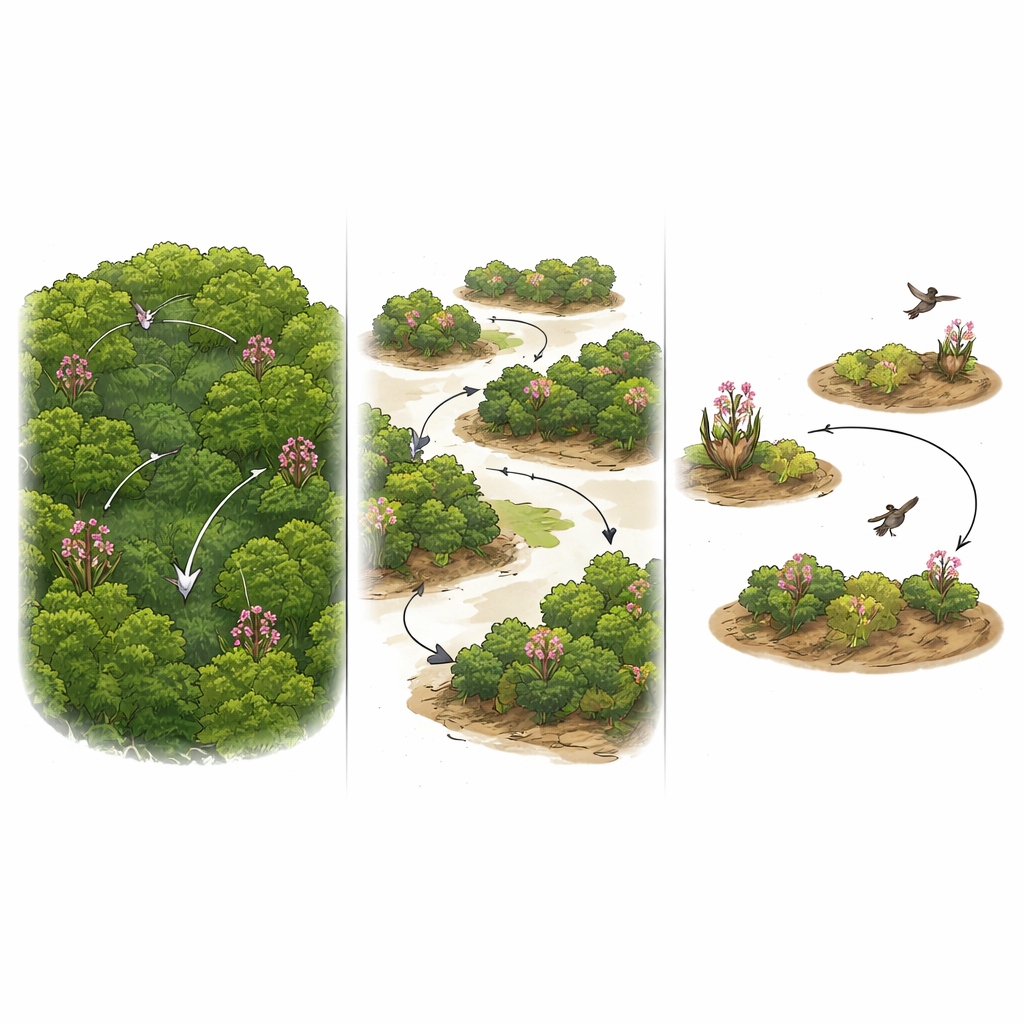
The orchid itself is projected to lose roughly 13 to 45 percent of its suitable habitat, with the harshest scenario causing almost half of its potential area to disappear. Just as important, its range becomes much more fragmented, breaking into scattered pockets in different parts of eastern and southern Brazil. Fragmentation can be as serious as outright loss: small, isolated populations are more vulnerable to inbreeding, random die‑offs, and the disappearance of the fungi and host trees they also depend on. The hummingbirds, by contrast, generally retain broader, less fragmented ranges, though they too lose ground, especially under strong warming.
When flowers and birds no longer line up
Because the orchid cannot reproduce without hummingbirds, the key question is where their ranges will still overlap. The analysis shows that one species, the violet‑capped woodnymph, remains a near‑constant companion, covering virtually all orchid populations even in future climates and including human‑altered areas such as parks and gardens. The other three bird species overlap with only a subset of the orchid’s range and show mixed futures, sometimes gaining climate space in one region while losing it in another. In the southernmost parts of the orchid’s range, climate change is expected to leave some orchid patches with no known bird visitors except the woodnymph, and some with none at all.
Hidden safe havens and conservation choices
By combining maps for the orchid and its bird partners, the study pinpoints regions such as Chapada Diamantina, Serra do Mar, and Serra Geral as climatic refuges where both flowers and pollinators are likely to persist together. These areas, the author argues, deserve special attention in conservation planning, especially given ongoing deforestation and land conflicts in the Atlantic Forest and neighboring biomes. While hummingbirds can usually switch among many nectar sources, highly specialized plants like this orchid cannot easily swap pollinators. The work therefore highlights a subtle but critical risk of climate change: not just the loss of species, but the quiet unraveling of the partnerships that keep ecosystems functioning.
Citation: Kolanowska, M. Impact of climate change on the suitable niches of an ornithophilous neotropical orchid (Elleanthus brasiliensis) and its pollen vectors. Sci Rep 16, 13243 (2026). https://doi.org/10.1038/s41598-026-43348-4
Keywords: climate change, orchids, hummingbirds, pollination, Atlantic Forest