Clear Sky Science · en
Correcting model error bias in estimations of neuronal dynamics from time series observations
Teaching Computers to Read the Hidden Language of Nerve Cells
Our brains run on tiny electrical pulses produced by nerve cells, but scientists can only measure part of this activity directly. This study shows how an artificial intelligence technique can fill in the missing pieces, correcting flaws in our mathematical models of neurons so that we can better understand how brain cells behave, even in ways we cannot observe in experiments.
Why Neuron Models Need a Helping Hand
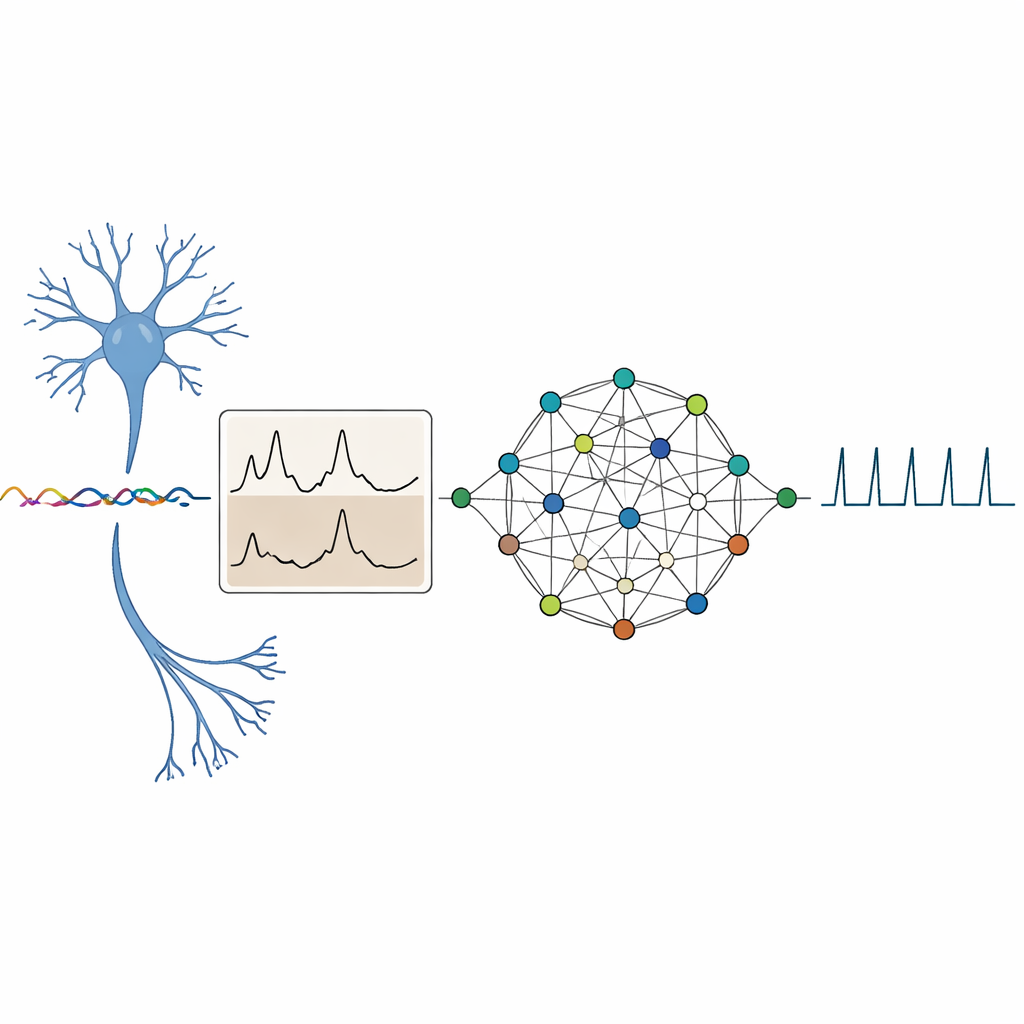
Neuroscientists use equations to mimic how a neuron responds when it is poked with an electrical current. These models try to reproduce the cell’s membrane voltage – the rapid rises and falls that underlie nerve impulses or “spikes.” Underneath those spikes, however, lie hidden processes: tiny protein gates that open and close to let ions flow. Experiments usually record only the voltage at the cell surface, not the motion of these gates. Worse, the equations scientists use are only approximations, and their parameters are often uncertain or “sloppy.” As a result, many different parameter sets can fit the same data, yet represent very different internal biology. The authors argue that to build reliable digital twins of neurons – and ultimately real brains – we must correct these model errors and recover both visible and hidden dynamics from ordinary voltage recordings.
A Hybrid of Physics and Machine Learning
The researchers build on a technique called reservoir computing, a form of recurrent neural network that excels at predicting complex time series. Instead of discarding traditional neuron equations, they embed a standard Hodgkin–Huxley–type model inside the reservoir. The neuron model receives a rich electrical stimulus made of random steps and chaotic currents, designed to probe all of its internal behaviors over many timescales. The model’s output, along with the driving current, is then fed into a fixed web of artificial neurons – the reservoir. Only the final readout layer is trained, by adjusting linear weights so that the combined system reproduces the reference voltage produced by an ideal, error-free model. Once trained, the hybrid takes only the input current and predicts how the neuron’s voltage and internal gates should evolve for new, previously unseen stimuli.
Testing Different Ways to Mix Models and Networks
To understand how best to correct errors, the team deliberately damages their surrogate neuron model by changing key parameters, such as the strength of sodium channels or the voltage at which they activate. They then compare several hybrid designs. In some, the reservoir sees only the membrane voltage from the model; in others, it also receives the hidden gate variables; in still others, the model’s outputs influence not just the inputs to the reservoir but also its final readout. The most successful design, called the “all state variables full hybrid,” feeds all four state variables – voltage and three gate variables – into both the input and output layers of the reservoir. This configuration stabilizes predictions under rapid or abrupt changes in the driving current, avoids the saturation problems that plague a reservoir alone, and sharply reduces errors in both subthreshold voltage fluctuations and full-blown action potentials.
Peering Into Hidden Ion Channels
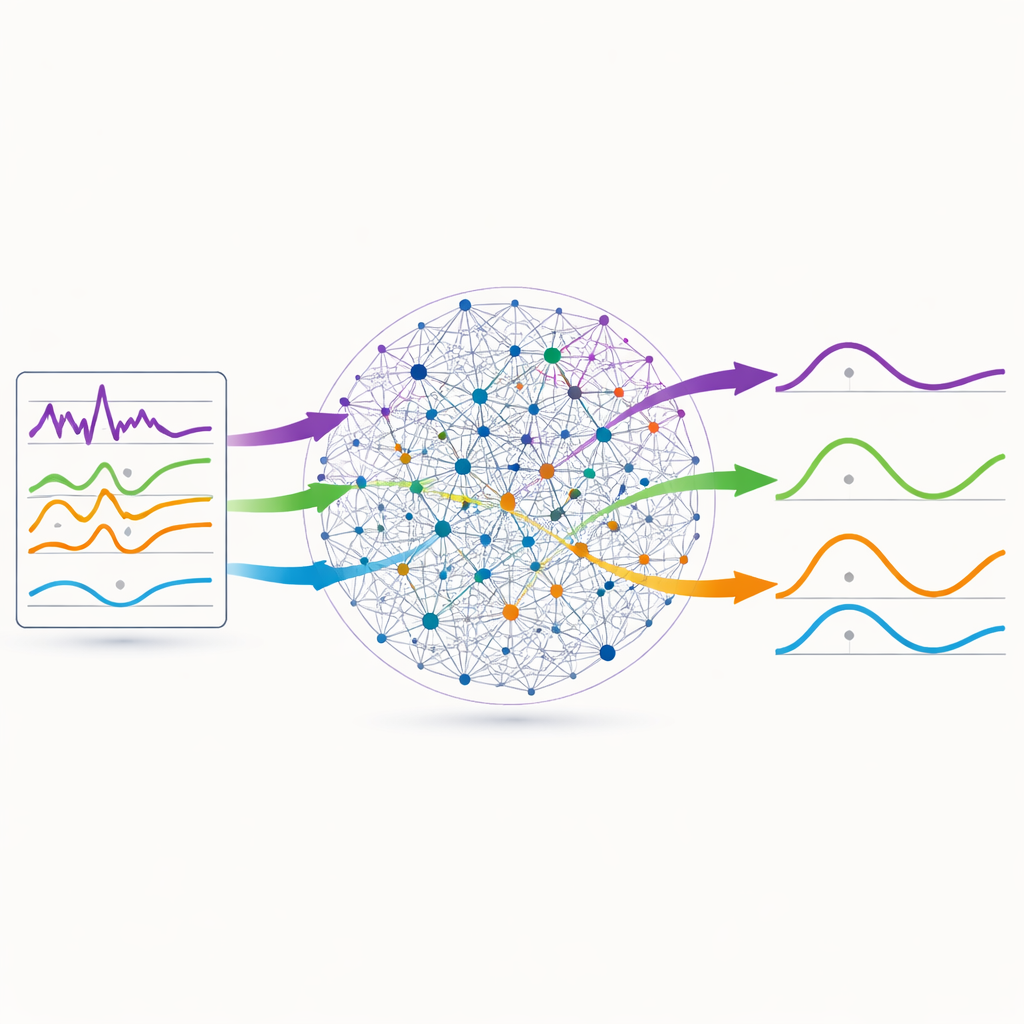
A striking result is that the hybrid system does not just fix the visible voltage trace; it also reconstructs the time courses of the hidden ion channel gates. Even when the surrogate model is so wrong that it no longer fires properly, the trained hybrid can recover gate dynamics that closely match those of the ideal reference. This works because information about the gates is indirectly encoded in delayed measurements of the membrane voltage. By tuning the reservoir’s internal connectivity so that it retains information over the right time window, the system effectively “remembers” enough of the recent voltage history to infer what the internal state must have been. Across a wide range of linear and nonlinear parameter errors, and even when multiple parameters are perturbed by orders of magnitude, the hybrid substantially improves predictions until errors become either vanishingly small (where intrinsic network noise dominates) or extremely large (where the system reverts toward behaving like a pure reservoir).
What This Means for Understanding Real Brains
For non-specialists, the key message is that combining mechanistic neuron equations with flexible machine-learning networks can yield models that are both physically grounded and highly accurate. This hybrid approach can correct biases in approximate neuron models, stabilize predictions under complex electrical stimulation, and infer hidden processes that experiments currently cannot measure in real time. As the method is extended to more realistic multi-channel, multi-compartment neurons and to networks of cells, it offers a powerful route toward building trustworthy digital replicas of living brain tissue from limited experimental data.
Citation: Williams, I., Taylor, J.D. & Nogaret, A. Correcting model error bias in estimations of neuronal dynamics from time series observations. Sci Rep 16, 13120 (2026). https://doi.org/10.1038/s41598-026-43346-6
Keywords: neuronal dynamics, reservoir computing, Hodgkin–Huxley model, model error correction, digital twin neurons