Clear Sky Science · en
Shear-enhanced dynamic permeability development of magma vesiculating in cylindrical conduits
Why the bubbles in lava matter
Volcanic eruptions are powered by gas trapped inside molten rock. Whether a volcano oozes lava gently or blasts ash high into the sky depends in large part on how easily that gas can leak out. This study explores how bubbles inside sticky, gas-rich magma connect to one another and to the outside world, turning the rock from a gas-trapping sponge into a leaky foam. Understanding this change helps explain why some eruptions are explosive while others are relatively quiet.
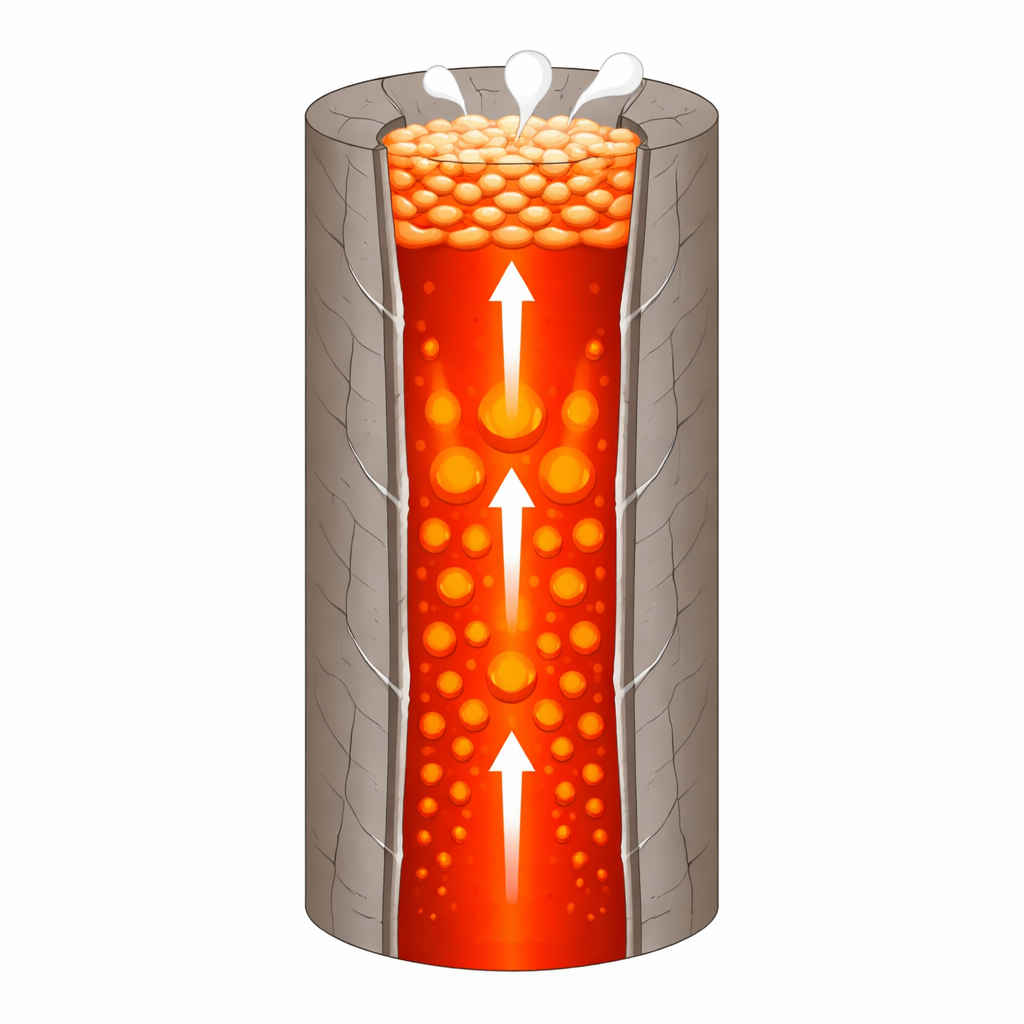
Bubbles rising in a rocky pipe
Inside a volcano, magma often travels upward through roughly cylindrical conduits—rocky pipes that can be meters wide. As pressure drops during ascent, dissolved water and other gases come out of solution, forming bubbles. When enough of these bubbles touch and link up, gas can percolate through the magma and escape. Earlier work suggested that a very high fraction of the magma volume—often over half—must be bubbles before such pathways form. But those estimates usually ignored how strongly the moving magma is sheared, or stretched, by rubbing against the conduit walls. The authors set out to recreate this situation in the laboratory using real rhyolitic obsidian, a natural volcanic glass, to see how shear changes the threshold where gas can flow freely.
Laboratory volcanoes in miniature
The team drilled small cylindrical cores of obsidian and heated them until bubbles began to grow. In one set of experiments the samples were allowed to expand freely, mimicking magma that is not strongly squeezed by its surroundings. In another set, each glass cylinder was placed inside a thicker basalt tube with a slightly larger inner diameter, forcing the bubbly magma to expand sideways until it touched the tube, and then mostly upward. By changing the size gap between sample and tube, the researchers controlled how soon shear started and how strong it became. Throughout the heating and holding period, they tracked how much the samples swelled, how many bubbles formed, how those bubbles changed shape, and how easily gas could move through the resulting network.
How stretching bubbles opens escape routes
The experiments reveal a stark contrast between calm and sheared magma. When the samples expanded freely, bubbles stayed nearly round and even at very high bubble contents—up to about three quarters of the volume—the magma remained effectively airtight, with extremely low permeability. Once shear was introduced by confinement, however, the picture changed. Near the margins, bubbles were quickly stretched into elongated shapes aligned with the flow, and neighboring bubbles began to touch and merge. In moderately sheared samples, significant gas pathways appeared as soon as the bubbly magma brushed against the container walls, at bubble fractions around 60–70 percent. In the strongest-shear cases, connectivity was established at much lower bubble contents, sometimes below 20 percent, although these early pathways were less permeable overall.
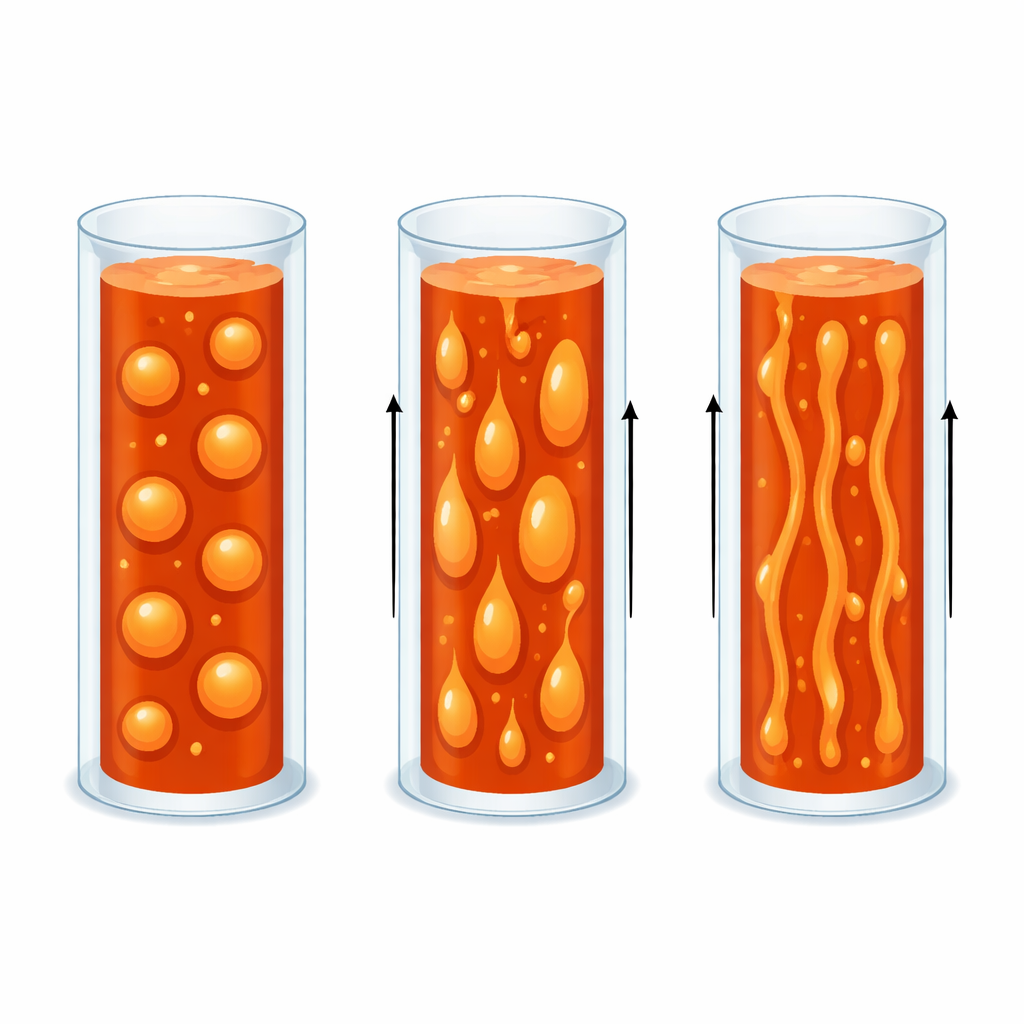
A dynamic balance between gas gain and gas loss
Permeability in the sheared samples did not simply rise with the total amount of bubbles. Instead, it depended on which portion of the pore space was actually connected, as well as on the sizes and shapes of the narrow throats linking bubbles together. Once pathways formed, gas began to escape through torn regions of the dense outer “rind” of glass that coats the samples. The authors combined their measurements with a bubble-growth model to reconstruct how bulk permeability evolved over time at high temperature. They found that in gently confined cases, shear-triggered connectivity allowed gas escape just fast enough to balance bubble growth, leading to a transient, self-regulating state. In strongly confined cases, bubble growth continued even after connectivity was reached, but at a slower pace, showing that linking bubbles does not automatically drain gas instantly from viscous magma.
What this means for real eruptions
For natural volcanic conduits, these results imply that even modest shear can drastically lower the bubble content required for gas to percolate, and that once connections form they can persist even as bubbles later relax toward rounder shapes. However, effective outgassing also requires continuous routes all the way to the surrounding rock and a pressure difference to drive flow. Thus, the shift from explosive to effusive behavior in silicic eruptions is controlled not just by how many bubbles are present, but by how magma is squeezed and stretched within the conduit and how its gas pathways connect to the wider volcanic plumbing system.
Citation: Birnbaum, J., Schauroth, J., Weaver, J. et al. Shear-enhanced dynamic permeability development of magma vesiculating in cylindrical conduits. Sci Rep 16, 9838 (2026). https://doi.org/10.1038/s41598-026-43344-8
Keywords: magma permeability, volcanic degassing, bubble networks, eruption style, rhyolitic magma