Clear Sky Science · en
Numerical study on the impact of coal fractures on seismic wave dispersion and attenuation: anisotropic WIFF effects
Listening to Cracks in Coal
Deep underground, seams of coal are crisscrossed by tiny natural fractures that store and guide methane gas. Energy companies use sound waves, much like medical ultrasound, to probe these rocks and plan where to drill and fracture. But those waves do not travel smoothly: the cracks bend, slow, and sap energy from them in ways that depend on direction and on the fluids filling the fractures. This study uses advanced computer models to show how those subtle effects can reveal the hidden structure of coal and improve coalbed methane production and monitoring.
Hidden Highways in Coal Beds
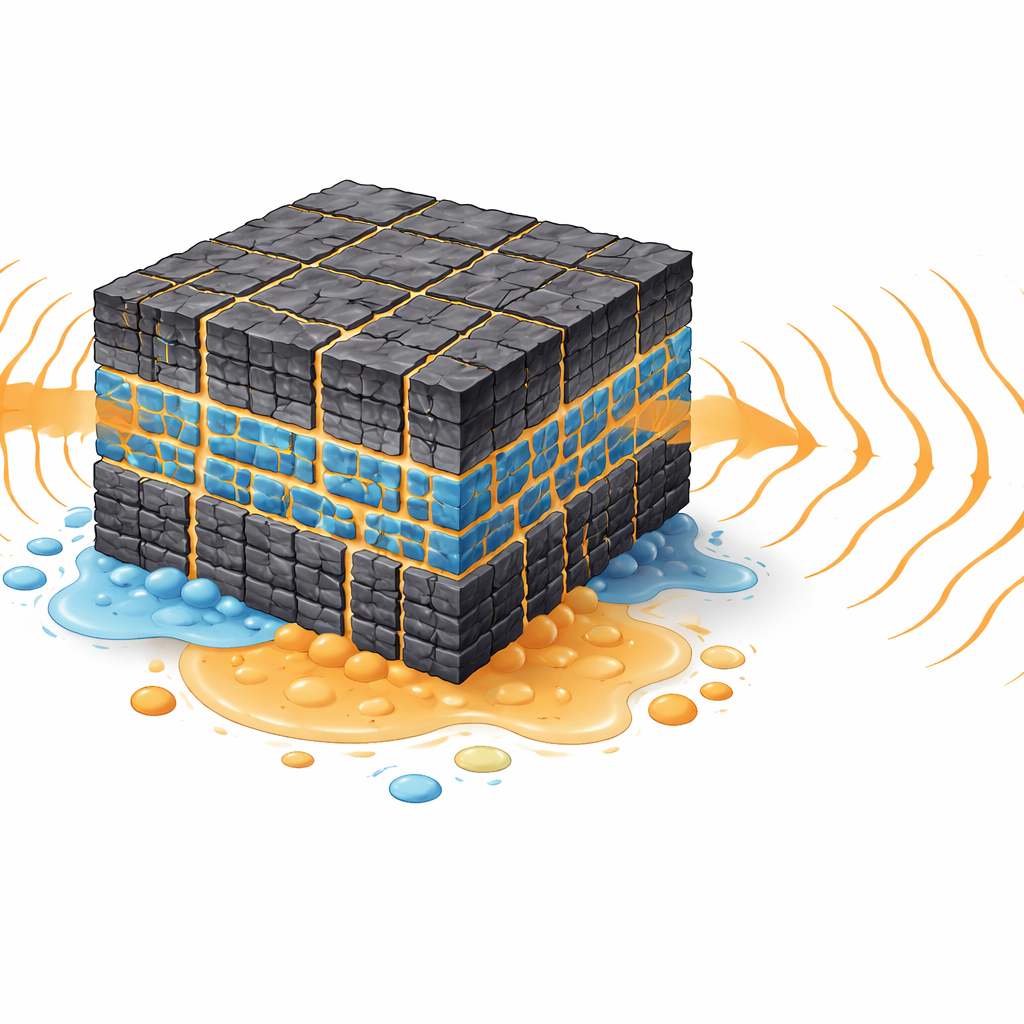
Coalbed methane reservoirs are not simple blocks of rock. They contain a dual network: tiny pores in the coal itself and two main sets of natural fractures called cleats. Long, continuous “face” cleats act like horizontal highways for gas and water, while shorter, less connected “butt” cleats cut across them. Together they form a near-orthogonal grid that controls how fluids move. Earlier work showed that this pattern makes coal behave differently depending on direction—waves travel faster and fluids flow more easily along some paths than others. However, previous models often treated fractures as if they were oriented randomly, glossing over the distinctive geometry of real cleat networks.
How Rock and Fluid Share the Load
The authors built detailed “digital rocks” on a computer to capture this geometry. They represented a two-dimensional slice of coal, 20 centimeters across, with explicit face and butt cleats of different lengths, thicknesses, and permeabilities. Into this framework they plugged a well-established physical description of how solid grains and pore fluids move together when a wave passes through. Instead of tracking fast, full-blown seismic waves, they solved a slower, but more efficient, form of the equations that focuses on how pressure diffuses through the pores. By gently squeezing the digital rock at many different frequencies and measuring how much it compressed, they could infer how fast waves would travel and how much energy they would lose.
Direction Matters for Wave Energy Loss
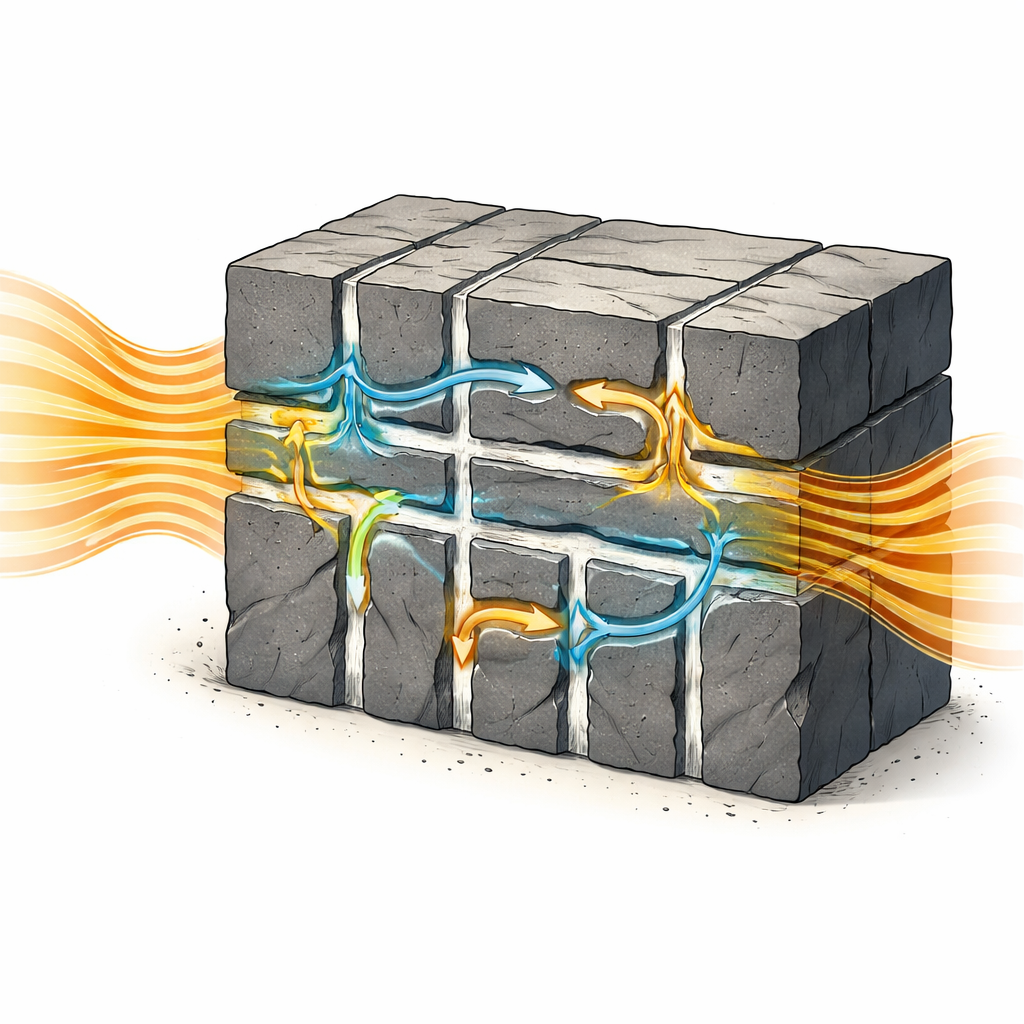
The simulations showed that the direction of wave travel relative to the cleats makes a big difference, especially at low frequencies comparable to earthquake and seismic-survey bands. When compression acted mainly across the face cleats, waves sped up more strongly with frequency and lost more energy than when they acted across the butt cleats. In both directions, the energy loss curve displayed two distinct peaks. The first, at lower frequency, was linked to fluid moving between the fractures and the tighter coal matrix. The second, at higher frequency, came from shorter-distance “squirt” flow between neighboring fractures. Visualizing the pressure patterns in the model revealed why: long, permeable face cleats created extended flow paths that allowed fluid pressure to adjust over large areas, enhancing energy loss and making the rock’s response highly directional.
Shape and Filling of Cracks Change the Story
Next, the team explored how the shape of butt cleats and the type of fluid inside them tune this behavior. Keeping fracture volume constant but stretching the fractures (making them flatter and longer) strengthened the high-frequency energy loss and slightly shifted its peak to lower frequencies, particularly when waves acted across the face cleats. In effect, slender fractures made fluid flow more efficient at draining wave energy. Changing the fluid—from water to supercritical carbon dioxide or methane—also had strong effects. Lower-viscosity fluids moved more easily, pushing the attenuation peaks to higher frequencies. At the same time, differences in fluid compressibility (how easily a fluid’s volume changes under pressure) strongly altered the height of those peaks and the contrast between directions. Methane, which is more compressible than water, produced the largest directional differences in wave speed.
Why These Findings Matter
In everyday terms, this study shows that coal does not respond to sound uniformly: its crisscrossed fractures and their fluid fillings make it ring differently depending on which way you “tap” it and at what pitch. By carefully measuring how wave speed and energy loss change with frequency and direction, geophysicists can infer not just the presence of fractures, but also whether they are long or short, wide or narrow, and what kinds of fluids they contain. For coalbed methane operations, that knowledge can guide where to drill, how to design hydraulic fracturing, and how to monitor gas extraction and carbon dioxide injection over time, all while reducing uncertainty in interpreting seismic data from the fractured subsurface.
Citation: Li, B., Zou, G., Wang, J. et al. Numerical study on the impact of coal fractures on seismic wave dispersion and attenuation: anisotropic WIFF effects. Sci Rep 16, 10926 (2026). https://doi.org/10.1038/s41598-026-43336-8
Keywords: coalbed methane, seismic waves, rock fractures, fluid flow, reservoir characterization