Clear Sky Science · en
Hybrid Aquila optimizer–Harris Hawks optimization for CNN hyperparameter tuning in brain tumor classification
Smarter Scans, Faster Answers
When doctors search MRI scans for signs of brain tumors, every minute and every pixel matters. Computers can help by spotting subtle patterns that even trained eyes might miss, but teaching these systems to be both accurate and fast is tricky. This study introduces a new way to automatically fine‑tune a popular type of image‑analysis model so it can classify brain tumors more accurately and in a fraction of the usual time—an advance that could one day support quicker, more reliable diagnoses in busy hospitals.
Why Tuning the Dials Is So Hard
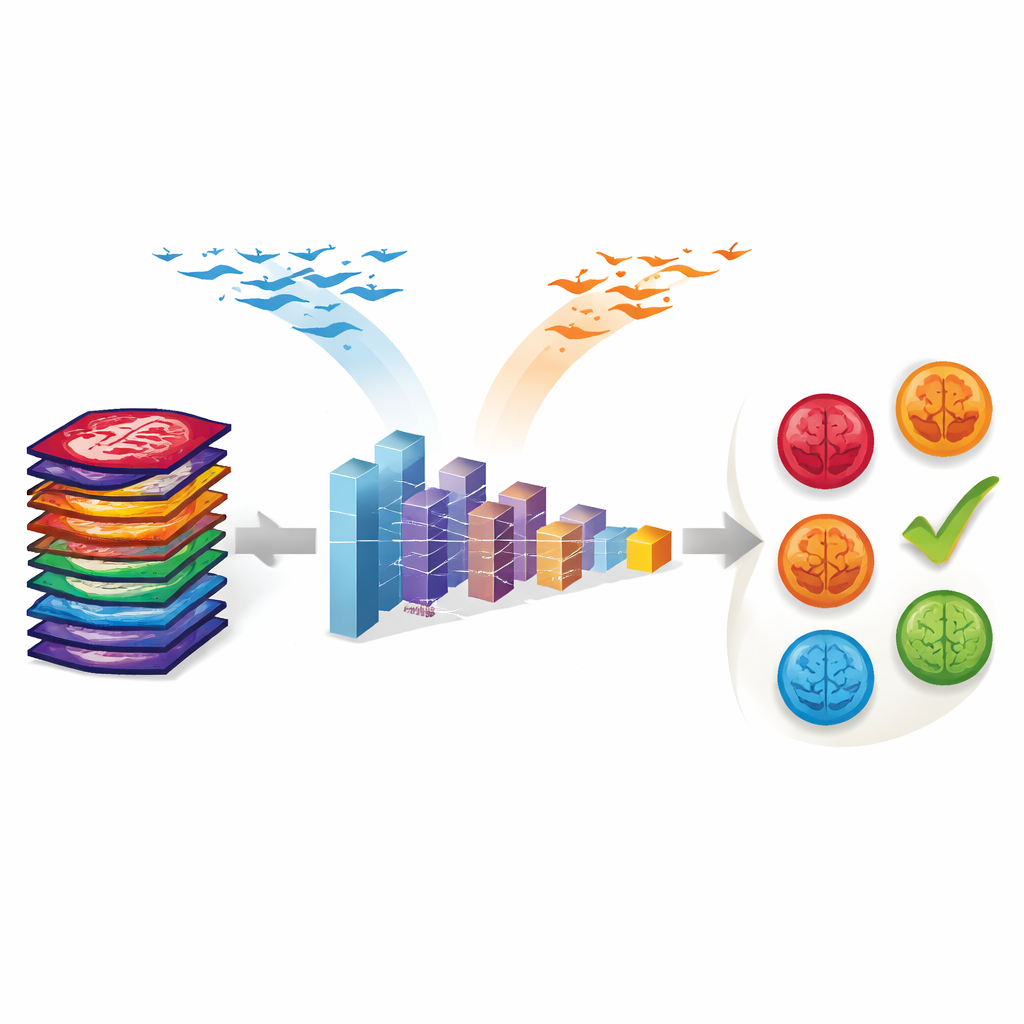
Modern AI systems, especially those used for images, depend on dozens of “dials” that humans must set before training begins. These dials, called hyperparameters, include how quickly the model learns, how many examples it sees at once, how deep the network is, and how strongly it is prevented from overfitting. Poor choices can make a model slow, unstable, or unreliable, even if the basic design is sound. Traditionally, researchers adjust these settings by trial and error or with simple search strategies, which quickly become impractical as models and datasets grow larger and more complex.
Nature-Inspired Search Partners
To tackle this challenge, the authors turn to two computer algorithms inspired by animal hunting strategies. One, called the Aquila optimizer, mimics an eagle soaring high to explore a wide area before diving toward prey. It is good at scanning a broad range of possibilities and avoiding bad local traps, but it can be slow to settle on a final answer. The other, Harris Hawks optimization, imitates hawks that work together to surround and exhaust their prey. It excels at carefully refining promising options but may miss better choices elsewhere if used alone. The researchers combine these two into a hybrid system—Aquila for early wide exploration, Harris Hawks for later fine‑grained polishing—to search for the best hyperparameter settings for a brain‑scan classifier.
Building a Lean but Capable Brain-Scan Model
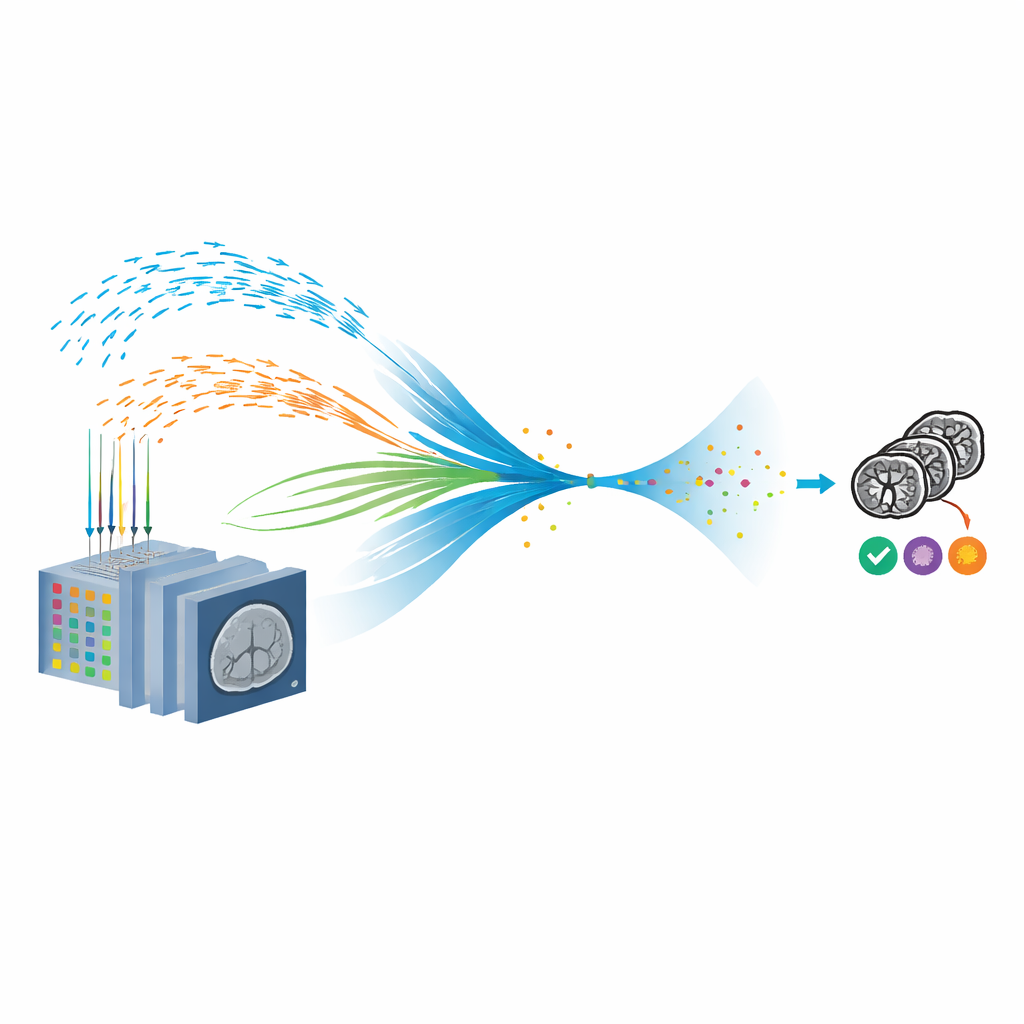
The team designed a relatively compact convolutional neural network, a common architecture for image tasks, to distinguish four categories in brain MRI scans: glioma, meningioma, pituitary tumor, and no tumor. They used an open dataset with 7,023 images and carefully prepared the data by resizing, normalizing brightness, and augmenting the images with small rotations, flips, and shifts so the model would not simply memorize the training examples. Key knobs to tune included learning rate, batch size, number of filters in each layer, dropout rate, and the choice of learning algorithm. The hybrid optimizer evaluated different combinations by training the network and scoring each candidate on both accuracy and training time, rewarding models that were not only correct but also efficient.
Outperforming Other Search Strategies
The new hybrid method was compared against three well‑known search techniques: Particle Swarm Optimization, Genetic Algorithms, and the Whale Optimization Algorithm. On average over multiple runs, the Aquila–Harris Hawks combination achieved about 87% accuracy, with similarly strong precision, recall, and F1‑score, all higher than the competing methods, which ranged roughly from 78% to 83% accuracy. Just as important, it reached good solutions much faster. Where the other methods needed more than 300 seconds of training time, the hybrid approach finished in under 80 seconds. Statistical tests showed that these gains in both accuracy and speed were unlikely to be due to chance.
What This Means for Patients and Clinics
In plain terms, the study shows that a carefully designed, nature‑inspired search strategy can help a relatively small neural network become both smarter and quicker at reading brain MRI scans. By combining one algorithm that casts a wide net with another that sharpens the best options, the method finds better settings for the model with far less wasted computation. While the work is demonstrated on a single public dataset and would need further testing across different hospitals and conditions, it points toward AI tools that can assist doctors with faster, more reliable tumor classification, even in settings with limited computing power.
Citation: Kumar, M., Mohd, N., Shivam, G. et al. Hybrid Aquila optimizer–Harris Hawks optimization for CNN hyperparameter tuning in brain tumor classification. Sci Rep 16, 12799 (2026). https://doi.org/10.1038/s41598-026-43329-7
Keywords: brain tumor MRI, medical image classification, hyperparameter optimization, convolutional neural networks, metaheuristic algorithms