Clear Sky Science · en
Interfacial engineering of aluminum powder with a tannic acid/Fe³⁺ complex and fluorosilane for high-performance energetic composites
Lighting a Better Fire
From fireworks to rocket launches, many spectacular feats depend on tiny metal grains that burn fast and hot. Aluminum powder is one of the most important of these fuels, but it comes with a frustrating flaw: each grain quickly grows a stubborn shell that slows down how it burns. This study shows how a simple, low‑cost surface treatment can give aluminum particles a protective raincoat, crack open that shell at the right moment, and unlock more reliable, powerful combustion for future propellants and energetic materials.
Why Ordinary Aluminum Holds Back Rocket Power
Aluminum powder is widely used in solid rocket motors because it is cheap, easy to handle, and packs a high amount of energy into a small volume. However, as soon as aluminum is exposed to air, its surface reacts with oxygen and forms a nanometer‑thin layer of aluminum oxide. This glassy skin has a very high melting point and poor heat flow, acting like armor that keeps the oxidizer away from the metal beneath. As a result, aluminum particles are harder to ignite, burn more slowly, and may not release all of their energy, especially in demanding or low‑oxygen conditions.
Designing a Smart Coating for Metal Fuel Grains
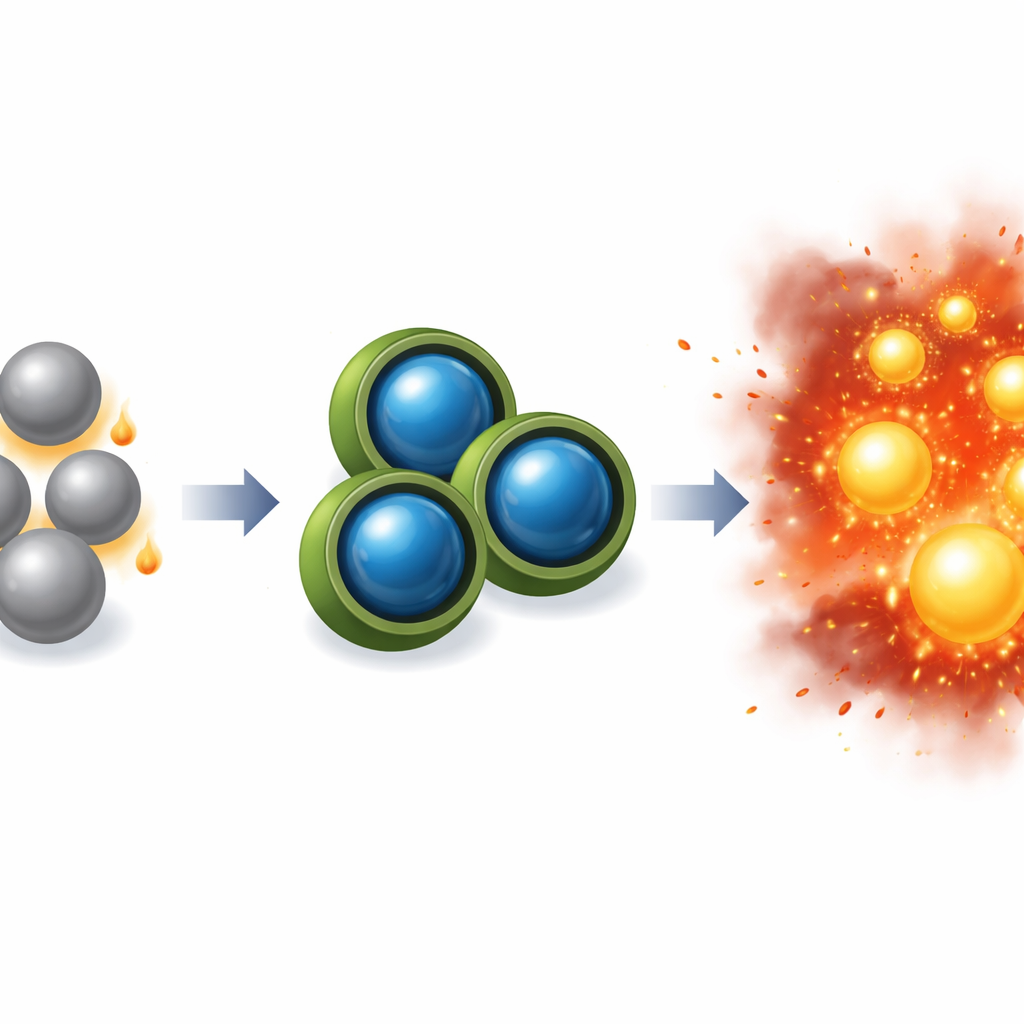
The researchers set out to redesign the surface of aluminum particles so that they would stay stable during storage but react more vigorously when heated. Their solution is a dual core‑shell structure called Al@TA‑Fe@PDTTS. At the heart is the standard aluminum core, already wrapped in its native oxide. On top of this, they add an inner layer built from tannic acid—a plant‑derived polyphenol—and iron ions, which self‑assemble into a strongly anchored network. Over that, they graft a thin layer of a fluorine‑rich silane compound. This outer skin makes the particles highly water‑repellent, helping prevent corrosion or clumping, while also serving as a built‑in chemical trigger that will later attack the oxide shell during heating.
Seeing How the New Surface Works
Using electron microscopes and surface‑sensitive spectroscopy, the team confirmed that the aluminum grains are evenly wrapped in the two added layers. The particles change from smooth spheres to rough, textured ones, and maps of their elements show clear signals from carbon, iron, silicon, and fluorine on the outside. Contact angle tests reveal that untreated aluminum readily wets with water, while the coated grains are strongly hydrophobic and even float on water after shaking, showing that the fluorinated skin is dense and durable. Computer simulations of the molecular interactions support the design: tannic acid clings strongly to the aluminum oxide, and the fluorinated silane adheres much better when the tannic acid layer is present, leading to a robust, well‑bonded shell.
How the Coating Turns from Shield to Accelerator
When the coated particles are heated, the two layers do not simply evaporate—they actively prepare the aluminum to burn. As temperature rises, the tannic acid–iron network and the fluorinated silane decompose, releasing heat, gases, and reactive fluorine‑containing fragments. These species chew into the rigid oxide skin, converting it into more volatile aluminum fluoride and opening cracks and pores. Microscopy of particles heated in air shows that bare aluminum remains largely spherical even at 800 °C, while the coated particles break into irregular, fragmented structures at lower temperatures, evidence that their outer shells are being disrupted and the metal core is more exposed to oxygen. Thermal measurements confirm that exothermic reactions occur just below the metal’s melting point, supplying extra heat that helps drive early and more complete oxidation.

Boosting a Key Rocket Oxidizer
The team then mixed the coated aluminum with ammonium perchlorate, a common oxidizer in solid propellants, to see if it could act as both fuel and catalyst. Compared with pure ammonium perchlorate, the mixture decomposes at a noticeably lower high‑temperature peak, meaning the oxidizer breaks down more easily in the presence of the engineered particles. Under different oxygen pressures, the coated aluminum mixtures release slightly more heat than conventional aluminum blends, and the advantage grows when oxygen is scarce—conditions under which sluggish burning normally becomes a problem. Laser ignition tests show a dramatic reduction in ignition delay, from about 13 milliseconds for standard aluminum–oxidizer mixtures to under 5 milliseconds for the new composite, along with brighter, longer‑lasting combustion and more visible sparks.
What This Means for Future Energetic Materials
In simple terms, the authors have turned the aluminum surface from a passive, blocking skin into an active helper that prepares the metal to burn. Their dual coating keeps particles dry and stable during storage, then, when heated, breaks down in a way that cracks open the oxide layer and feeds extra heat and reactive fragments into the reaction zone. This leads to earlier ignition, faster burning, and more thorough use of the fuel, especially under challenging conditions. Because the process relies on straightforward solution steps and relatively low‑cost ingredients, it offers a practical path toward smarter metal fuels for propellants, explosives, and other energetic technologies.
Citation: Liu, B., Gou, X., Li, Y. et al. Interfacial engineering of aluminum powder with a tannic acid/Fe³⁺ complex and fluorosilane for high-performance energetic composites. Sci Rep 16, 12486 (2026). https://doi.org/10.1038/s41598-026-43316-y
Keywords: aluminum propellant, energetic composites, surface coatings, rocket combustion, ammonium perchlorate