Clear Sky Science · en
Network analysis of personality traits, gender roles, and team cohesion in youth athletes
Why team chemistry in young athletes matters
Parents, coaches, and young players all know that some teams just “click” while others fall apart under pressure. This study looks under the hood of that team chemistry. Focusing on Chinese youth athletes aged 12 to 18, the researchers asked how personality, ideas about being “masculine” or “feminine,” and the feeling of togetherness on a team are linked as a whole system. Their goal was not only to see which traits predict strong teams, but also to map how these traits interact with each other in real groups of young athletes.
Looking at traits as a living web
Instead of examining one trait at a time, the researchers used a method that treats each trait and attitude as a point in a web and looks at how these points are connected. They surveyed 518 youth athletes from a sports school in Jiangsu Province, China, asking about their Big Five personality traits (such as agreeableness and neuroticism), their views of themselves along masculine and feminine lines, and how strongly they felt attached to their team’s goals and to their teammates. This web-like view allowed them to see which traits cluster together, which ones sit on the edge, and which serve as hubs that link different areas of a young athlete’s psychological life.

The power of kindness and confidence
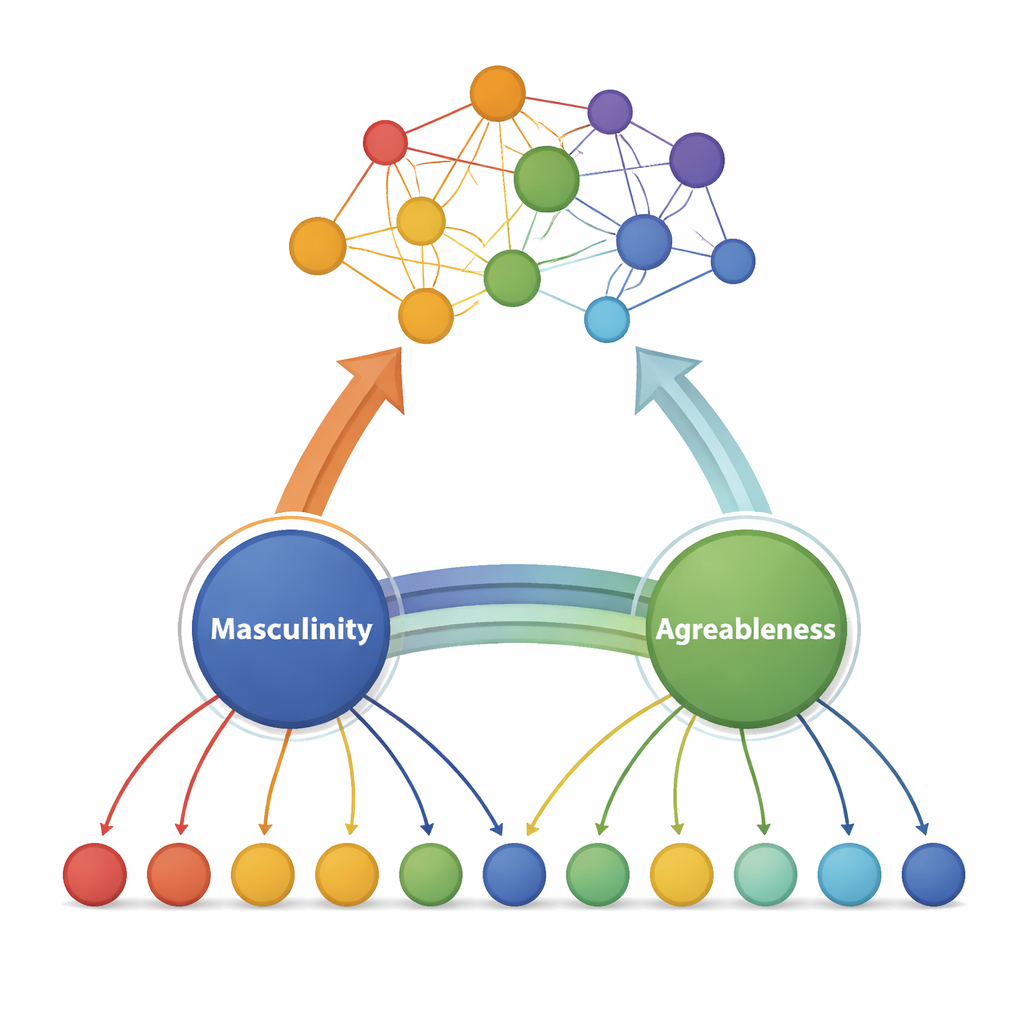
Two traits stood out as especially important for team life: agreeableness (a tendency to be kind, cooperative, and considerate) and masculinity as defined in this Chinese context (traits such as responsibility, assertiveness, and task focus, not simply biological sex). Athletes who saw themselves as more agreeable and more masculine tended to report stronger bonds to their team, both in terms of caring about shared goals and feeling attracted to the group. When the researchers used traditional statistical models, these two traits were the strongest predictors of overall team cohesion, even after taking into account other personality dimensions and feminine traits like warmth and modesty.
Bridges between self and team
When the team of scientists examined the web of connections, they found that links within each broad area (personality, gender roles, and cohesion) were stronger than links between areas. Yet a few key “bridges” carried a lot of traffic. Masculinity turned out to be the main bridge connecting personality traits to how united a team feels, while agreeableness helped tie together both personality and cohesion measures. Feminine traits played a different role: they sat in the middle of the web, acting like a hub that kept the whole structure connected, even if they were not the strongest direct predictors of team closeness. In contrast, neuroticism (a tendency toward anxiety and moodiness) sat on the edge of the network, weakly connected and generally pulling against other positive traits.
Different paths for boys and girls
The study also compared the web of connections for male and female athletes. For boys, the pattern centered more on tasks: traits like being outgoing and diligent linked strongly to sticking to team goals, and masculine traits served as key bridges to feeling united around the work of sport. For girls, the pattern was more about relationships. Traits such as agreeableness, extraversion, and femininity formed a dense cluster tied to liking teammates and feeling socially connected. Worry-prone tendencies showed different patterns too, relating more strongly to strained social ties in girls and to lower responsibility and kindness in boys.
What this means for real teams
Taken together, the findings suggest that youth team chemistry grows out of a web of personal tendencies and gendered self-images. Traits linked to being cooperative and responsibly “masculine” appear especially close to the heart of team unity in this Chinese sample. The authors do not claim that simply turning up these traits will automatically fix struggling teams, but they argue that coaches and psychologists might pay particular attention to how they encourage responsibility, assertiveness, and kindness in young athletes. Because the study was based on one point in time and one cultural setting, it cannot prove cause and effect, yet it offers a valuable map of where the most important connections lie. Future work can test whether nurturing these traits, in gender-sensitive ways, truly strengthens both performance and mental well-being in youth sports.
Citation: Tang, H., Qiu, W., Li, R. et al. Network analysis of personality traits, gender roles, and team cohesion in youth athletes. Sci Rep 16, 13977 (2026). https://doi.org/10.1038/s41598-026-43312-2
Keywords: youth athletes, team cohesion, personality traits, gender roles, sports psychology