Clear Sky Science · en
Exploring associations between energetic and anthropometric characteristics with front crawl technique in young male swimmers using IMU sensors: a preliminary study
Why this study matters for young swimmers
For many parents and coaches, it can be hard to see why one young swimmer seems to glide effortlessly while another fights the water, even when they train just as hard. This study looks inside the stroke itself, asking how a boy’s body build and arm power shape his ability to sprint front crawl. Using small motion sensors on the hands and modern data analysis, the researchers show how growth, muscle power, and detailed arm movements all combine to produce speed in the pool.
Looking closely at fast front crawl
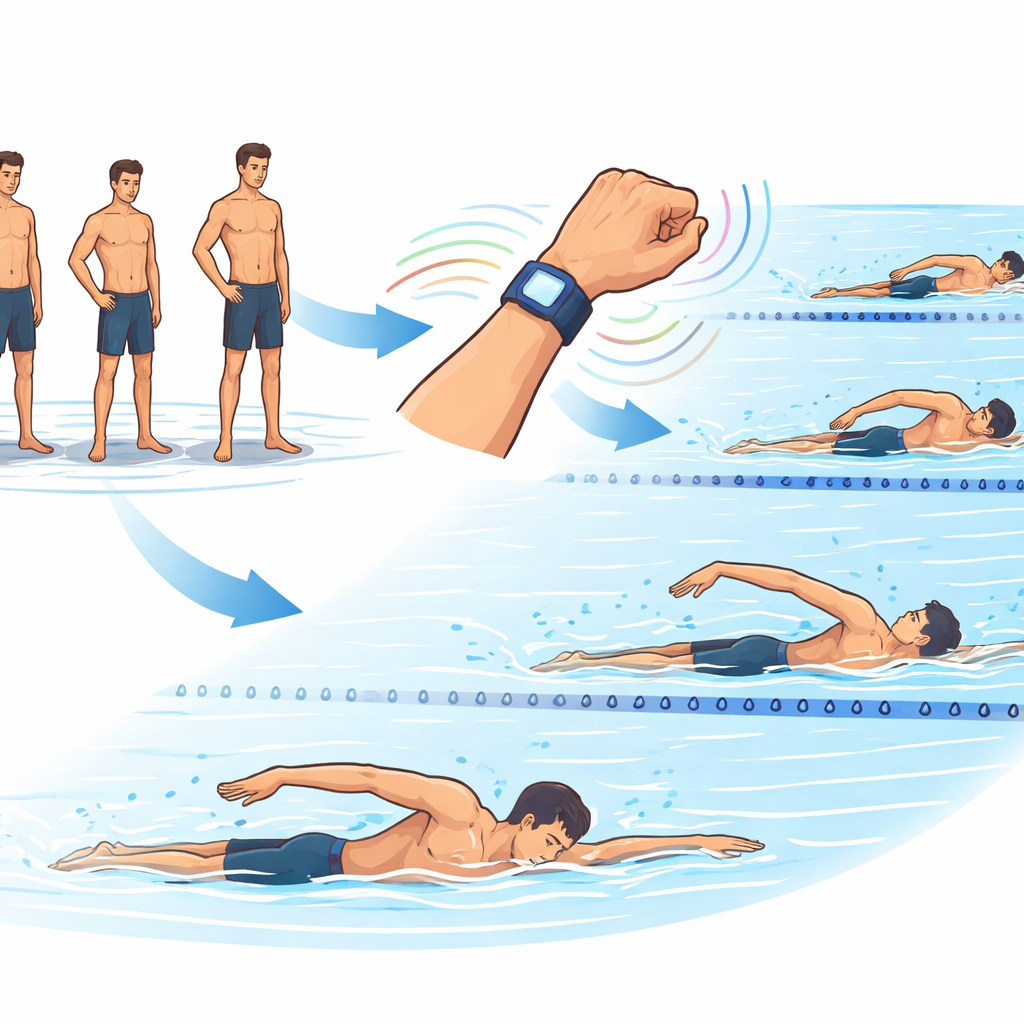
The researchers studied 41 regional-level male swimmers aged 12 to 14 who specialized in freestyle. Each boy completed three kinds of tests: measurements of body size and composition, a short all-out arm-cranking test on land to gauge upper-body power, and a 25-meter maximum-effort front crawl swim. During the swim, video cameras captured overall performance, such as speed and stroke rhythm, while waterproof motion sensors strapped to the hands recorded how the arms moved through each stroke. This setup allowed the team to connect what the swimmer looks like and how strong he is with how he actually moves through the water.
Body build, power, and the shape of the stroke
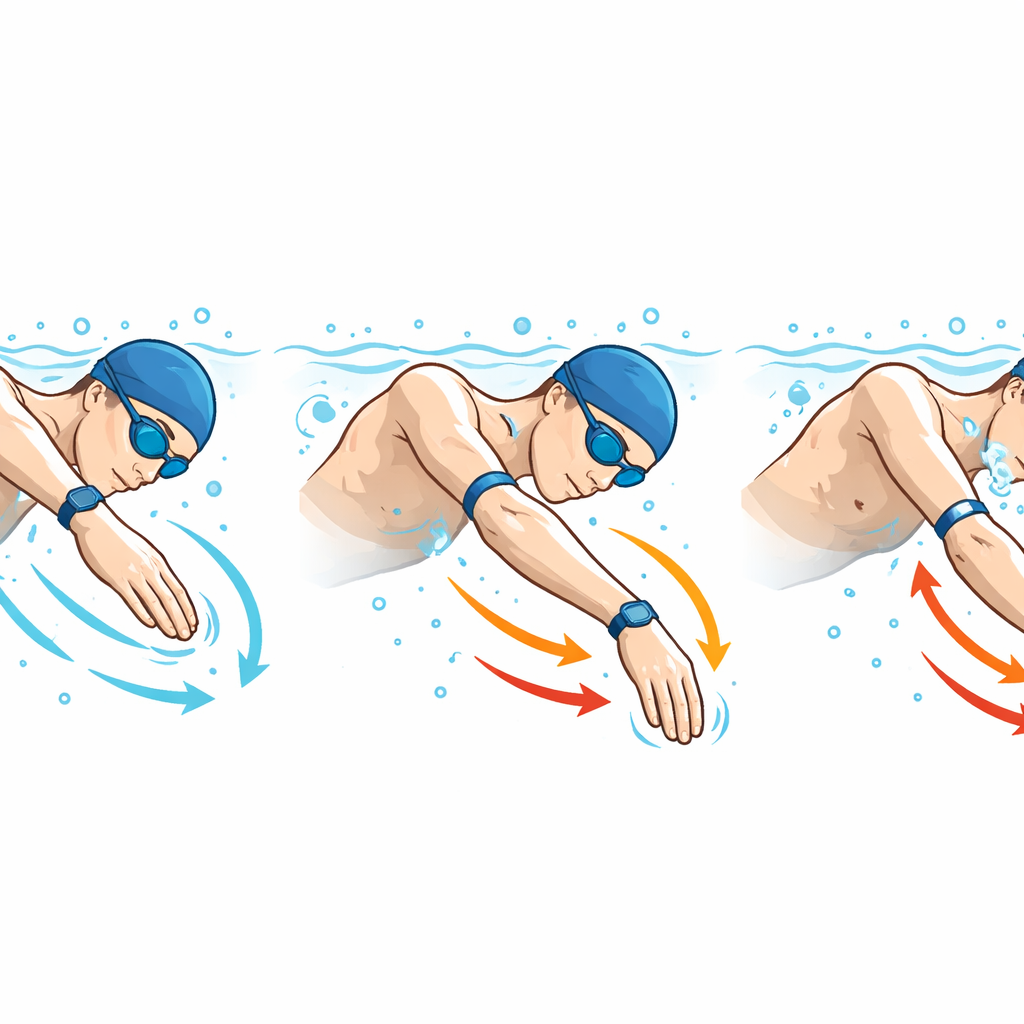
From the many body measurements, the researchers identified two main types of build: overall large body size (taller, heavier, more lean tissue) and relatively low body fat. From the power test, they derived a single “enormous power” profile reflecting how much force the arms could produce and how quickly. The motion-sensor data revealed two main patterns of arm use: a “dynamism” pattern linked to how strongly the hands accelerate and decelerate, and a “high angular velocity” pattern related to how quickly the arms rotate. Larger boys tended to have more arm power, and those with more arm power tended to show more dynamic arm movements, meaning their hands sped up and slowed down more forcefully during each stroke.
How arm action turns potential into pool speed
The study confirmed that front crawl sprint speed depends on the familiar balance between how often a swimmer takes a stroke and how far he travels with each one. Faster boys swam with a higher stroke rate more than with especially long strokes, a pattern often seen in younger or developing swimmers. The motion sensors helped explain why: swimmers whose hands showed greater acceleration within each stroke tended to have higher stroke rates and, in turn, higher speed. However, this rapid arm turnover worked best in boys who were both relatively large and powerful. Simply spinning the arms faster without the muscle power and body structure to support it did not appear to be an effective path to better performance.
Growing bodies and changing strokes
Because the swimmers were in early adolescence, their bodies were changing quickly. The authors suggest that during growth spurts, when arms and legs lengthen before muscles fully catch up, young athletes may temporarily struggle to maintain the high stroke rates needed for top sprint speeds. Extra body fat, while sometimes helpful for floating, did not support arm power and may increase drag by enlarging the body’s cross-section. The findings imply that tracking not just times, but also body build, body fat, and how the hands accelerate through the water can help explain why a swimmer’s results improve, stall, or even dip during phases of rapid growth.
What coaches and parents can take away
In simple terms, this study shows that fast front crawl sprinting in young boys depends on how well their arms can turn body size and muscle power into sharp, dynamic hand movements in the water. Small motion sensors and artificial-intelligence-based analysis proved accurate enough to describe these patterns and connect them to speed. For training, the authors argue that technique work for developing swimmers should not just push them to “move their arms faster.” Instead, practice should build the strength and power needed to support a high stroke rate, while keeping an eye on stroke length and body composition. When these pieces line up, young swimmers are better able to use their natural build and energy systems to move efficiently and quickly through the pool.
Citation: Wądrzyk, Ł., Staszkiewicz, R., Sokołowski, K. et al. Exploring associations between energetic and anthropometric characteristics with front crawl technique in young male swimmers using IMU sensors: a preliminary study. Sci Rep 16, 12562 (2026). https://doi.org/10.1038/s41598-026-43309-x
Keywords: youth swimming, front crawl sprint, wearable sensors, stroke mechanics, body composition