Clear Sky Science · en
Cerium and samarium doped TiO2 for degradation of crystal violet dye in wastewater by photo-degradation method
Why cleaning colored water matters
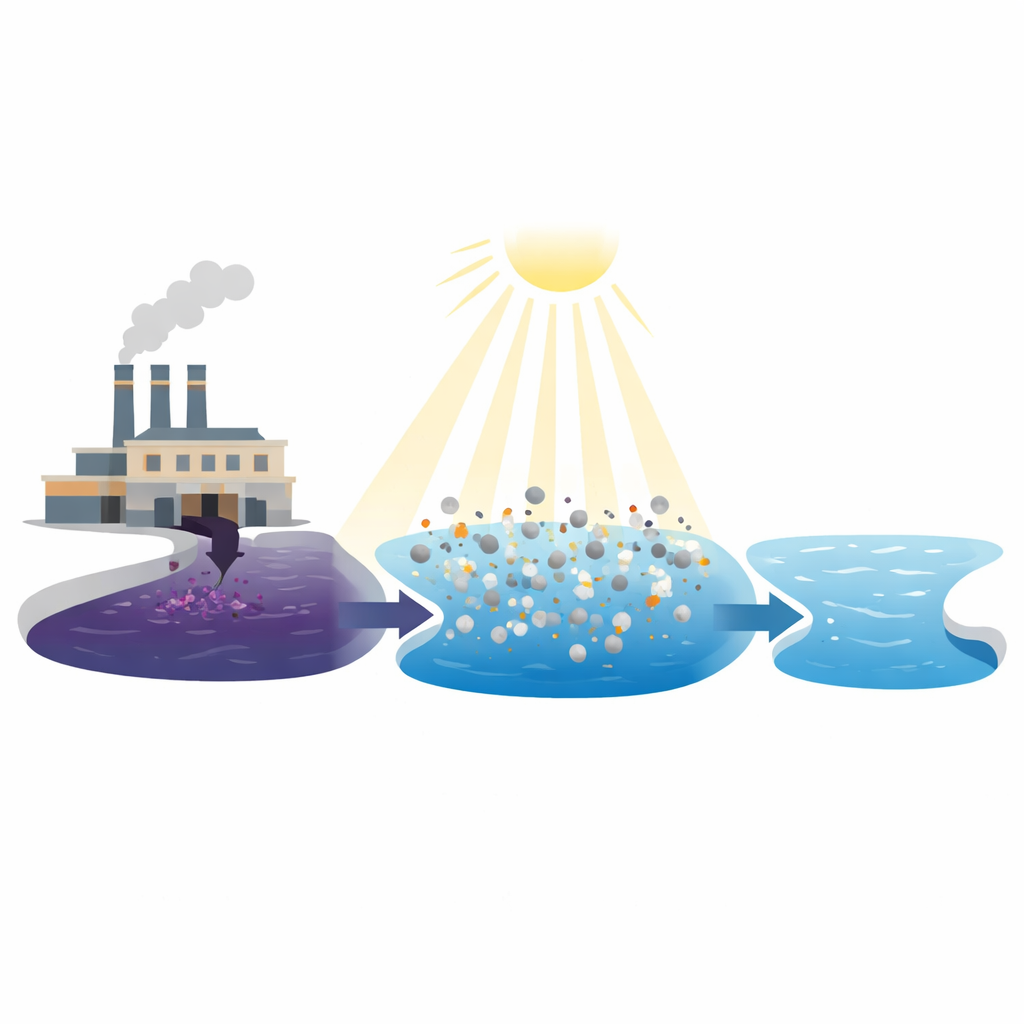
Brightly colored wastewater from textile and printing factories may look merely unsightly, but it can hide serious health and environmental dangers. One common dye, crystal violet, is especially worrisome because it is toxic, can cause cancer, and resists natural breakdown in rivers and lakes. This study explores a sunlight‑driven way to strip such stubborn dyes from water using tiny particles of a familiar material, titanium dioxide, tweaked with small amounts of rare‑earth metals to make it work faster and more efficiently.
Tiny helpers powered by light
The heart of the work is a process called photocatalysis, in which light energizes a solid material so that it can tear apart unwanted chemicals. Titanium dioxide, already used in sunscreen and paint, is a popular photocatalyst because it is stable, cheap, and not toxic. On its own, however, it mostly responds to ultraviolet light—a small slice of sunlight—and wastes much of the energy it absorbs. The researchers set out to upgrade titanium dioxide by adding trace amounts of two rare‑earth elements, cerium and samarium, to create “doped” nanoparticles that could grab light more effectively and keep the energy available long enough to destroy dye molecules.
Making and checking the smart powder
To build these enhanced powders, the team used a straightforward co‑precipitation method, mixing commercial titanium dioxide with cerium and samarium salts in water and using a base to form tiny solid particles. After filtering, drying, and heating, they obtained nanoparticles containing about 1% of each metal. A suite of lab techniques then revealed what was happening inside the material. X‑ray measurements showed that the particles kept titanium dioxide’s desirable crystal form while subtly stretching its atomic lattice to accommodate the larger rare‑earth ions. Infrared and electron‑microscope studies confirmed that the dopants were well distributed, created a rough, porous surface, and did not form unwanted clumps of separate metal oxides.
Watching dye disappear
The real test was whether these powders could scrub crystal violet from water. The researchers prepared dye solutions similar in strength to those found in industrial effluent and shone ultraviolet light on them while stirring in small amounts of either cerium‑doped or samarium‑doped titanium dioxide. By tracking the fading color with a UV–visible spectrophotometer, they found that both modified materials removed over 85–95% of the dye, far outperforming undoped titanium dioxide. Samarium‑doped particles were the clear winner, erasing about 95% of the dye within roughly 700 minutes under the chosen conditions, while the cerium‑doped version trailed slightly behind yet still showed strong activity.
How the breakdown works
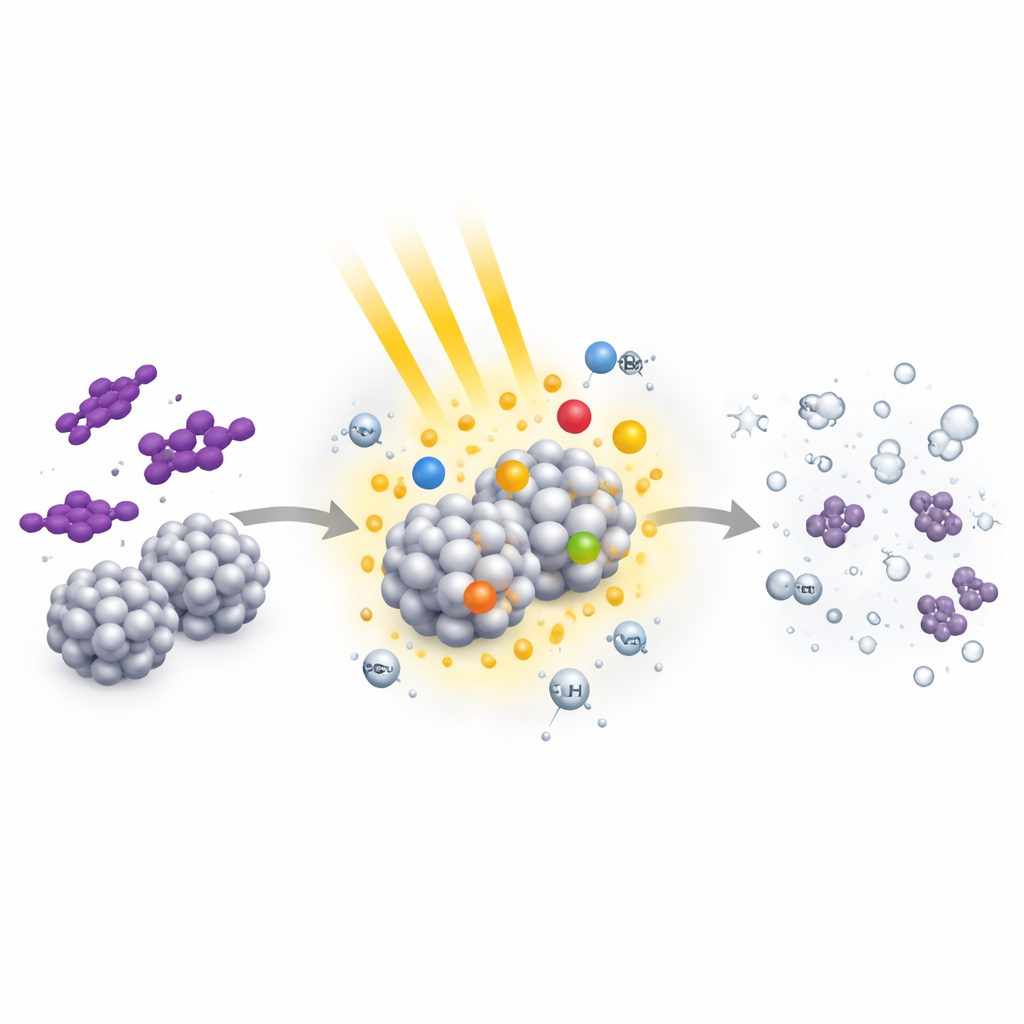
At the microscopic level, the doped particles act like miniature solar reactors. When light hits them, electrons are kicked into a higher‑energy state, leaving behind positively charged “holes.” In ordinary titanium dioxide, these charges quickly rejoin and the energy is lost as heat. The added cerium and samarium act as strategic traps, holding onto electrons or holes just long enough for them to react with oxygen and water at the particle surface. This sequence creates extremely reactive forms of oxygen that attack the complex crystal violet molecules, chopping them into smaller fragments and ultimately into harmless carbon dioxide, water, and simple inorganic ions. The study also shows that factors such as pH, catalyst amount, and light intensity steer how efficiently this chain of events unfolds.
From the lab to real factory water
To see whether the approach could handle messier mixtures, the team tested cerium‑doped titanium dioxide on real wastewater from a textile plant, which contained multiple dyes and other chemicals. Even in this challenging setting, the catalyst removed up to 88% of the color under ultraviolet light, and the particles remained stable over repeated uses. Because the process relies mainly on light and reusable powders, it generates little sludge and avoids adding new toxic chemicals—advantages over many traditional treatment methods. The authors conclude that rare‑earth‑doped titanium dioxide is a promising, environmentally friendly tool for cleaning dye‑laden wastewater, and they point toward future versions tuned to work efficiently under ordinary sunlight and in large‑scale treatment systems.
Citation: Sharma, B., Mohan, C., Kumar, R. et al. Cerium and samarium doped TiO2 for degradation of crystal violet dye in wastewater by photo-degradation method. Sci Rep 16, 12387 (2026). https://doi.org/10.1038/s41598-026-43299-w
Keywords: wastewater treatment, photocatalysis, titanium dioxide, rare earth doping, textile dyes