Clear Sky Science · en
Human pose recognition and automated scoring detection for sports rehabilitation
Smarter Help for Recovery Exercises
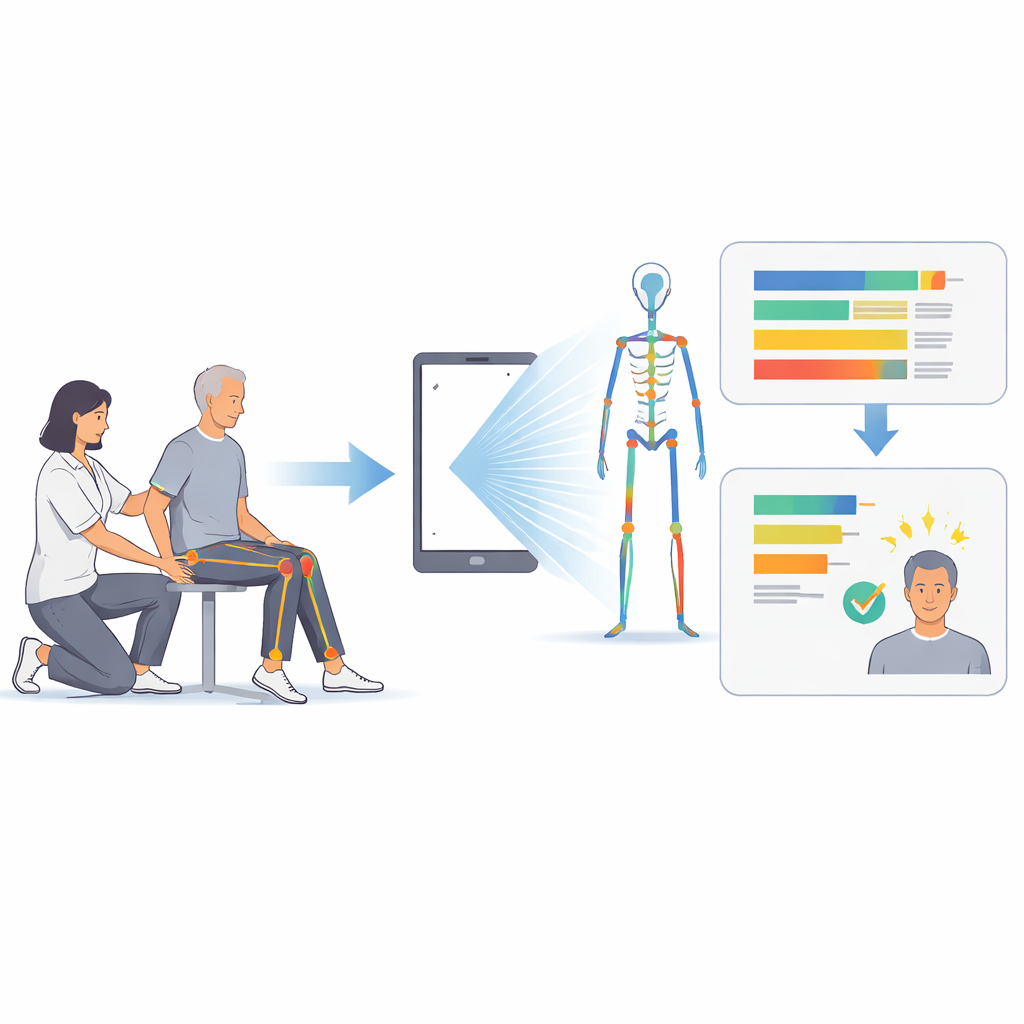
Anyone who has gone through physical therapy knows how hard it is to repeat the same movements correctly, day after day, often without knowing whether they are “good enough.” This study introduces a computer-based assistant that watches rehabilitation exercises through a camera, understands body posture in real time, and automatically scores how well each movement matches a therapist-approved standard. The goal is to give patients instant, objective feedback and to lighten the load on medical staff, while making rehab more precise and more motivating.
Why Watching Every Joint Matters
Modern sports rehabilitation relies heavily on how accurately we can observe and measure body movements. Traditional assessment methods depend on a therapist’s eye and experience, which are valuable but also subjective and time‑consuming. Small mistakes in posture, such as a slightly twisted knee or a limited shoulder angle, can slow recovery or even cause new problems, yet they are easy to miss during busy clinic sessions. The authors argue that a digital “second pair of eyes” that tracks joint positions frame by frame could provide more consistent judgments, support remote care, and help tailor exercise plans to each person’s progress.
A Three-Part Digital Coach
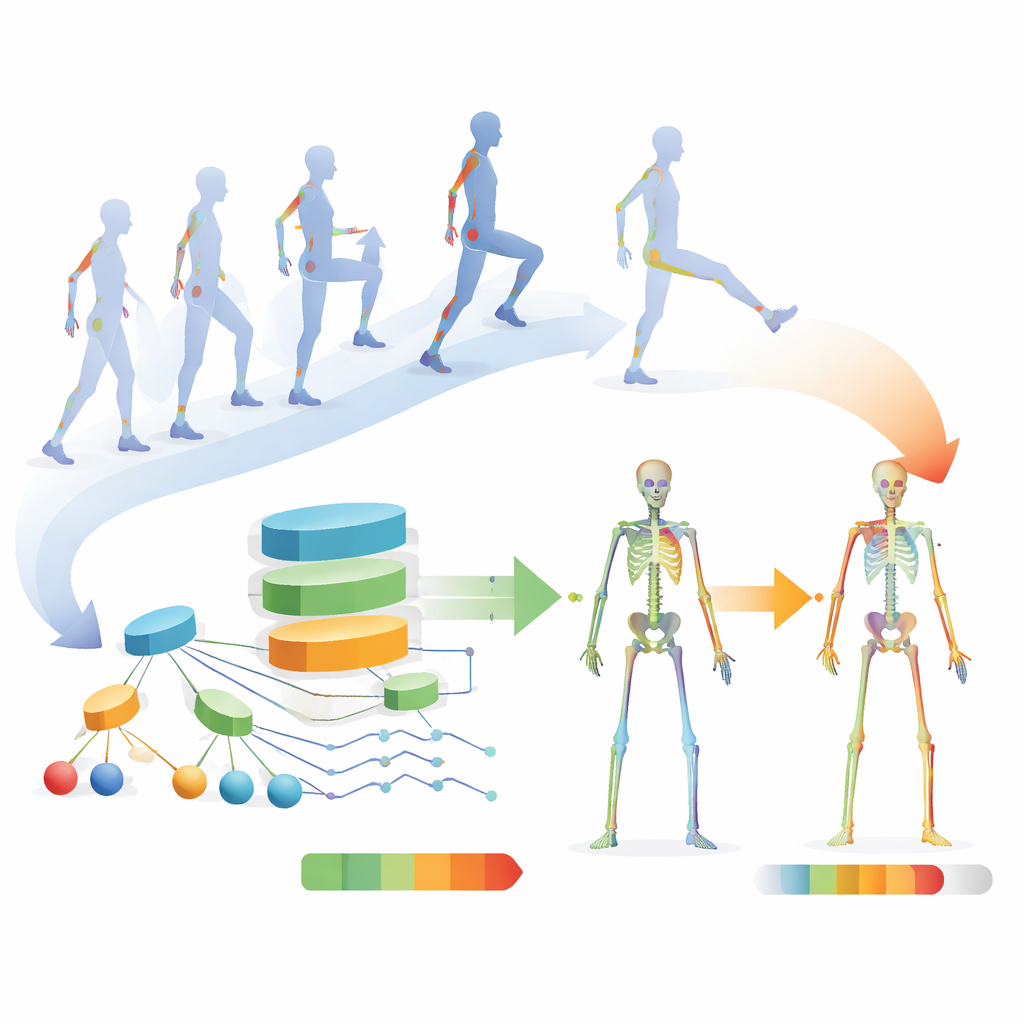
The system the authors built works like a pipeline with three main stages. First, a camera records the person performing rehabilitation exercises, such as squats, lunges, or arm raises after back surgery. A pose-tracking tool called BlazePose then turns each video frame into a skeletal model made of 33 key points—hips, knees, shoulders, and so on—capturing how the body is arranged and moves over time. Next, a machine-learning method known as a random forest looks at patterns in these key points and decides which type of movement is being performed and whether the posture appears normal or abnormal. This helps the system recognize many different exercise types in real-world conditions, where backgrounds are cluttered and body parts may briefly be hidden.
How the System Learns to Score Like an Expert
Recognizing a pose is only half the problem; the other half is grading how well it matches a “gold standard” movement. For that, the researchers add a special kind of paired neural network that excels at comparing things. The network is trained on pairs of motion examples: one from a standard exercise template and one from a patient. It learns to measure how similar the two are by looking at joint positions and angles over time. A similarity measure then turns this comparison into a quality score, much like a digital version of an expert marking a checklist. Movements that closely follow the standard template receive high scores, while those that deviate too far are flagged as substandard, allowing the system to highlight which exercises need correction.
Putting the Digital Assistant to the Test
To see whether their tool is ready for practical use, the authors tested it on two large collections of movement data: one with many everyday poses and another focusing on yoga and fitness exercises. They compared their integrated system against simpler alternatives that either used a basic classifier or a time‑based neural network alone. Across these tests, the new method recognized body poses with up to 98% accuracy, kept the error in estimated joint angles below about 6%, and produced rehabilitation scores that agreed strongly with expert-style ratings. It also ran fast enough—on the order of a few to a couple of dozen milliseconds per frame—to support real-time feedback during training sessions.
What This Means for Patients and Therapists
In plain terms, the study shows that a camera plus smart software can reliably “see” how people move, label each exercise, and judge its quality in ways that line up well with human experts. While the system still needs testing in more diverse settings and with different patient groups, it already demonstrates that automated pose tracking and scoring can become a powerful helper in sports rehabilitation. If refined and deployed widely, tools like this could give patients clearer guidance, encourage them with immediate feedback, and free therapists to focus on higher-level decisions—ultimately improving recovery outcomes and quality of life.
Citation: Peng, X., Mao, X. & Fang, X. Human pose recognition and automated scoring detection for sports rehabilitation. Sci Rep 16, 13545 (2026). https://doi.org/10.1038/s41598-026-43294-1
Keywords: sports rehabilitation, human pose estimation, automated movement scoring, physical therapy technology, computer vision in healthcare