Clear Sky Science · en
Parametric assessment of rainfall-related slope stability through SRM modeling and orthogonal experimental design: insights from the Zhuquedong slope, China
Why Rain-Soaked Hillsides Matter
In many mountain regions, a night of heavy rain can turn a quiet hillside into a deadly landslide, threatening homes, roads, and lives. Yet engineers still struggle to predict exactly which slopes are most vulnerable when the ground becomes saturated. This study focuses on a rainfall-sensitive slope in Hunan Province, China, and uses a smart blend of computer modeling and statistics to tease apart which features of a hillside matter most for keeping it standing when storms hit.
Looking Closely at a Rainy Chinese Hillside
The researchers centered their work on the Zhuquedong slope, a representative hillside in a subtropical, mountainous part of southern China where intense rains often trigger shallow landslides. They first built a detailed picture of the site: laser-based mapping (LiDAR) captured the shape and steepness of the ground, while boreholes and test pits provided soil samples from several depths. Laboratory tests revealed how dense the soil is and how strongly its grains stick and slide against one another. Together, these measurements defined realistic ranges for key factors such as slope height and angle, soil strength, and how wet the ground can become.
Turning Many Possibilities into a Manageable Test Set
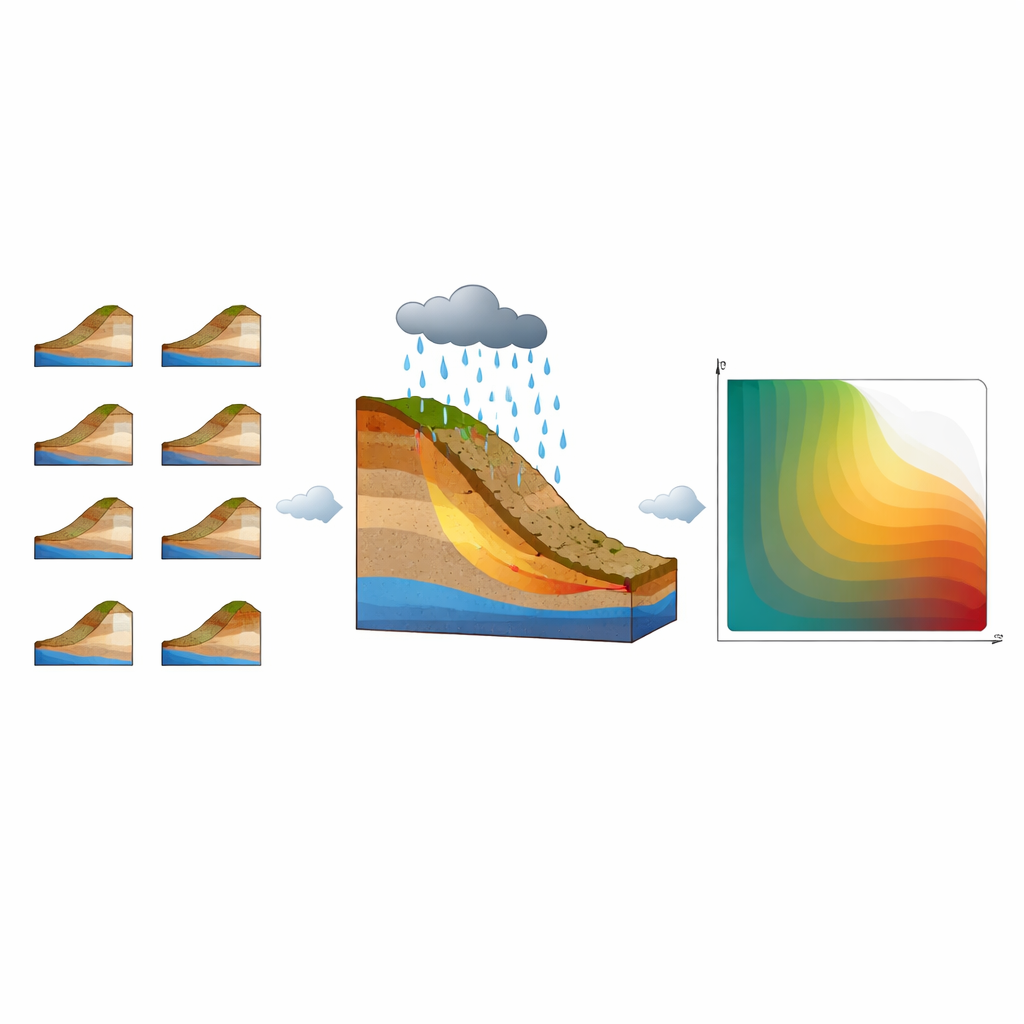
Because all of these influences interact, testing them one by one would miss important combinations and require an impractical number of computer runs. Instead, the team used an approach borrowed from industrial design called an orthogonal experimental design. They systematically combined different values of five main ingredients—slope height, slope angle, soil cohesion, soil friction, and soil weight—along with simplified descriptions of groundwater level and saturation. This produced 28 carefully chosen scenarios that span a wide variety of realistic conditions without exploding the computational cost. For each of these, a numerical method called the strength reduction method was used to calculate a “factor of safety,” a number that indicates how close a slope is to failure.
How the Hillside Responds to Water and Shape
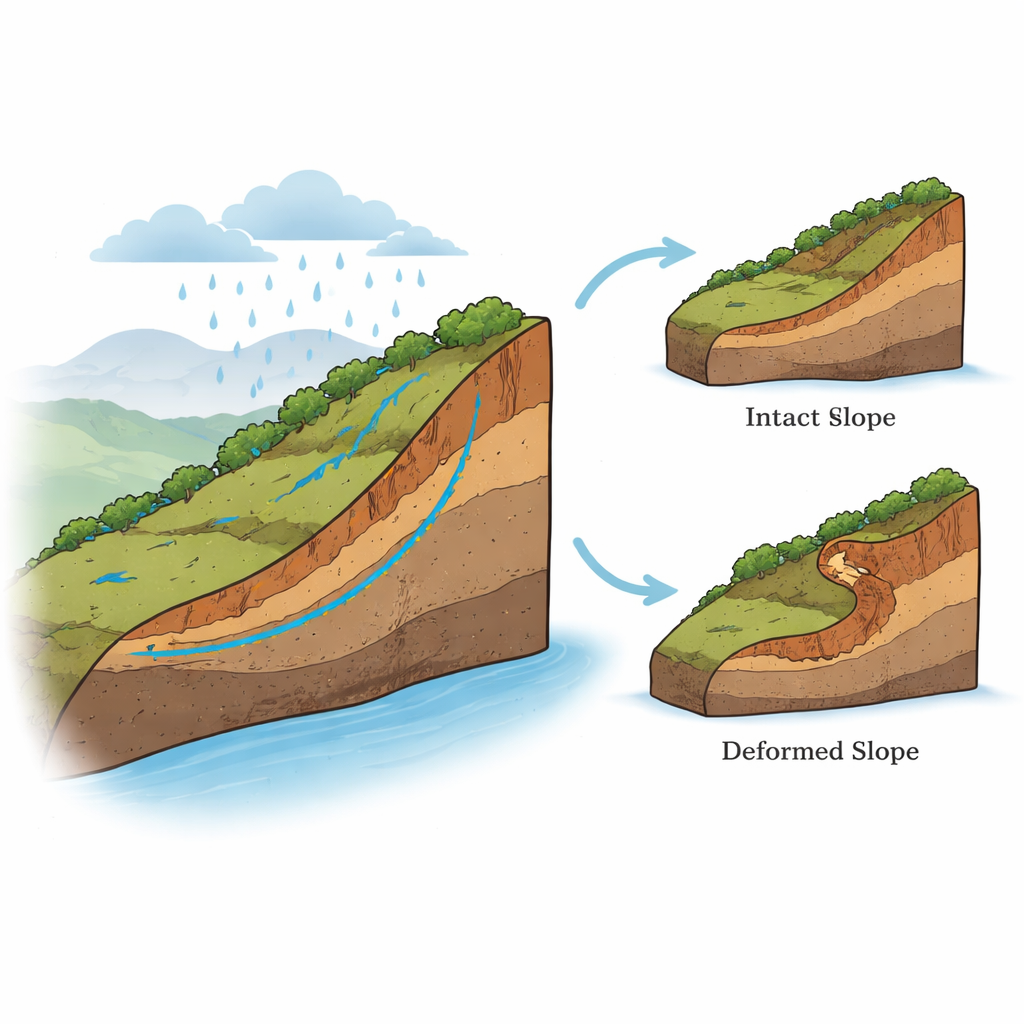
With this tailor-made set of slope simulations in hand, the researchers then turned to classical statistics—correlation analysis, analysis of variance, and multiple regression—to see which ingredients most strongly push the factor of safety up or down. The clearest signal came from geometry: taller and steeper slopes consistently showed lower safety, meaning they are more likely to slide. Moisture-related factors, especially how saturated the soil became and how shallow the groundwater sat, also reduced safety by weakening the soil from within. In contrast, the soil’s own strength properties, cohesion and friction, played a stabilizing but secondary role over the tested ranges, while soil weight itself had only a minor effect.
Seeing Failure Develop from Within
Beyond simple numbers, the simulations allowed the team to visualize how failure develops as water seeps in. Under relatively dry conditions, the modeled slope had a safety factor comfortably above the threshold for stability, and zones of high internal stress remained localized. When the soil was assumed to be saturated, the safety factor dropped well below unity and a broad curved zone of intense shearing emerged, connecting the upper slope to the toe. Step-by-step images showed how small patches of plastic deformation coalesced into a continuous slip surface, eventually leading to a coherent block of soil sliding downslope. These visual sequences underscore how added water transforms a seemingly solid hillside into a fragile structure poised to fail.
What Matters Most for Safer Slopes
By combining a structured set of simulations with straightforward statistical tools, the study reframes a complex geotechnical problem into a clear message for practice. To keep rain-soaked hillsides safe, the single most powerful lever is geometry—lowering very high slopes or softening very steep ones can greatly increase safety margins. Managing water through drainage or limiting saturation is the next priority, because rising pore pressures quickly erode the soil’s ability to resist sliding. Strengthening the soil itself, while still helpful, generally plays a supporting role. The authors emphasize that their method is not meant to replace detailed, site-specific analysis. Instead, it offers engineers and planners a fast, transparent way to screen which factors deserve the most attention when designing or upgrading infrastructure in landslide-prone terrain.
Citation: Liu, F., Dong, Z. & Khayatnezhad, M. Parametric assessment of rainfall-related slope stability through SRM modeling and orthogonal experimental design: insights from the Zhuquedong slope, China. Sci Rep 16, 13091 (2026). https://doi.org/10.1038/s41598-026-43289-y
Keywords: rainfall-induced landslides, slope stability, slope geometry, groundwater and saturation, geotechnical modeling