Clear Sky Science · en
Design and evaluation of a systematic finger-based intervention for early numeracy in 5- to 6-year-olds
Why Fingers Matter for Early Math
Before most children ever see a worksheet, they already have a powerful math tool at hand: their fingers. This study asked a simple but important question for parents and teachers: can carefully designed finger games in kindergarten noticeably boost children’s early number skills, without turning playtime into drill time? By following children over several weeks, the researchers tested whether a structured finger-based program could help 5- to 6-year-olds become more confident and accurate with counting, understanding “how many,” and doing simple calculations.
Turning Hands into Learning Tools
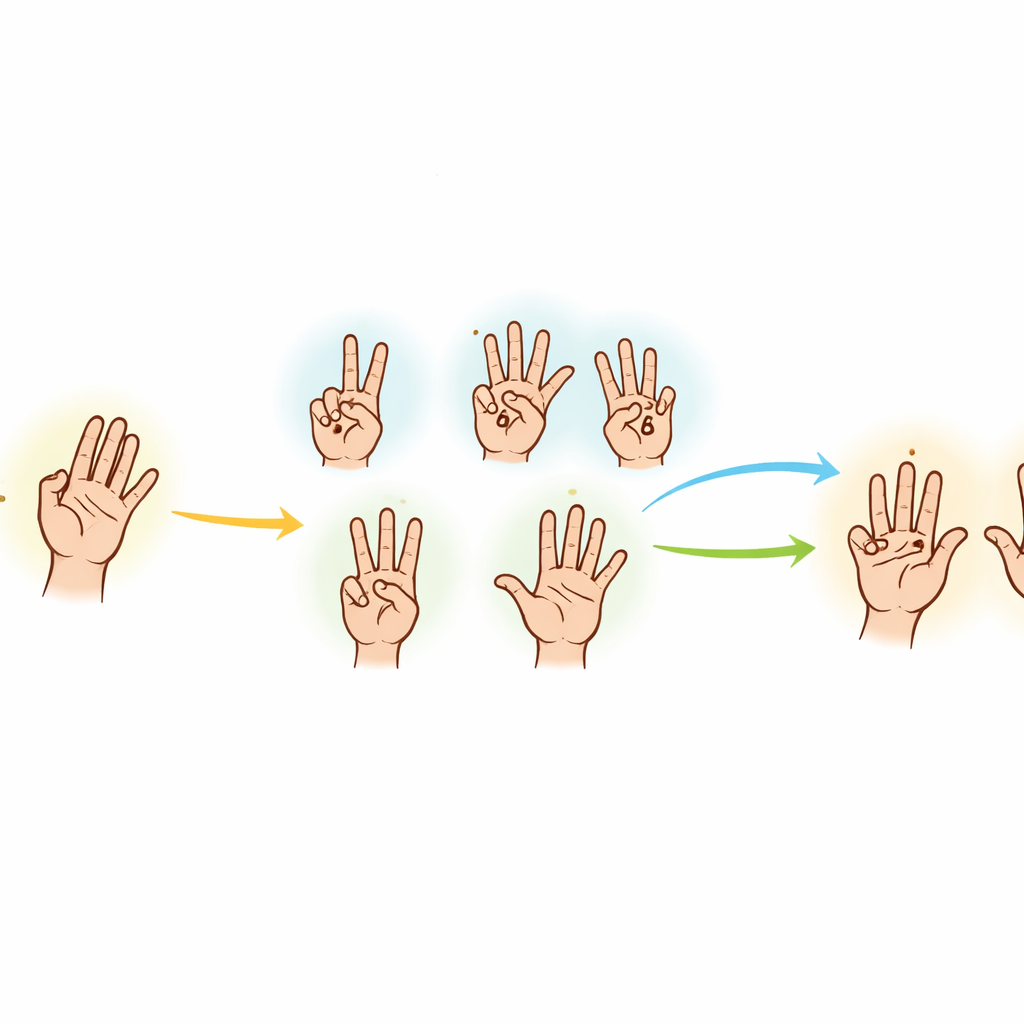
The authors built their program around the idea that math learning follows a rough staircase: first children learn to say the counting words in order, then they grasp that each number stands for a specific quantity, and finally they begin to see relationships between numbers, such as how they can be split and recombined. Fingers can support each of these steps. When a child touches or raises one finger per count, it becomes easier to see that each number word goes with exactly one object. When they stop with a "hand shape" and hold it still, that shape can stand for a quantity like four or seven at a glance. And when they rearrange fingers into different groupings, they get a concrete feel for how numbers can be broken apart and put back together.
A Twelve-Session Finger-Focused Program
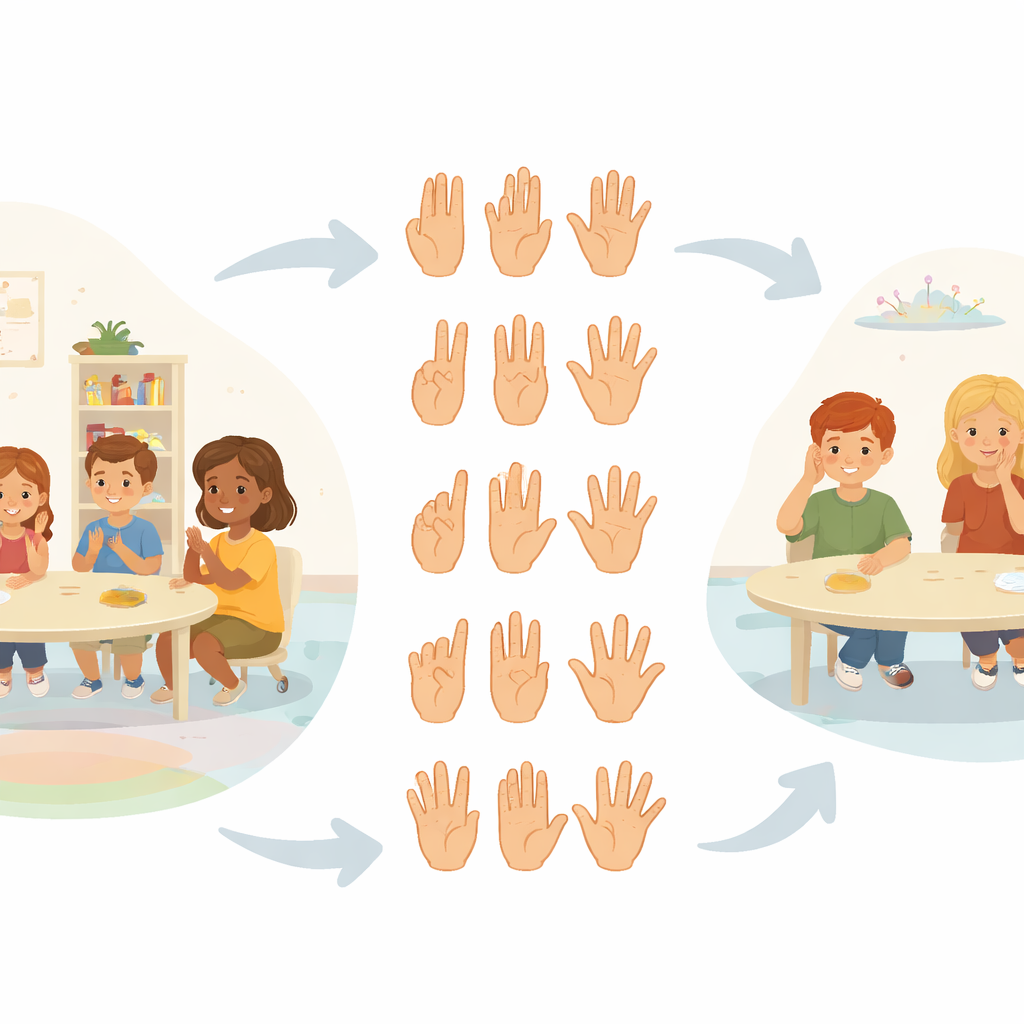
To turn these ideas into practice, the researchers created a short course of twelve 30-minute sessions delivered in small groups in German childcare centers. Across the sessions, children counted objects and actions with fingers, learned stable finger patterns for the numbers from zero to ten, and then used these patterns to tackle simple problems such as “how many more are needed to reach ten?” Activities were playful: children met two glove puppets, Ed and Ted, sorted “number houses,” walked along a taped number path, and played treasure chest games in which they won glass stones by combining quantities. Crucially, the program did not include separate fine-motor drills like tracing lines; instead, fingers were always tied directly to number meaning and calculation.
Putting the Program to the Test
A total of 70 children nearing school entry took part in the evaluation. Half received the finger-based sessions in addition to their normal activities, while the other half continued with usual kindergarten routines. All children completed the same set of tasks before and after the intervention, covering counting, knowledge of written digits, judging which of two numbers was larger, and solving very simple addition and subtraction problems. The researchers also measured general thinking skills, such as pattern reasoning and remembering sequences of tapped blocks, to check whether any gains were specific to number learning or reflected broader changes.
What Improved—and What Did Not
Children who took part in the finger-based sessions showed a clear advantage in overall early numeracy by the end of the study, with a medium-sized benefit compared with the control group. The strongest gains appeared in the most basic skills: confidently reciting number sequences, finding the next or previous number, and recognizing written digits. Improvements in simple arithmetic were smaller and only borderline reliable, and understanding of “how many” and ordering numbers was already so high at the start that there was little room left to grow. Importantly, the program did not change scores on general reasoning or spatial memory, suggesting that the benefits were specific to number learning rather than a general boost in test performance.
Finger Users as Early Number Experts
The study also tracked which children chose to use their fingers during arithmetic tasks. Over time, slightly more children used finger strategies, both in the intervention and control groups. Across the entire sample, though, finger users consistently outperformed non-users on number tasks, not just in calculation but also in counting and understanding quantities. Children who started using their fingers between the first and second test ended up with stronger number skills than peers who never did, even if the total number of finger users did not shift dramatically because of the intervention.
What This Means for Parents and Teachers
For adults who worry that finger counting is a habit to be broken as soon as possible, these findings point in the opposite direction. A short, well-structured program that treats fingers as meaningful number tools helped kindergartners strengthen core number knowledge, and children who used their fingers tended to be the ones with better early numeracy. While more time and practice may be needed to fully translate this into stronger arithmetic, the study supports the simple idea that encouraging children to show numbers on their hands, and guiding them through thoughtful finger games, can lay a solid foundation for later success in school mathematics.
Citation: Roesch, S., Conze, M. & Moeller, K. Design and evaluation of a systematic finger-based intervention for early numeracy in 5- to 6-year-olds. Sci Rep 16, 10495 (2026). https://doi.org/10.1038/s41598-026-43286-1
Keywords: early numeracy, finger counting, kindergarten math, embodied learning, math intervention