Clear Sky Science · en
Mechanical mechanism of noise reduction performance of rubber granular asphalt mixture under freeze-thaw cycles
Quieter Roads from Old Tires
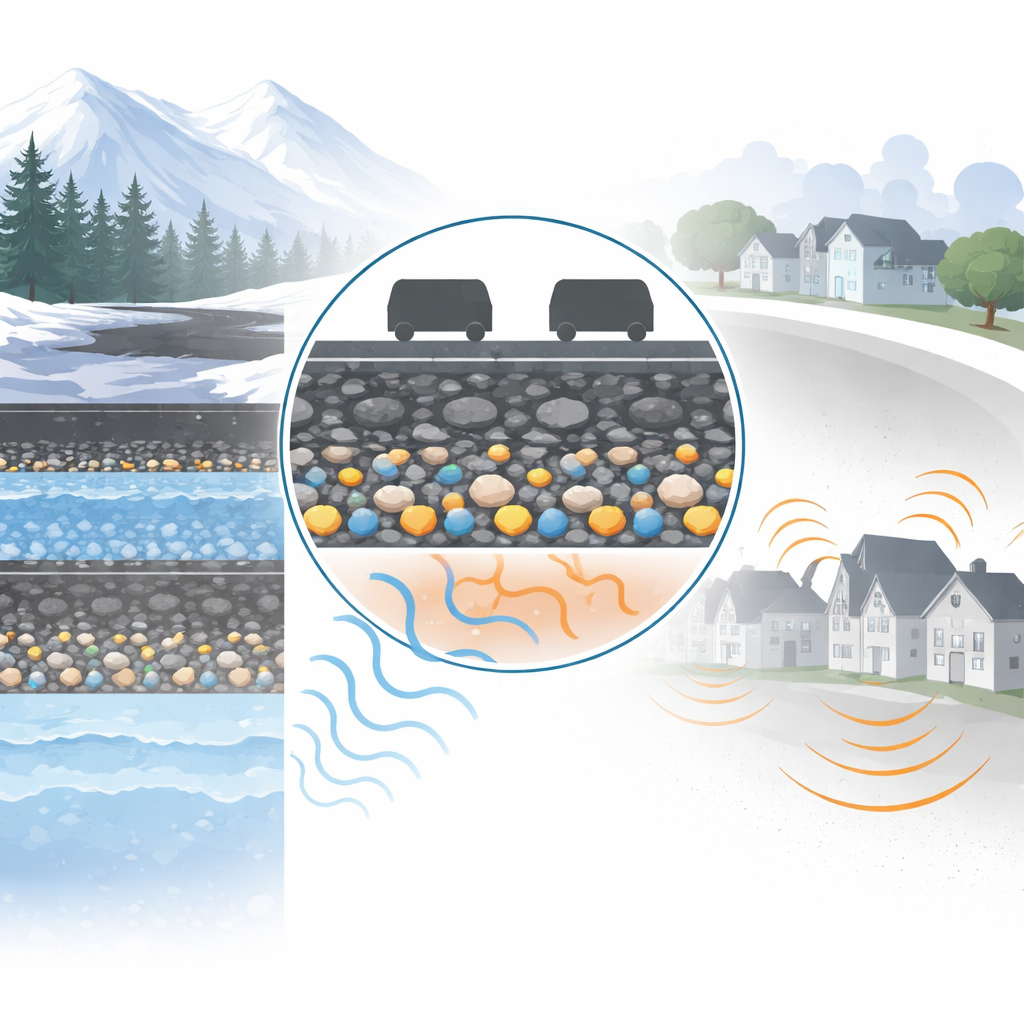
Anyone who has driven along a noisy highway knows how tiring road roar can be. This study explores an intriguing solution: mixing tiny bits of old car tires into asphalt to make roads that are not only more sustainable, but also quieter—especially in very cold regions where the pavement repeatedly freezes and thaws. The researchers wanted to know how these rubber-filled roads behave deep inside the material, and why they can still reduce noise even after years of harsh winter conditions.
Turning Waste Tires into Quiet Pavements
The team focused on a common type of dense asphalt—similar to what many city streets use—and compared a standard mixture with one that included small rubber particles cut from waste tires. These rubber grains act like tiny, springy cushions inside the road surface. Earlier work had shown that such mixtures can cut the sound from tire–road contact by a few decibels, which people clearly notice as a quieter ride. But in places like eastern Inner Mongolia, pavements must survive long winters and repeated freeze–thaw cycles that slowly damage the road structure. The key question was whether rubberized asphalt could keep its noise-reducing ability under these tough conditions.
Putting Pavement Through Artificial Winters
To mimic years of service, the researchers made cylindrical road specimens and repeatedly froze them at –20 °C and then thawed them at 60 °C, up to 15 times. After different numbers of cycles, they squeezed the specimens in triaxial compression tests and measured how stiff and strong they were. They also ran dynamic loading tests that mimic the pulsing of passing wheels, tracking how the material flexed and how much vibration energy it could dissipate. Overall, both the normal and rubberized asphalts became weaker and less stiff as the number of freeze–thaw cycles increased. However, the rubberized mix ended up with lower stiffness but better ability to stretch without cracking, and it showed larger “phase angles,” a sign that it was converting more vibration into harmless heat instead of bouncing energy back as noise.
Looking Inside the Road, Grain by Grain
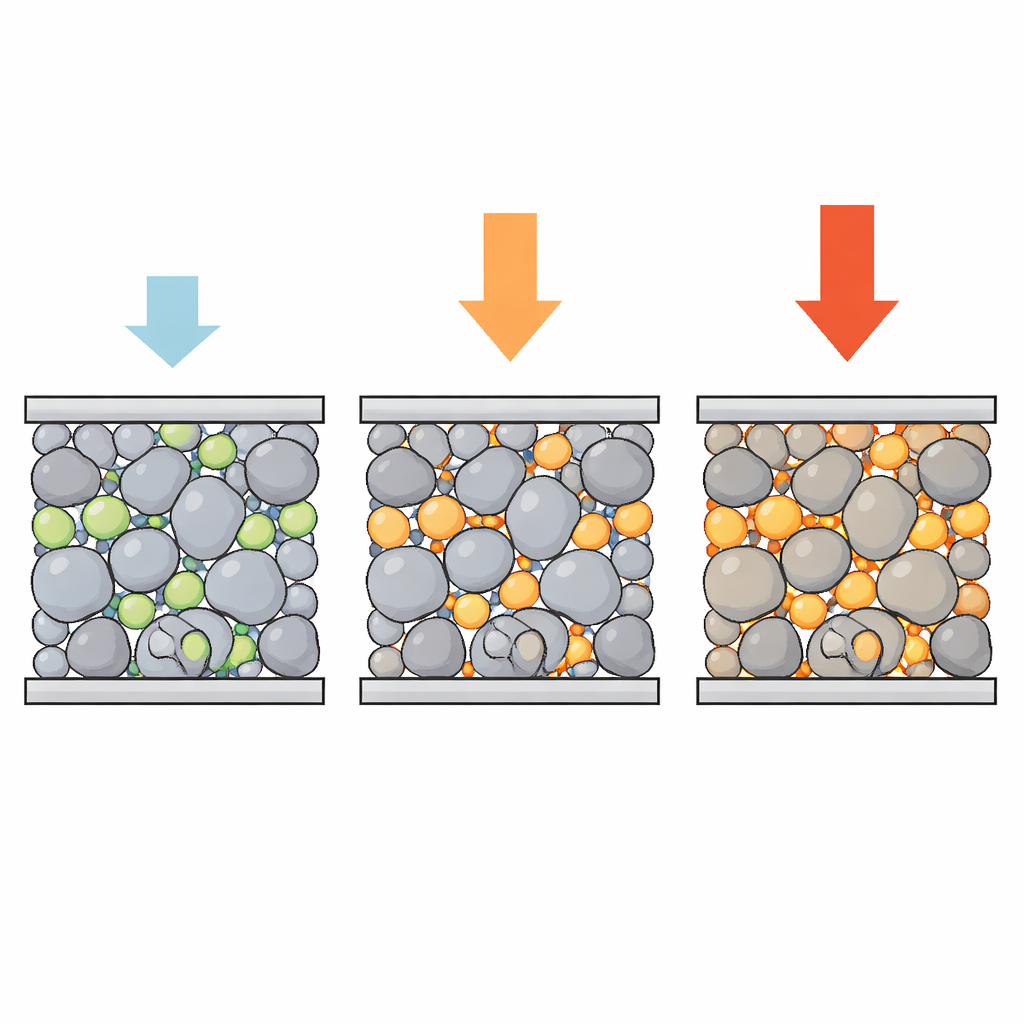
Because it is impossible to see every tiny stone and rubber particle inside a real road, the team built detailed computer models using the discrete element method. In these virtual specimens, the asphalt mix is represented as thousands of small spheres that can press, slide, and separate from each other. The researchers automatically tuned the microscopic contact properties—such as how strongly particles stick and how easily they slide—until the simulated stress–strain curves matched their lab measurements. This allowed them to watch how “force chains,” the hidden pathways that carry load through the stone skeleton, formed and changed during loading.
How Rubber Helps Without Carrying the Load
The simulations revealed that the main load in the pavement is carried by the coarse and medium-sized mineral aggregates, which form a connected skeleton from top to bottom. Rubber particles rarely sit in these main load paths and contribute little to directly holding up vehicles. Instead, the rubber grains deform first when the load is applied, sliding and squashing against nearby stones and asphalt. This motion increases local friction and hysteresis—the tiny internal losses that turn mechanical vibration into heat. As freeze–thaw cycles create more internal voids and weaken the bonding between asphalt and stone, both mixtures rely increasingly on friction between particles. The rubberized mix responds by dissipating more energy through friction and damping than the conventional mix, especially after many freeze–thaw cycles.
Energy Dissipation and Lasting Noise Reduction
By tracking energy flows in the simulations, the team showed that both frictional and damping energy increase with the number of freeze–thaw cycles for all mixtures. After 15 cycles, the rubberized asphalt released considerably more energy through these mechanisms than the standard mix. In practical terms, this means that under passing traffic, more of the vibration is soaked up inside the road rather than radiated as sound. Although freeze–thaw damage reduces overall strength, the rubberized pavement retains a more stable performance and keeps its vibration-absorbing behavior. The trade-off is that its stiffness is somewhat lower, making it better suited for quieter urban streets and lighter traffic in cold regions, rather than for the heaviest truck routes.
What This Means for Future Streets
For a non-specialist, the takeaway is straightforward: adding ground tire rubber to asphalt can create roads that are kinder to our ears and recycle a troublesome waste product at the same time. Even after many cycles of winter freezing and summer thawing, the rubberized pavement continues to act like a built-in shock absorber, turning vibration into heat inside the material. While engineers must still design carefully for heavy loads, this study offers a clear mechanical explanation of how and why rubberized asphalt can provide durable noise reduction, helping cities in cold climates build streets that are both quieter and more sustainable.
Citation: Li, D., Gao, M. & Fan, X. Mechanical mechanism of noise reduction performance of rubber granular asphalt mixture under freeze-thaw cycles. Sci Rep 16, 13271 (2026). https://doi.org/10.1038/s41598-026-43279-0
Keywords: rubberized asphalt, road noise, freeze–thaw damage, waste tire recycling, pavement damping