Clear Sky Science · en
Exact and numerical optical soliton solutions of the fractional quadratic–cubic nonlinear Schrödinger equation in conformable derivative framework
Light pulses that keep their shape
Modern communication depends on flashes of light racing through hair thin glass fibers. Ideally, each flash travels long distances without smearing out. This article explores how certain special light pulses, called solitons, can remain sharply defined even in very fast, complex fibers, and how new mathematics reveals many more ways these pulses can behave and be controlled.
Why steady light pulses matter
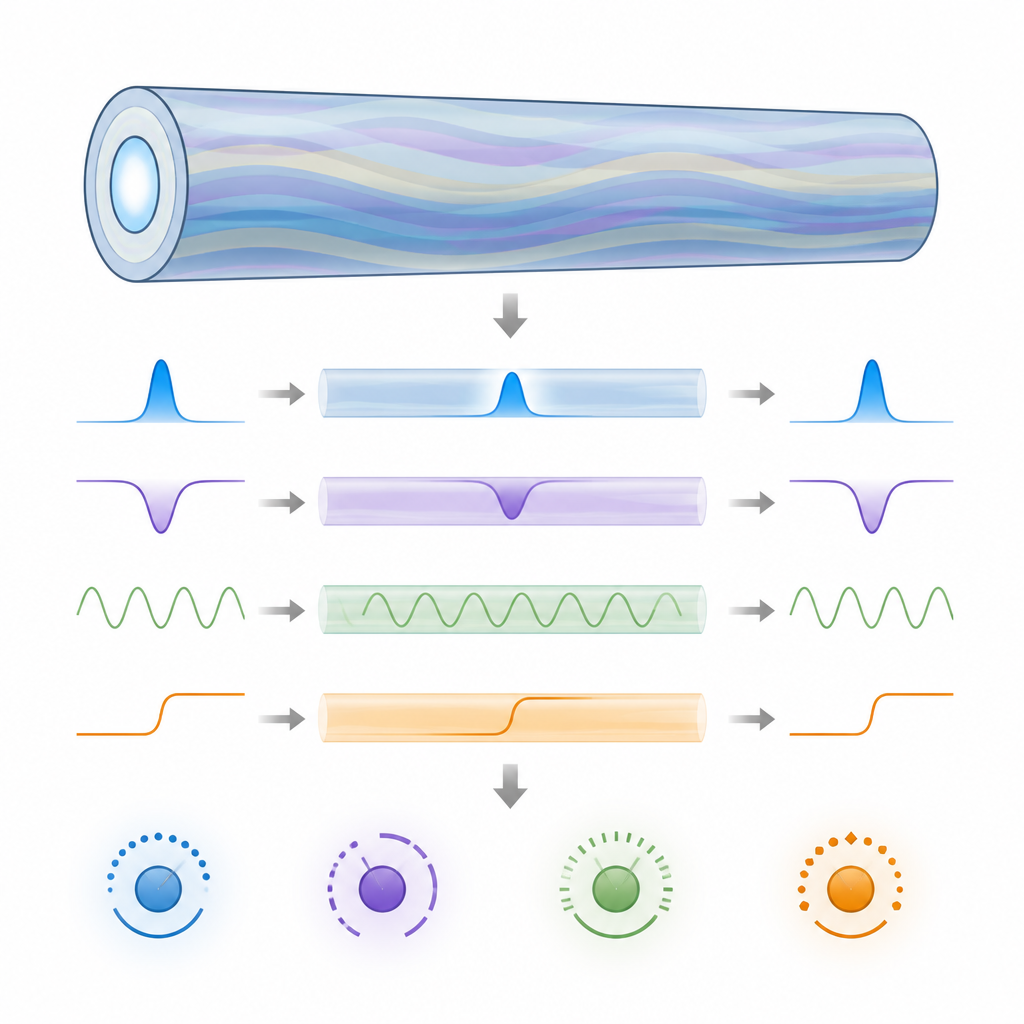
When a short burst of light travels down an optical fiber, it naturally tends to spread, just as a drop of ink disperses in water. In real fibers, this spreading competes with how strongly the material responds to intense light. Under the right balance, a pulse can lock into a stable shape and travel like a tiny optical bullet. The paper studies such pulses in fibers whose response is more intricate than usual, involving both quadratic and cubic effects, and where the medium “remembers” its past, a feature captured through fractional calculus.
Using new math tools to track waves
To understand these pulses, the authors analyze a refined version of a famous wave equation used in quantum physics and fiber optics. They treat space and time with a fractional derivative, a way of modeling media that have memory and nonlocal behavior. With clever changes of variables, they convert the original problem into a simpler one that depends on a single combined space time coordinate. They then apply two advanced but systematic techniques, the modified Sardar sub equation method and a related expansion method, to extract exact shapes of traveling pulses directly from the equation.
Many kinds of solitary light structures
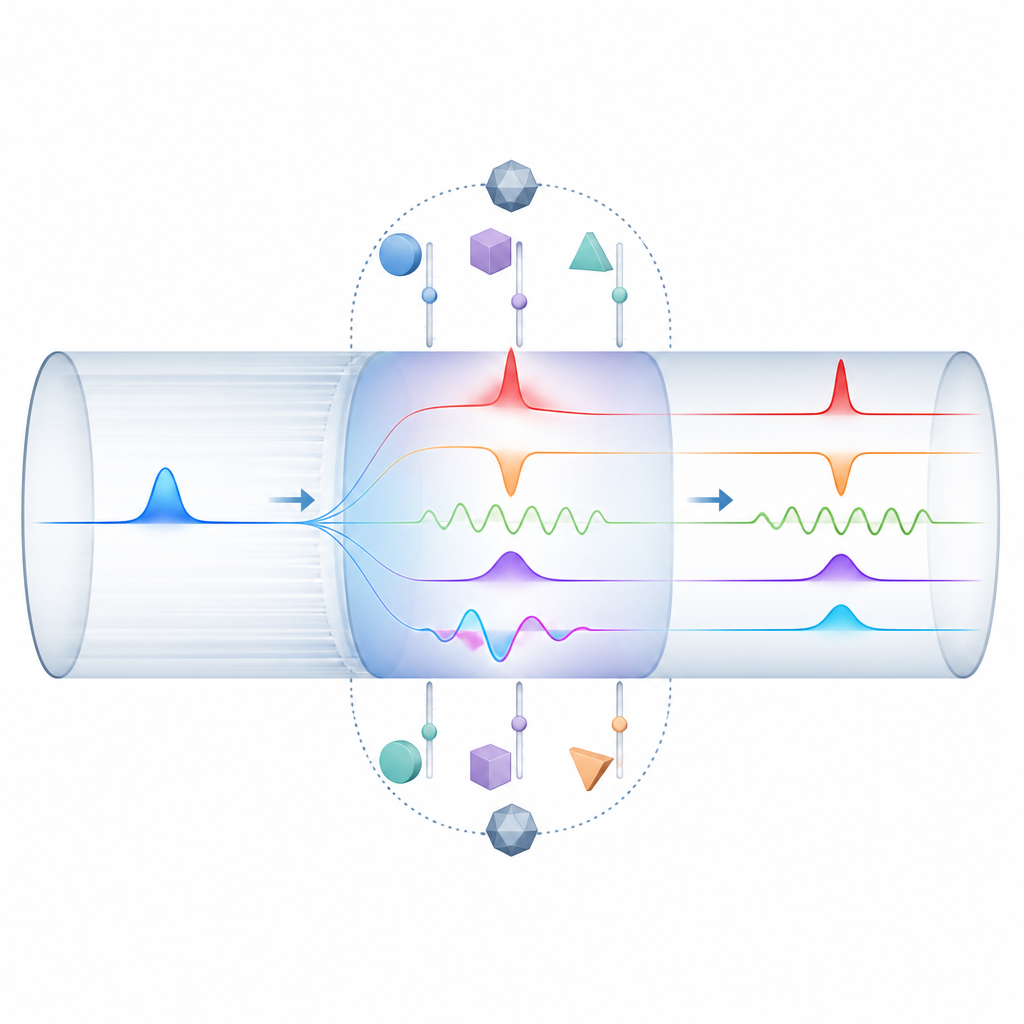
The analysis reveals a rich collection of waveforms. Some are bright solitons, sharp peaks of light riding on a dark background. Others are dark solitons, localized dips sitting in an otherwise uniform beam. The authors also find periodic wave trains, kink like steps, and mathematically singular waves whose intensity spikes sharply. Particularly striking are mixed forms where bright and dark features coexist, or where regular and singular behavior combine. By varying the fractional order parameter, which encodes how strongly the medium’s memory influences the pulse, they show how the height, width, and localization of these structures can be tuned continuously.
Checking the math with numerical experiments
Exact solutions are powerful, but the authors also verify that their formulas truly satisfy the equation. They do this using a numerical approach called the differential transform method, which builds a series representation of the pulse and evolves it step by step. Comparing the numerical results with the exact expressions shows excellent agreement, with errors shrinking to near machine precision. This close match gives confidence that the wide variety of predicted solitons is not an artifact of the methods but a genuine feature of the model.
What this means for future fiber systems
In simple terms, the work shows that light in advanced optical fibers can organize itself into many more stable patterns than previously recognized, and that a single parameter linked to the material’s memory can be used to sculpt these patterns. While the study is theoretical, it maps out how carefully designed fibers might support tailored light pulses for use in high speed communication, signal processing, or other technologies that rely on controlling light with great precision.
Citation: Amer, A., Jaradat, E.K., Rehman, H.U. et al. Exact and numerical optical soliton solutions of the fractional quadratic–cubic nonlinear Schrödinger equation in conformable derivative framework. Sci Rep 16, 15118 (2026). https://doi.org/10.1038/s41598-026-43272-7
Keywords: optical solitons, fiber optics, fractional calculus, nonlinear waves, Schrodinger equation