Clear Sky Science · en
SPHT-LSTM: a novel industrial equipment condition prediction method
Why keeping machines healthy matters
From steel mills to wind farms, modern industry runs on machines that are expected to work for years without failing. When a critical gearbox, bearing, or battery dies unexpectedly, the result can be costly downtime or even dangerous accidents. This paper introduces a new way to watch over such equipment using the data already coming from sensors, with the goal of spotting problems much earlier and planning maintenance instead of reacting to breakdowns.
Listening to long, noisy histories
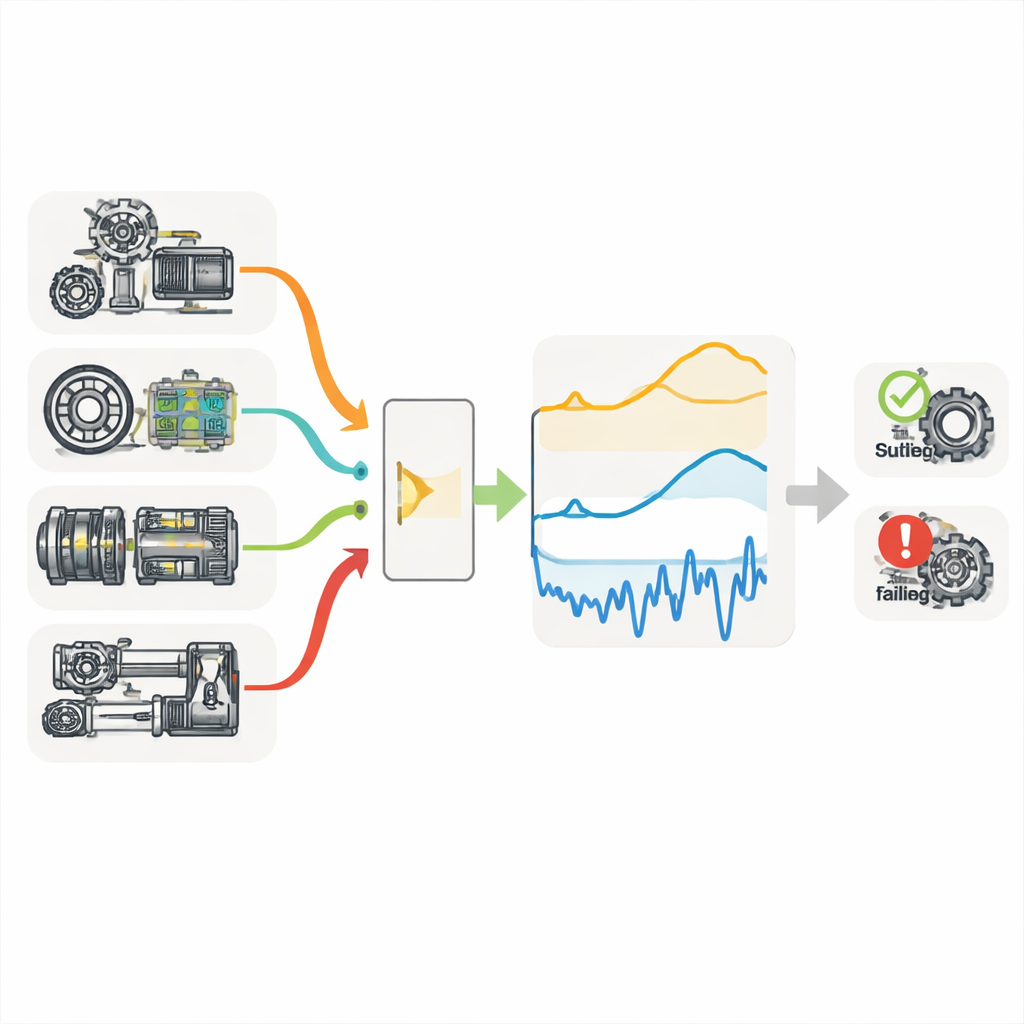
Industrial machines constantly generate streams of vibration, current, and other sensor signals. These readings form very long, wiggly traces over time, full of noise and small fluctuations. Hidden inside are faint hints that a bearing is starting to flake, a gearbox tooth is wearing, or a battery is losing capacity. Traditional approaches either rely on simplified physics models, which are hard to build for complex systems, or on data-driven models that struggle with ultra-long sequences and weak early signs. The authors focus on this gap: how to turn overwhelming, noisy histories into clear, useful clues about a machine’s health.
Compressing wear and tear into a simple curve
The first idea in the study is a new health indicator called Mean Performance Degradation, or MPD. Instead of feeding every single sensor reading into a model, the method cuts the full operating life into many time blocks. For each block, it looks at the average behavior and how far it deviates from a global reference. That distance becomes one point on a much shorter “degradation curve” that tracks how the machine drifts away from healthy operation. This step filters out high-frequency noise, reduces the amount of data to process, and makes phase changes—such as the move from normal operation to early damage—stand out more clearly.
Two ways of looking at the future
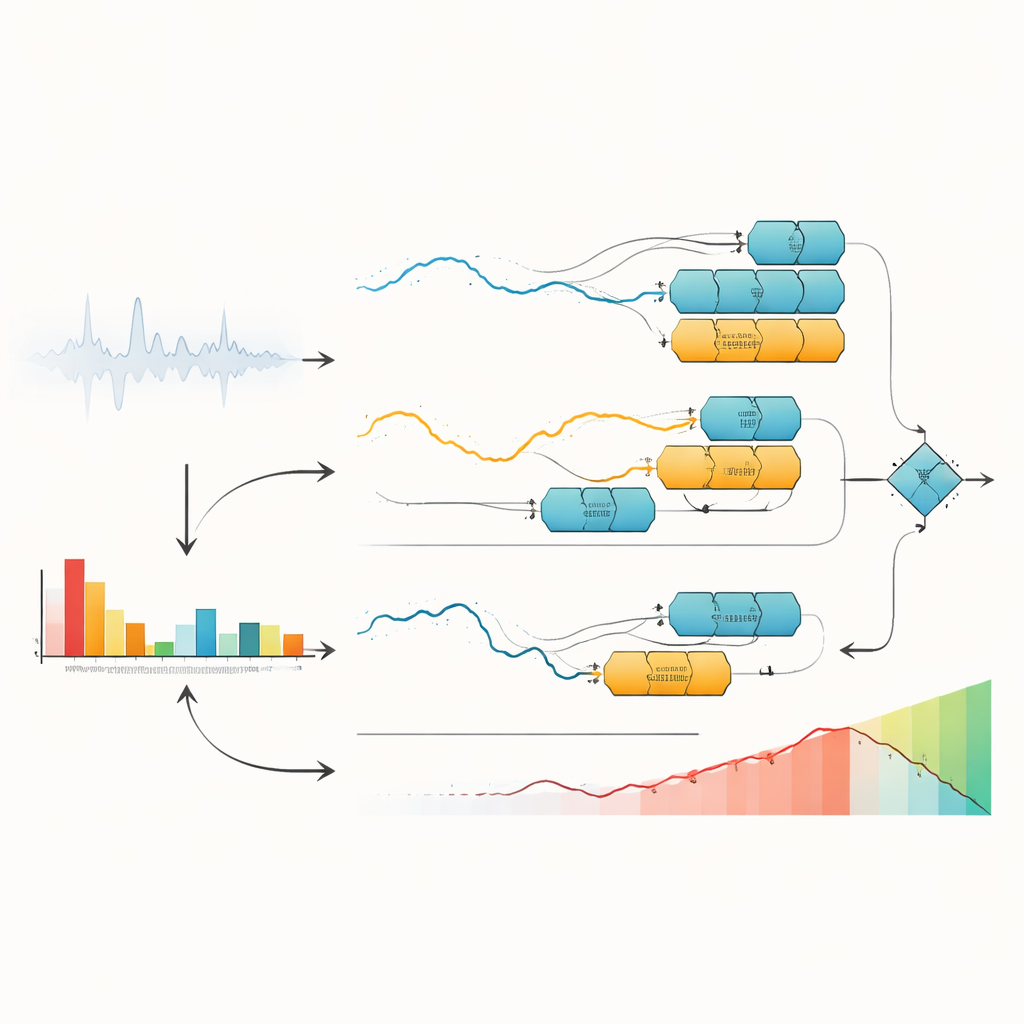
On top of this compressed curve, the authors build a dual-channel prediction model called SPHT-LSTM. One branch, called the superposition channel, concentrates on slow, long-term trends: the gradual drift that reflects overall wear. The other, called the progressive channel, focuses on short bursts and local fluctuations that capture small, sudden changes. Each branch combines two powerful deep learning tools: LSTM units, which are good at handling sequences over time, and Transformer blocks, which are good at spotting relationships across distant points in the sequence. By keeping the two branches separate, the system can specialize: one becomes an expert in smooth drift, the other in sharp wiggles.
Letting the more reliable voice speak
Because machines do not age in a smooth, predictable way, the model does not simply average the two branches. Instead, it continually checks how well each branch has been doing recently, based on prediction errors over a sliding window. At each step, it chooses the branch with the lower recent error as the official forecast. This acts like a simple referee that listens more to the expert currently performing better under the present conditions. When early damage is subtle and localized, the short-term branch tends to win; when degradation becomes steady and pronounced, the long-term branch takes over. The authors further analyze the predictions in both time and frequency domains to confirm that the changes match known fault patterns.
Putting the method to the test
The team tests their approach on three kinds of data. First, they use well-known run-to-failure bearing signals, where a bearing is operated until it breaks. Second, they examine battery aging data, linking changes in internal resistance and charging behavior to capacity loss. Third, they analyze real gearbox vibration from a hot-rolling mill in a steel plant. In all three cases, MPD provides a clear degradation curve, and the dual-channel predictor can mark when the system enters an early fault phase and when degradation speeds up. Compared with classic neural networks and a standard Transformer, SPHT-LSTM reduces forecasting error and more accurately flags the transition into dangerous stages.
What this means for real factories
For non-specialists, the main outcome is simple: this method gives factory operators a clearer early-warning signal. By compressing messy sensor histories into an intuitive degradation curve and then using two cooperating “experts” to predict where that curve is heading, the approach can correctly identify about nine out of ten early weak faults and even more of the rapid failure stages in the tested scenarios. That level of foresight can support condition-based maintenance: servicing equipment when its health indicator crosses a threshold rather than on a fixed calendar. In practical terms, this could mean fewer surprise breakdowns, better use of maintenance resources, and safer, more reliable industrial operations.
Citation: Hu, B., Zhang, Y., Guo, J. et al. SPHT-LSTM: a novel industrial equipment condition prediction method. Sci Rep 16, 13865 (2026). https://doi.org/10.1038/s41598-026-43263-8
Keywords: predictive maintenance, equipment health monitoring, time series forecasting, deep learning models, fault detection