Clear Sky Science · en
Ecosystem health in the Yellow River Estuary based on the DPSIR model: a case study in China
Why This River Delta Matters
The Yellow River Estuary, where China’s “Mother River” meets the sea, is more than a scenic coastline. It is a hub of oil and gas, fisheries, shipping, farming, and growing cities, while also sheltering wetlands that store carbon, filter water, and support wildlife. These overlapping roles mean that the estuary’s “health” directly affects regional livelihoods, food security, and long-term environmental safety. This study asks a simple but crucial question: under years of rapid development and climate stress, is the Yellow River Estuary getting better or worse—and why?
Looking at the Big Picture
To answer this, the researchers used a framework called DPSIR, which organizes cause-and-effect in five steps: what drives change, how much pressure is put on nature, what state the environment is in, what impacts emerge, and how society responds. They pulled together long-term data from 2010 to 2023, including satellite observations of vegetation, land use, and productivity, as well as maps of population, industry, pollution, and government spending. By treating the estuary as a living system influenced by both people and nature, they could track not just whether the region is stressed, but which parts are improving and which are falling behind. 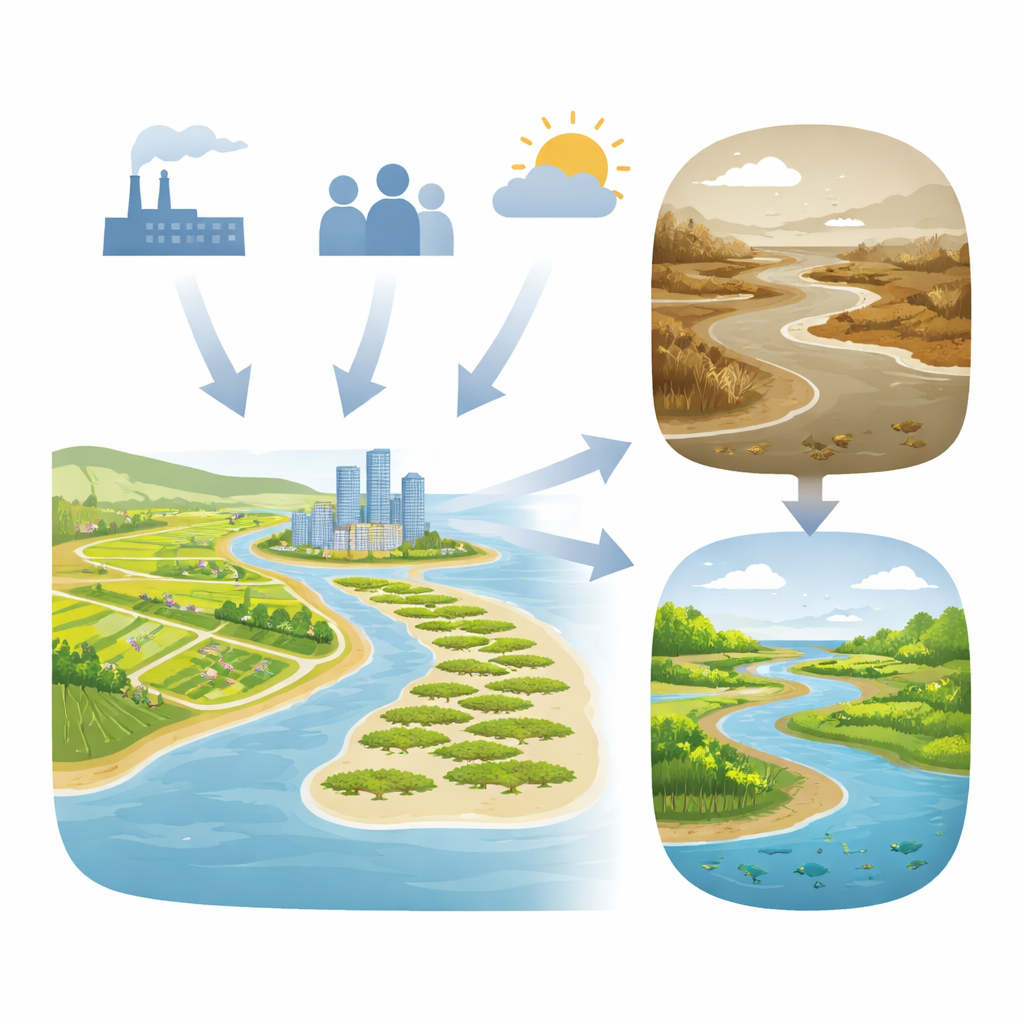
Turning Many Signals into One Health Score
Because no single number can capture ecosystem health, the team built an index using 16 different indicators. These ranged from economic growth and population change to air pollution, nighttime light as a proxy for human activity, landscape fragmentation, plant growth, and public spending on environmental management. They then used a hybrid weighting approach that blends expert judgment with mathematical methods that measure how informative and how variable each indicator is. This combined method reduces the risk that the final score is skewed by either personal opinion or a single quirky dataset, giving a more robust picture of overall ecosystem condition.
Where the Estuary Is Thriving—and Where It Is Not
The results show that, on average, the Yellow River Estuary has stayed in a “sub-healthy” state over the past 14 years. The city of Dongying and industrial Guangrao County started from relatively stressed conditions but have generally improved, as environmental investments and industrial restructuring took hold. Wetland-rich Hekou and Kenli Districts, long seen as ecological strongholds, still fare better than other areas but have recently slipped in some years as development and extreme weather add new stress. Lijin County, with high pressure and weak management response, remains the most fragile. Across the map, a clear pattern appears: northern and southern zones tend to be healthier, while the central belt lags behind. Over time, the most degraded patches have shrunk and medium-to-high health areas have expanded, suggesting that large-scale restoration and pollution controls are starting to pay off. 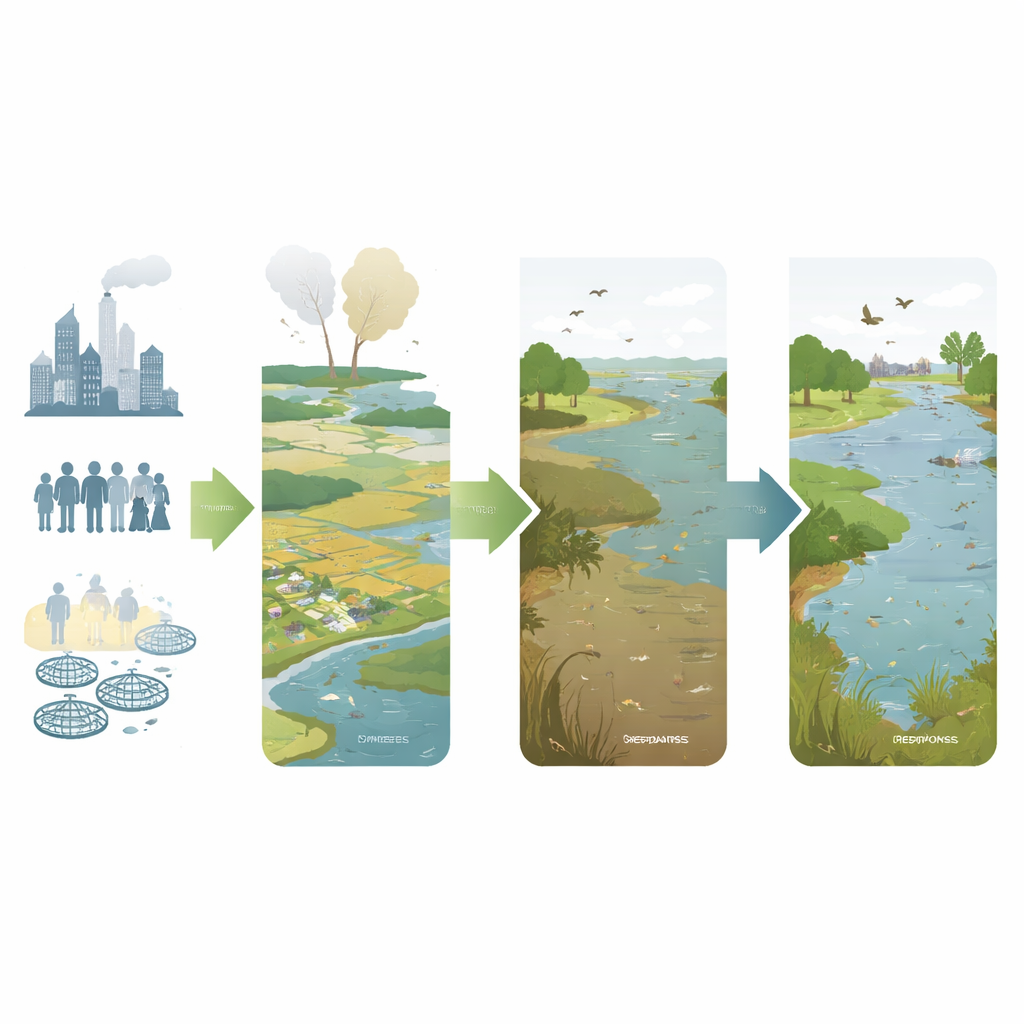
How People and Policies Shape the River’s Future
By comparing health scores with major policy milestones, the study highlights time lags between action and visible improvement. Pollution control, wetland restoration, and large tree-planting efforts often take years before they show up as greener vegetation, cleaner air, or more stable landscapes. Districts that paired strong economic growth with sustained ecological projects tended to move upward, while areas with heavy industry but weaker governance stayed stuck or declined. The analysis also shows that even nature-rich counties cannot rely on natural resilience alone; without continued funding and coordinated planning, today’s balance can quickly tip toward degradation under mounting human pressure.
What the Findings Mean for Everyday Life
For non-specialists, the message is both cautionary and hopeful. The Yellow River Estuary is not yet “healthy,” but it is not doomed either. It sits in a middle zone where long-term stress from factories, farms, and cities is being partially offset by stronger environmental rules and restoration projects. The study demonstrates that with sustained, well-targeted policies, a busy industrial coastline can edge toward recovery instead of collapse. At the same time, the uneven progress between districts warns that piecemeal efforts are not enough. Keeping this vital river mouth functioning—for fisheries, clean air and water, storm protection, and local economies—will require coordinated, long-term care that treats the estuary as one connected system, rather than a collection of separate projects.
Citation: Ji, M., Li, J., Li, L. et al. Ecosystem health in the Yellow River Estuary based on the DPSIR model: a case study in China. Sci Rep 16, 13587 (2026). https://doi.org/10.1038/s41598-026-43259-4
Keywords: Yellow River Estuary, ecosystem health, wetland restoration, human impacts, environmental policy