Clear Sky Science · en
Comparative optimization of overcurrent relay coordination in DG-integrated distribution networks: water cycle algorithm versus genetic algorithm and big bang–big crunch
Keeping the Lights On When Power Flows Both Ways
As homes and businesses add rooftop solar panels, small wind turbines, and other local generators, electricity no longer flows only from big power plants outward. Instead, power can move in many directions at once, especially when parts of the grid operate like islanded “microgrids” cut off from the main system. This shift is good for clean energy, but it makes it much harder to ensure that faults—such as short circuits—are quickly detected and isolated without turning off more customers than necessary. This study explores how modern search algorithms can tune the grid’s protective devices so they still work reliably in this new, more complex world.
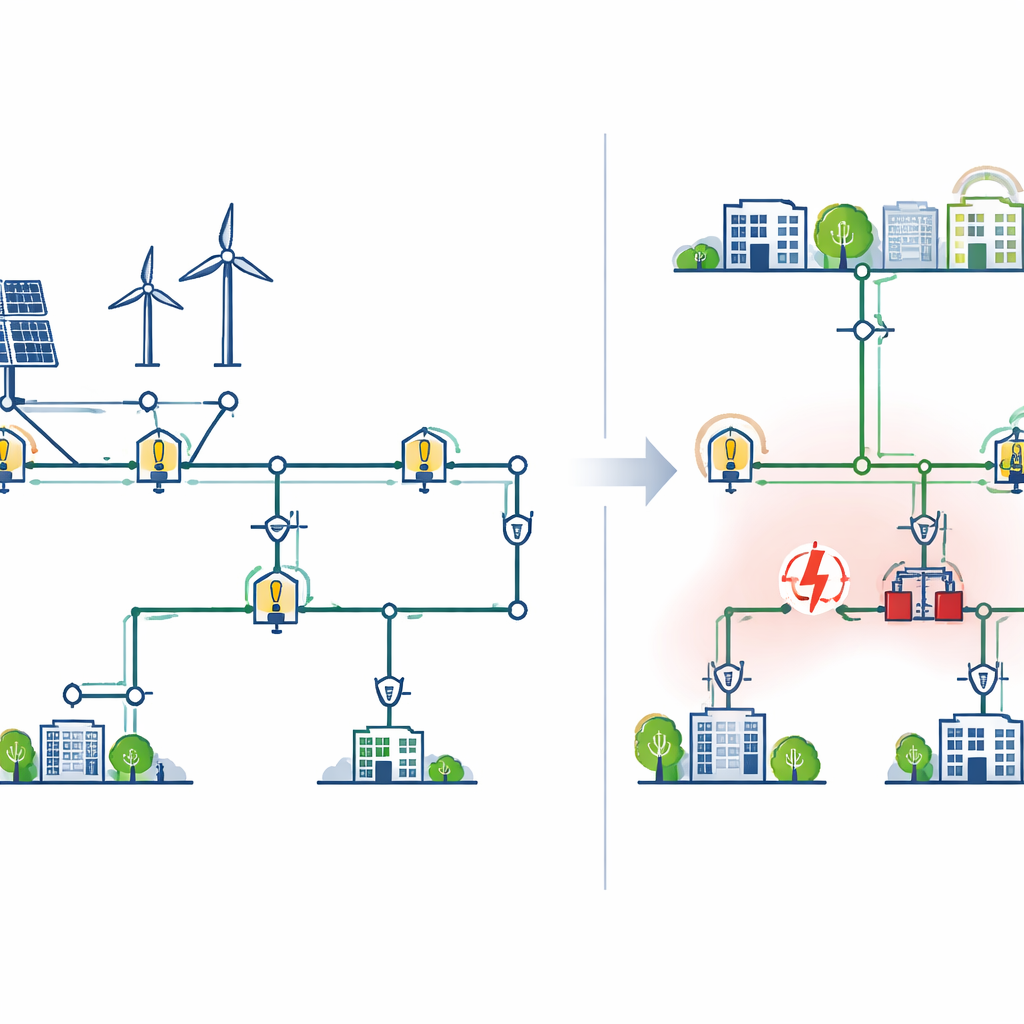
Why New Power Sources Confuse Old Protection
Traditional distribution grids were built with a simple idea in mind: power flows from the main grid through lines and transformers to customers. Protective devices called overcurrent relays watch how much current passes through them. If that current suddenly spikes, signaling a fault, a nearby relay trips first while others wait a little longer, providing backup. This careful timing, called coordination, assumes that fault currents always come from one direction. Once local generators such as solar arrays and wind turbines are added throughout the network, that assumption breaks down. Fault currents can now come from multiple points and in both directions, changing their size and path depending on how the generators and lines are configured at that moment.
When the Grid Becomes an Island
The problem is even tougher when a neighborhood grid disconnects from the larger system and runs on its own, a mode known as islanded operation. In this case, inverter-based generators provide only limited fault current, making the difference between normal and fault conditions much smaller. That leaves less room for error in relay timing: trip too fast and you may disconnect healthy parts of the network, trip too slow and you risk equipment damage and longer outages. The authors study two test networks—a simple 9‑bus radial layout and a more intricate 30‑bus mesh—to see how well different optimization methods can find relay settings that work in grid‑connected, with‑generation, and islanded conditions.
Letting Algorithms Search for Better Settings
Instead of adjusting relay settings by hand, the researchers treat coordination as an optimization problem. The goal is to minimize how long primary relays take to clear faults, while still leaving a safe time gap before any backup relay would act. They use fault current calculations from specialized power‑system software and then apply three metaheuristic algorithms—Genetic Algorithm (GA), Water Cycle Algorithm (WCA), and Big Bang–Big Crunch (BB‑BC)—to search through possible time‑multiplier settings for each relay. These methods mimic natural processes such as evolution, water flow, or cosmic expansion and collapse to explore a large number of combinations without needing detailed mathematical gradients.
What Happens in Simple and Complex Networks
For the simpler 9‑bus system in normal, grid‑connected mode without local generation, all three methods quickly find good solutions with short overall clearing times and proper coordination. When distributed generators are added and fault currents become bidirectional, the task becomes harder. GA finds the fastest total clearing time but in some cases edges close to, or slightly beyond, the desired safety margin between primary and backup relays. WCA and BB‑BC give somewhat longer overall clearing times but keep the coordination margins healthier. Under islanded operation, where fault currents are lowest and margins tightest, GA again gives the shortest total time but shows a coordination violation in at least one relay pair, while WCA maintains coordination at the cost of slightly slower action and BB‑BC struggles the most. In the more complex 30‑bus meshed system, which uses relays that distinguish between forward and reverse fault directions, all three methods succeed, with WCA producing the lowest combined clearing time.
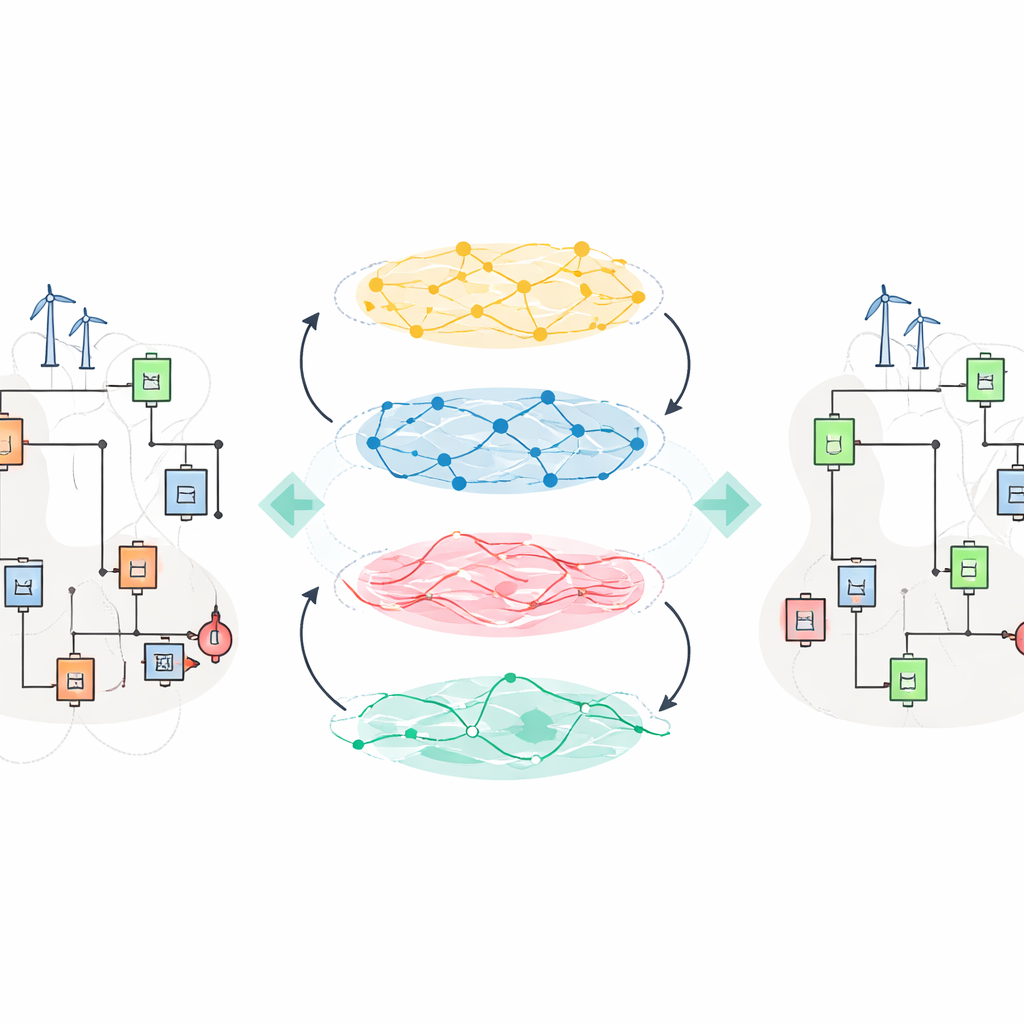
What This Means for Future Grids
For non‑specialists, the takeaway is that keeping a power system both clean and reliable is a balancing act. Pushing relay timings to be as fast as possible is not always the best choice when local, inverter‑based generators are involved and fault currents are modest. Instead, methods like the Water Cycle Algorithm that balance speed, robustness, and respect for safety margins may offer more dependable protection as grids become more dynamic and decentralised. The study suggests that carefully chosen optimization tools, paired with realistic models of fault behavior, can help ensure that even as power flows become more complicated, faults are still cleared selectively and most customers stay energized.
Citation: Mohamed, R.E., Saleh, S.M. & Ahmad, A.G. Comparative optimization of overcurrent relay coordination in DG-integrated distribution networks: water cycle algorithm versus genetic algorithm and big bang–big crunch. Sci Rep 16, 10529 (2026). https://doi.org/10.1038/s41598-026-43242-z
Keywords: distributed generation, microgrid protection, overcurrent relays, relay coordination, metaheuristic optimization