Clear Sky Science · en
Prototypical contrastive learning with patch-based spatio-temporal alignment for multivariate time series anomaly detection
Keeping an Eye on Complex Machines
Modern power grids, water plants, spacecraft, and server farms are laced with thousands of sensors that stream data every second. Hidden in these signals are early hints of faults, cyberattacks, or wear and tear. Spotting those rare warning signs without crying wolf is hard: normal behavior keeps changing, and today’s AI systems can be fooled into treating abnormal patterns as business as usual. This paper introduces P-ALIGN, a new way to watch multichannel sensor data that aims to catch problems early, stay robust to noise, and avoid overwhelming engineers with false alarms.

Why Usual Alarm Systems Fall Short
Many current anomaly detectors work like overzealous copy machines. They learn how normal sensor traces look, then try to reconstruct them; if the reconstruction is poor, they declare an anomaly. But powerful deep networks, especially Transformer-based ones, can become so flexible that they also reproduce abnormal patterns with surprising accuracy. When that happens, the difference between normal and faulty behavior shrinks, and true alarms vanish in the noise. At the same time, these models struggle with very long histories of data because their computation grows rapidly with sequence length. In real industrial settings, where sensor readings drift with changing loads and maintenance actions, these weaknesses lead to missed faults and floods of false alerts.
Breaking Data into Meaningful Chunks
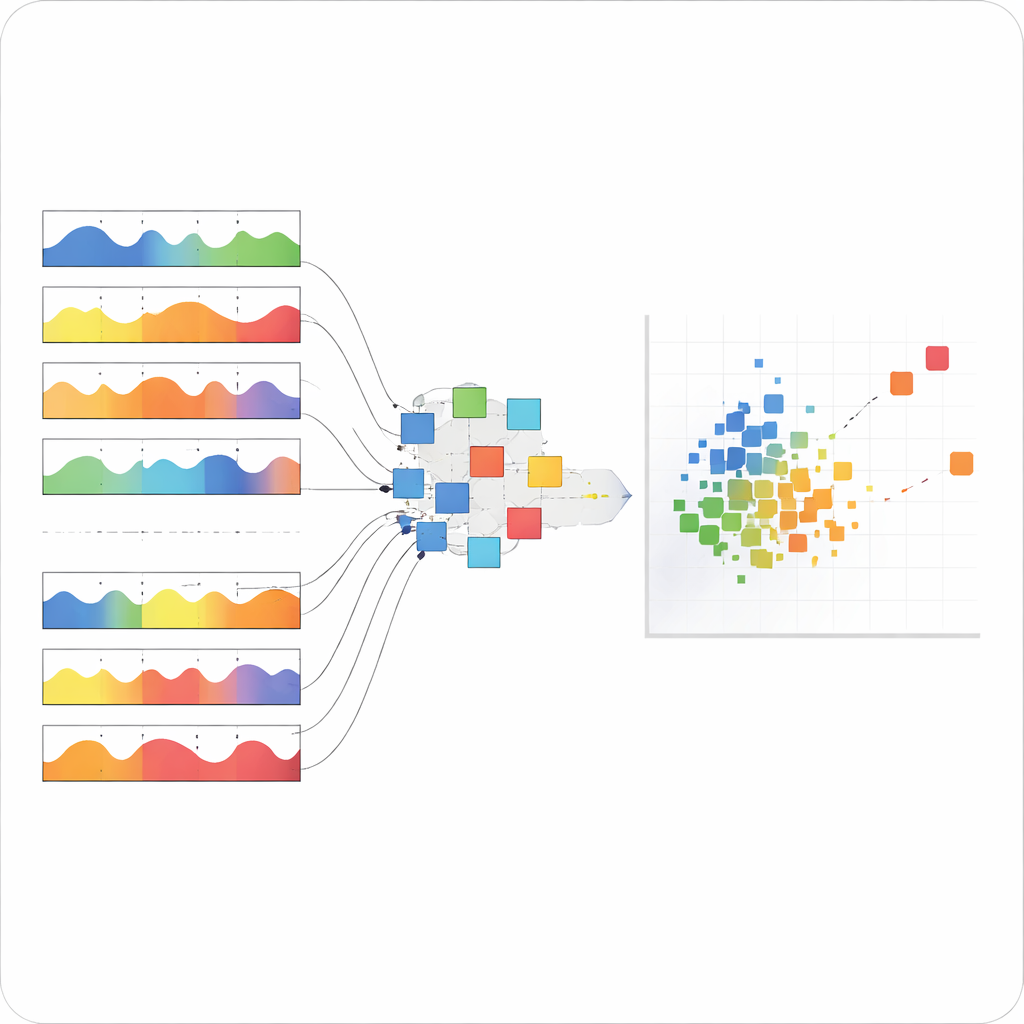
P-ALIGN tackles these issues by rethinking how time series are represented. Instead of examining each moment in isolation, it slices the sensor streams into moderately long "patches"—short segments of multichannel data—which serve as higher-level tokens. A feature extractor first models how different sensors influence each other, then an EmbedPatch encoder compresses each patch into a compact summary. This acts as a controlled information bottleneck: fleeting jitters and random spikes are averaged out, while the slower, more physically meaningful trends are preserved. Because the model now reasons over a manageable number of patches instead of thousands of time points, it can cover long time windows with far lower computational cost.
Anchoring Normal Behavior and Highlighting Outliers
The heart of P-ALIGN is a module called Spatio-Temporal Prototypical Alignment, or ST-PAC. Here, the system learns a small set of "normal prototypes"—abstract points that capture typical operating states across all sensors and times. Each incoming patch is pulled toward the closest prototype if it behaves normally, creating a compact, stable "normal region" in the model’s internal space. Patches that do not fit well resist this pull and remain at a distance, naturally standing out as potential anomalies. On top of this, a Contrastive Fusion module trains two parallel encoders, a slow-moving teacher and a faster learner, on slightly disturbed versions of the same data. By forcing the learner to stay consistent with the teacher even when patches are noised or partially masked, the system becomes robust to random fluctuations while sharpening its sensitivity to true structural changes in the data.
Performance Across Real-World Datasets
The authors tested P-ALIGN on six challenging real-world benchmarks, including NASA spacecraft telemetry, water treatment and distribution testbeds, large-scale server metrics, and drinking water quality data with very few anomalies. Across these diverse settings, P-ALIGN consistently beat 20 state-of-the-art competitors, ranging from classic statistical methods to graph neural networks, Transformers, diffusion models, and large language model adapters. On average, it improved the standard F1-score by about 11% and a stricter segment-level metric called Normalized Affinity by over 12%. These tougher metrics reward sustained, well-aligned detection of fault intervals rather than isolated lucky hits, showing that P-ALIGN maintains stable alerts throughout an incident instead of briefly spiking and then "learning the fault as normal."
Implications for Safer Infrastructure
For non-experts, the key takeaway is that P-ALIGN provides a more trustworthy early-warning system for complex, sensor-rich infrastructure. By summarizing long histories into patches, anchoring them to a library of learned normal patterns, and training with contrastive disturbances, it reduces both missed alarms and nuisance alerts. The framework is fast enough for real-time monitoring and resilient to routine shifts such as changing loads or seasonal trends, while remaining sensitive to subtle, slowly developing faults. Though the method still faces challenges in handling extreme, long-term changes in what "normal" looks like, it marks a significant step toward AI guardians that can watch over grids, plants, and spacecraft with a steadier, more discerning eye.
Citation: Yang, C., Li, X., Xu, K. et al. Prototypical contrastive learning with patch-based spatio-temporal alignment for multivariate time series anomaly detection. Sci Rep 16, 13165 (2026). https://doi.org/10.1038/s41598-026-43236-x
Keywords: time series anomaly detection, industrial monitoring, multivariate sensor data, contrastive learning, smart grid reliability