Clear Sky Science · en
Non-Hermitian quantum state discrimination and information flow
Seeing the Difference Between Nearly Identical Quantum States
Modern quantum technologies store information in fragile quantum states that can look almost, but not quite, the same. Telling these states apart reliably is vital for secure communication and powerful quantum computers, yet it is also notoriously hard. This paper explores a fresh route to this problem using a class of systems called non-Hermitian quantum systems, which effectively describe particles that can gain or lose energy to their surroundings. By harnessing these open-system effects, the authors show how two nearly indistinguishable quantum states can be made perfectly distinguishable in surprisingly short times.
Why Telling Quantum States Apart Is So Hard
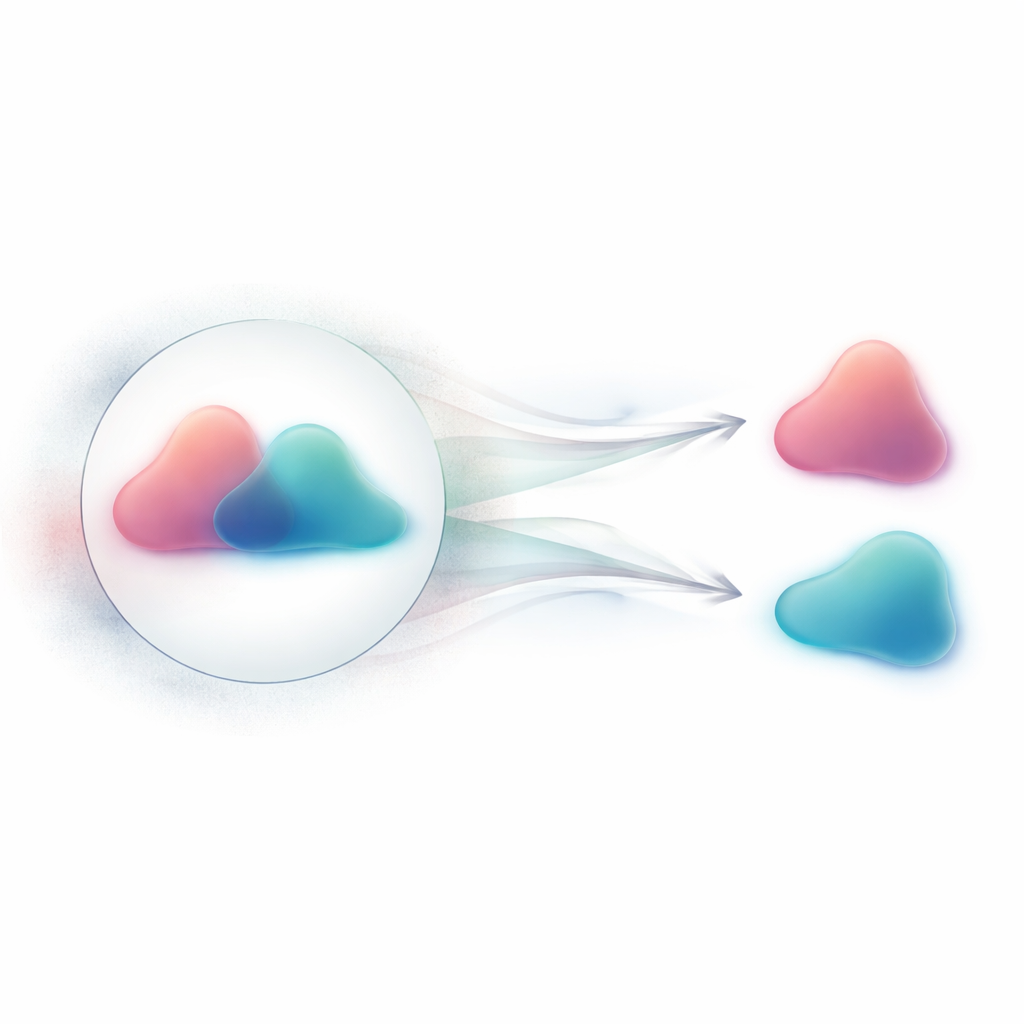
In conventional quantum mechanics, information is encoded in a quantum state, and a central task is to identify which state a system is in after a measurement. When two states are not exactly perpendicular to each other, there is always a chance of confusion. Standard strategies follow two main philosophies: either accept a small error rate but always give an answer, or insist on never being wrong at the price of sometimes saying “I don’t know.” The latter, called unambiguous discrimination, is especially attractive for quantum cryptography but becomes extremely complex as the number of possible states grows. Mathematically, the problem has resisted complete solutions for decades, motivating researchers to look for new physical settings where the task might become more tractable.
Letting the Environment Help Instead of Hurt
Most discussions of quantum information assume closed, perfectly isolated systems described by Hermitian Hamiltonians, where time evolution preserves the “angle” between states. Under such evolution, two non-orthogonal states can never become perfectly distinct. Non-Hermitian Hamiltonians offer another viewpoint: they arise as effective descriptions of open systems that can lose or gain excitations through decay, absorption, or measurement and postselection. In this setting, the distance between two states—measured by a quantity called the trace distance—need not stay fixed. It can increase over time, meaning that information which seemed lost can effectively flow back from the environment to the system, temporarily making states more distinguishable than before.
Designing Fast Discrimination in Special Non-Hermitian Systems
The authors first analyze two well-studied families of non-Hermitian models: PT-symmetric and P-pseudo-Hermitian Hamiltonians in their so-called broken phases, where their energy levels become complex. Working mainly with two-level systems (qubits), they show analytically how two initially non-orthogonal states can evolve into exactly orthogonal ones, enabling unambiguous discrimination with a nonzero probability of success. Under a fixed energy constraint—essentially limiting how “strong” the evolution can be—they derive criteria for tuning P-pseudo-Hermitian Hamiltonians so that they separate states faster, or for smaller initial angular separations, than any given PT-symmetric setup. They also explore how special parameter points called exceptional points influence the minimal evolution time and the smallest angle between states that can still be cleanly distinguished.
Going Beyond Symmetry: Generic Open Quantum Dynamics
Crucially, the work extends beyond these symmetric models to more general non-Hermitian Hamiltonians with complex spectra. By expressing the dynamics in terms of non-orthogonal eigenstates, the authors show that much of the behavior can already be captured in carefully chosen two-level examples. They identify conditions under which the trace distance between two states can either oscillate and reach its maximum value or decay monotonically to zero, depending on whether a certain effective energy gap is real or purely imaginary. This viewpoint links state discrimination directly to information flow in open quantum systems: whenever the distinguishability grows, it can be interpreted as memory effects or non-Markovian behavior in the underlying environment. Experiments using quantum simulation and postselection—such as Naimark dilation with auxiliary qubits or photonic loss channels—provide realistic routes to implementing these non-Hermitian evolutions.

What Really Matters for Quantum Information Flow
Putting all these results together, the authors argue that what truly powers unambiguous state discrimination in non-Hermitian settings is not the presence of PT symmetry or pseudo-Hermiticity by themselves, but rather the non-orthogonal nature of the eigenstates of the effective Hamiltonian. These non-orthogonal eigenstates allow the trace distance between initially similar states to reach its maximum value, making them perfectly distinguishable in principle and revealing a controlled flow of information between system and environment. The study thus broadens the landscape of quantum information processing beyond idealized closed systems, suggesting that carefully engineered loss, gain, and measurement can be turned from a threat into a resource for reading out quantum information quickly and reliably.
Citation: Dong, Q., Liu, Z. & Zheng, C. Non-Hermitian quantum state discrimination and information flow. Sci Rep 16, 13586 (2026). https://doi.org/10.1038/s41598-026-43224-1
Keywords: quantum state discrimination, non-Hermitian physics, open quantum systems, PT symmetry, information flow