Clear Sky Science · en
Simultaneous effect of ZnO nanoparticles and silica fume on the mechanical properties of the concrete
Stronger concrete for tough places
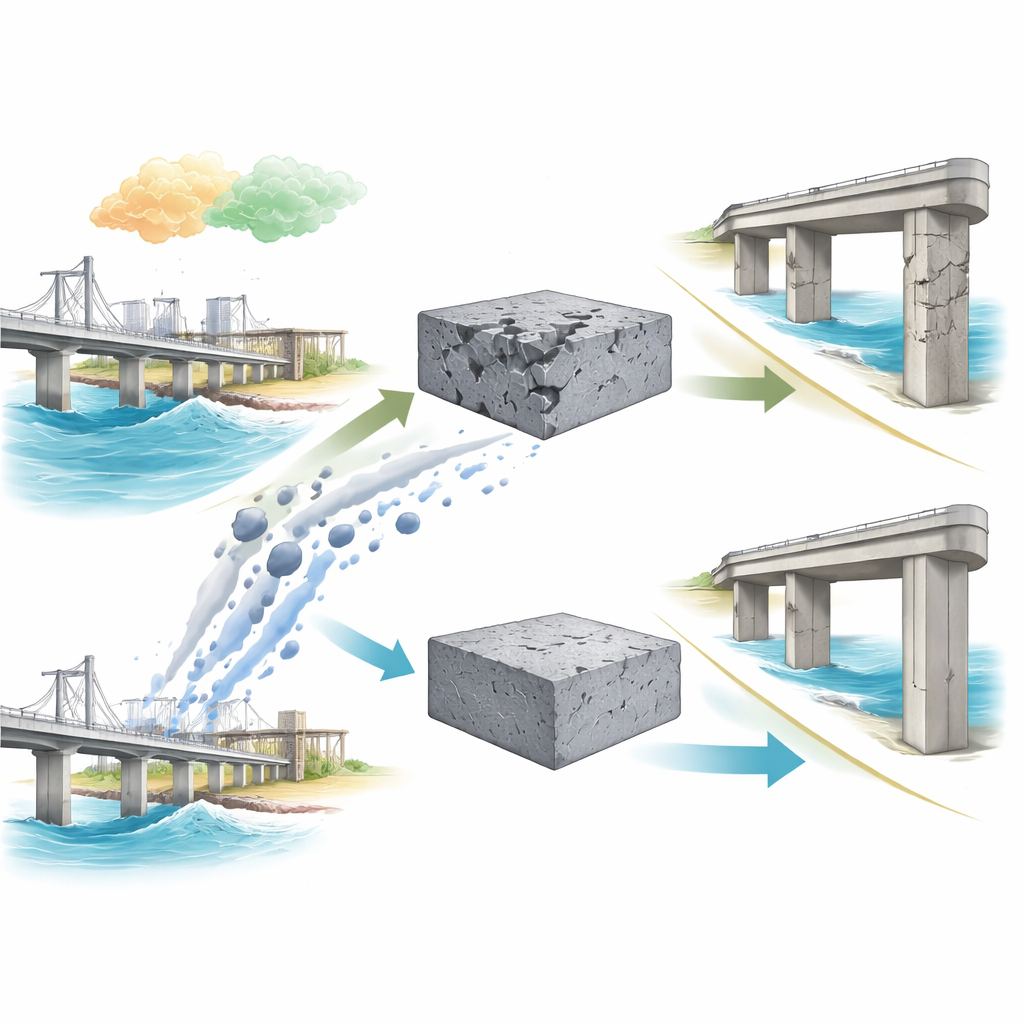
From coastal bridges to city tunnels, many critical structures slowly weaken as salt and pollution eat away at the concrete that holds them up. This study explores a simple idea with big consequences for everyday life: can we tweak what goes into concrete at the microscopic and nanoscopic scale so that buildings and infrastructure last longer in harsh environments like seawater and de-icing salt? By carefully blending two industrial by-products and additives—silica fume and zinc oxide nanoparticles—the researchers show that it is possible to create more durable, longer-lasting concrete without radically changing how it is made today.
What is special about this new concrete mix?
Concrete is a mixture of cement, sand, stones, and water. When cement reacts with water, it forms a glue-like network that holds everything together, but it also produces weaker by-products that are vulnerable to chemical attack. Silica fume, a very fine powder from the silicon industry, can react with these weak by-products and turn them into extra glue, making the internal structure denser. Zinc oxide nanoparticles, which are thousands of times smaller than grains of sand, can act as tiny starting points where new solid material grows. In this work, the authors systematically varied the amounts of silica fume and zinc oxide added to a standard high-strength concrete, looking for the combination that delivered the best balance between ease of mixing, strength, and resistance to damage.
How the experiments were carried out
The team produced thirteen different concrete recipes, starting from a conventional mix and then partially replacing cement with silica fume (up to 16%) or zinc oxide nanoparticles (up to 1.2%), or both together. All mixes used the same sand, gravel, and water ratio so that only the binder changes were being tested. After casting and curing, the researchers measured how easily each mix flowed, how quickly it hardened, and how strong it became in compression, in tension, and in bending over a full year. To mimic real-world exposure, some samples, after initial curing, were soaked for months in solutions rich in sulfate or chloride ions—chemicals known to attack concrete in soils, seawater, and road-salt environments. The team also used X-ray diffraction and electron microscopy to look inside the hardened material and see how its tiny building blocks were arranged.
What the results revealed about strength and durability
Individually, both silica fume and zinc oxide improved the strength and chemical resistance of the concrete, but only up to an optimum dosage. Too much silica fume or too many nanoparticles made the fresh mix harder to work with and could create subtle flaws. The standout recipe was a ternary blend containing 8% silica fume and 0.9% zinc oxide nanoparticles by weight of cement. After one year, this mix showed nearly 9% higher compressive strength and modest but consistent gains in tensile and flexural strength compared with ordinary concrete. More importantly for long-term performance, specimens made with this blend lost far less strength when exposed to sulfate and chloride solutions; their residual strength was roughly 18–19% higher than that of the control after prolonged chemical attack.
What is happening inside the material
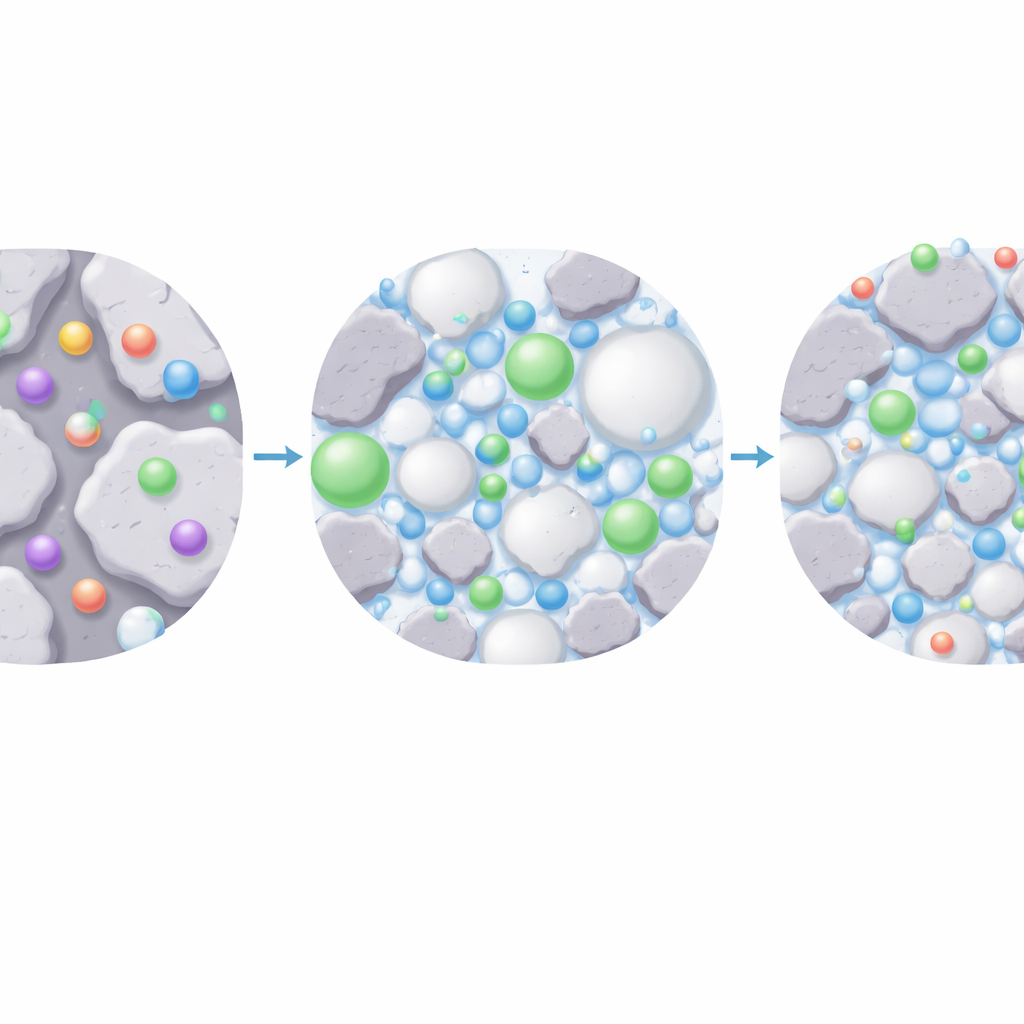
Microscopic and X-ray studies helped explain why this particular combination works so well. In the plain concrete, the internal structure contained many plate-like crystals and loosely packed regions with obvious gaps where harmful ions could penetrate. Adding silica fume reduced the amount of weak, calcium-rich crystals and increased a more gel-like binding phase, tightening the internal structure. Adding zinc oxide introduced new zinc-containing compounds and created extra nucleation sites, encouraging the formation of a more continuous, compact network. When both additives were used together at the optimized doses, the microstructure became notably smoother and denser, with fewer large crystals and fewer connected pores. This refined internal layout made it harder for aggressive chemicals to move in and damage the material.
Why this matters for everyday structures
For non-specialists, the takeaway is straightforward: by carefully tuning what goes into cement at the micro and nano scales, it is possible to make concrete that is modestly stronger and significantly more resistant to chemical attack without changing how it is used on site. The study shows that a mix with 8% silica fume and 0.9% zinc oxide nanoparticles can better withstand salty and sulfate-rich conditions, which are common causes of premature cracking and repair costs in bridges, coastal defenses, parking structures, and industrial floors. In practical terms, this approach offers engineers a realistic path to longer-lasting, more sustainable infrastructure that needs fewer repairs over its lifetime.
Citation: Kumar, M., Bansal, M., Krishan, B. et al. Simultaneous effect of ZnO nanoparticles and silica fume on the mechanical properties of the concrete. Sci Rep 16, 12936 (2026). https://doi.org/10.1038/s41598-026-43196-2
Keywords: high-performance concrete, silica fume, zinc oxide nanoparticles, sulfate and chloride resistance, microstructure