Clear Sky Science · en
Effect of Pr2O3 addition on the mechanical properties of the mullite/ZTA composites
Why Stronger Ceramics Matter
From jet engines and mining drills to artificial joints and armor, modern technology leans heavily on ceramics that can shrug off heat, wear, and sudden impacts. This study explores a way to make one such workhorse material—known as zirconia-toughened alumina with mullite—stronger and more reliable by adding tiny amounts of a rare-earth oxide called praseodymium oxide. The work shows that a few tenths of a percent of this additive can noticeably boost hardness and crack resistance, but that more is not always better.

Building a Tough Ceramic Mix
The base material in this research is a carefully engineered ceramic blend. It combines alumina, a very hard and widely used technical ceramic, with zirconia, which can help stop cracks, and a phase called mullite that improves thermal and mechanical stability. These ingredients are mixed with kaolin clay and a small amount of magnesium oxide, then pressed into shape and fired at temperatures up to about 1650 °C. The key twist is the addition of praseodymium oxide (Pr2O3) at levels of 0.5, 0.75, and 1 percent by weight to see how this rare-earth dopant changes the internal structure and, in turn, the performance of the composite.
Shaping and Heating the Samples
To test the effect of praseodymium oxide, the researchers prepared bars and pellets from powdered alumina, zirconia, kaolin, magnesium oxide, and the chosen amount of Pr2O3. After thorough mixing, the powders were compacted at very high pressure and then fired for two hours at three different temperatures: 1550, 1600, and 1650 °C. The team measured how dense the materials became, how many pores remained, and how easily the pieces cracked or bent under load. They also examined the internal crystal phases and grain shapes using X-ray diffraction and electron microscopy, allowing them to link mechanical behavior to microscopic changes.
What Happens Inside the Ceramic
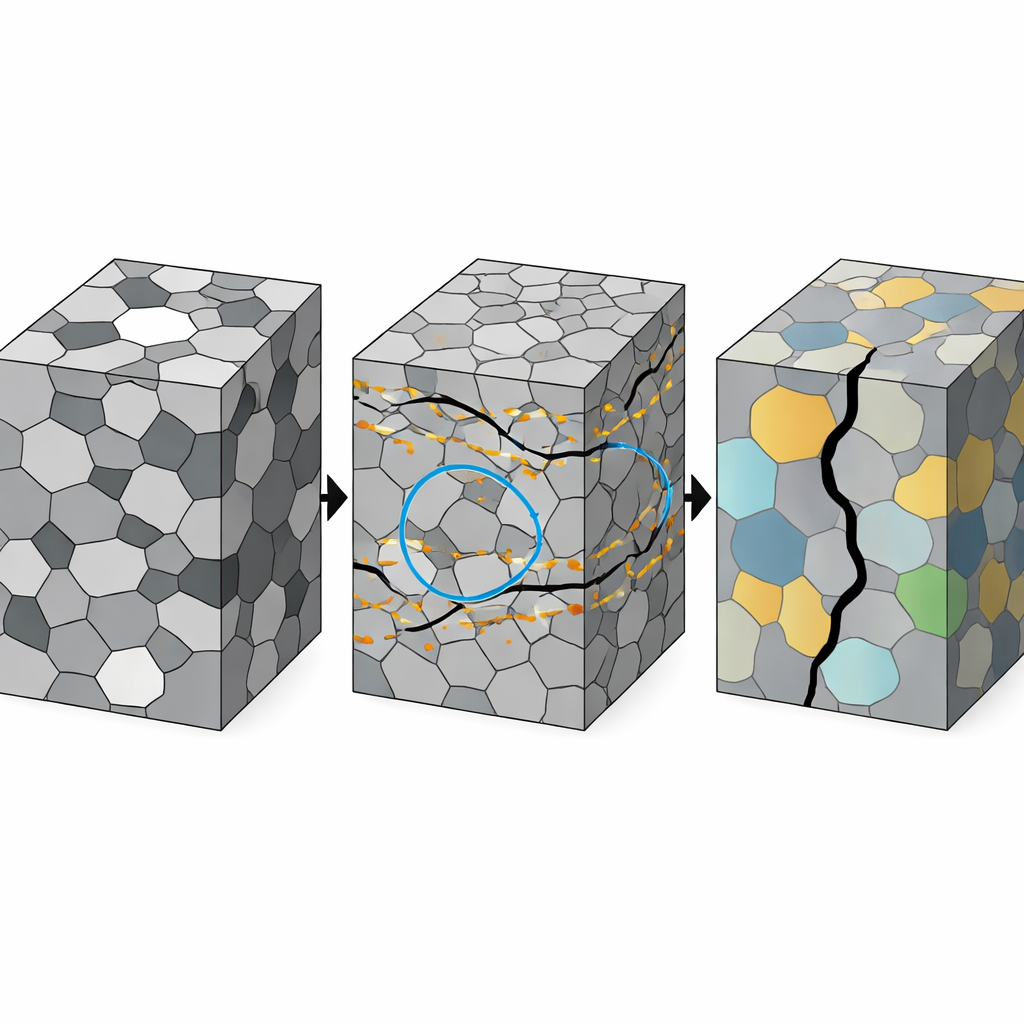
The tiny dose of praseodymium oxide turned out to have a big influence on the inner arrangement of the material. Compared with undoped samples, the doped ceramics reached high density at slightly lower firing temperatures, meaning less energy is needed to produce them. As Pr2O3 content increased, alumina grains tended to grow in elongated, rod-like forms, and mullite also developed rod or flake-like shapes. Zirconia grains remained very fine and well distributed around alumina grains. At about 0.75 percent Pr2O3, the structure showed features known to resist cracking, such as grain shapes that force cracks to twist and bridge rather than slicing straight through, along with subtle internal defects that can absorb fracture energy.
Finding the Sweet Spot for Strength
Mechanical tests confirmed that there is an optimal amount of praseodymium oxide. As the Pr2O3 level rose from zero to 0.75 percent, fracture toughness, flexural strength, and hardness all improved. The material at this intermediate level combined high density with a favorable mix of crystal phases and grain shapes, giving it a strong resistance to crack growth. However, when the Pr2O3 content was raised to 1 percent, the benefits started to reverse. Porosity increased, the balance between different zirconia phases shifted, and the overall strength and toughness dropped. In effect, the extra additive over-saturated the structure, creating more weak spots than reinforcements.
What This Means for Real-World Use
In practical terms, the study shows that adding a carefully controlled, small amount of praseodymium oxide—up to about three-quarters of a percent by weight—can make a widely used engineering ceramic both tougher and harder, while lowering the temperature needed to produce it. For industries that demand components able to withstand high temperatures, sudden shocks, and corrosive conditions, this offers a path to longer-lasting parts without a complete material redesign. At the same time, the work highlights a broader lesson in advanced materials: even when a special ingredient is helpful, there is a narrow window between just enough and too much, and the best performance emerges when chemistry, processing, and microstructure are tuned together.
Citation: Naga, S.M., Awaad, M., Amer, A.A. et al. Effect of Pr2O3 addition on the mechanical properties of the mullite/ZTA composites. Sci Rep 16, 11371 (2026). https://doi.org/10.1038/s41598-026-43191-7
Keywords: zirconia-toughened alumina, rare-earth dopants, advanced ceramics, fracture toughness, mullite composites