Clear Sky Science · en
Integrated morphological, molecular, and immunopathological characterization of Raillietina hymenolepidoides from Psammomys obesus reveals potent in vitro anthelmintic activity of Androctonus crassicauda venom
Why desert rats and scorpion venom matter
Most of us think of tapeworms and scorpions as simple desert dangers. This study shows they can also be clues—and tools—for protecting human and animal health. By carefully examining a little-known tapeworm living in fat sand rats on Egypt’s North Coast, and then testing the power of black scorpion venom against it, researchers uncovered both how this parasite harms its host and how venom might someday inspire new worm-killing drugs.
A hidden tapeworm in a common desert rodent
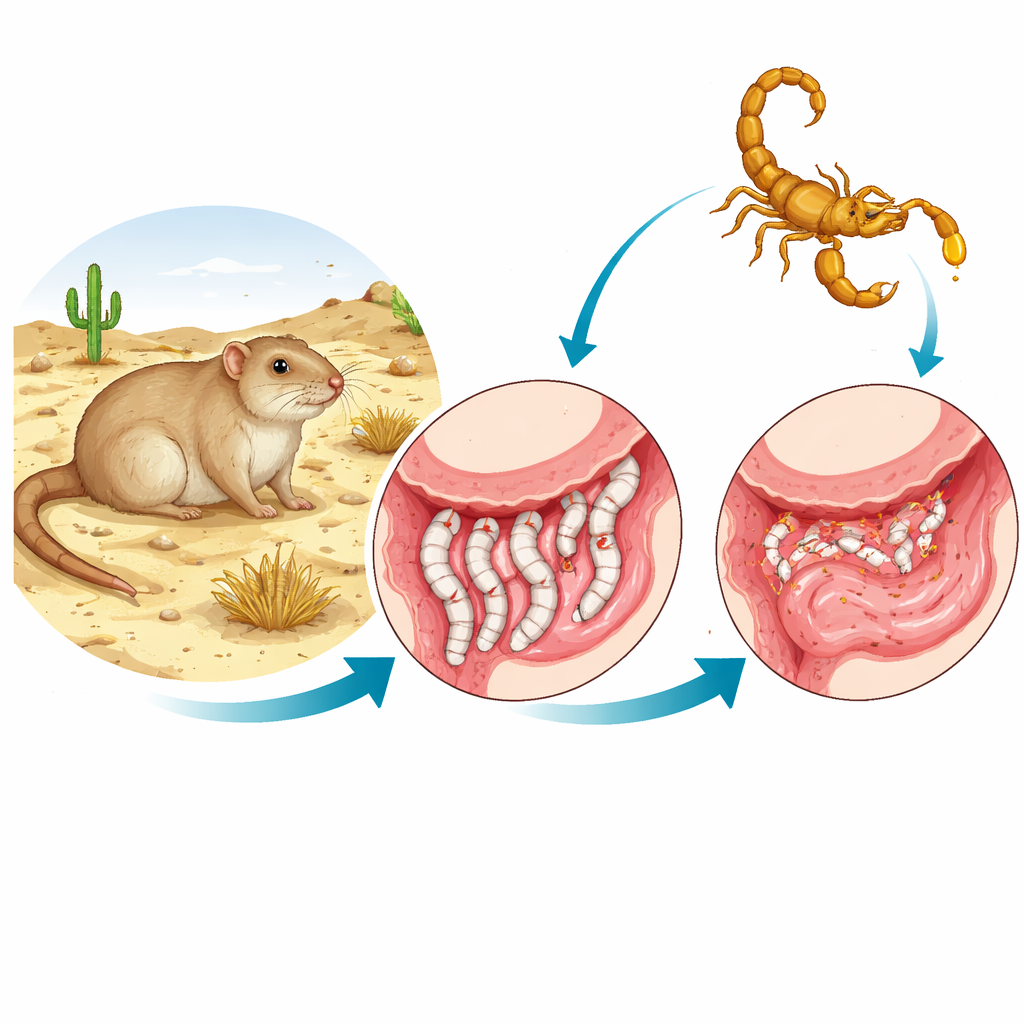
The fat sand rat, a small rodent of North African and Middle Eastern deserts, often lives close to people and livestock and is already known to carry several disease-causing microbes. When scientists examined the intestines of sand rats caught in salty marsh areas of Egypt’s North Coast, they found that most animals—about nine out of ten—harbored heavy infections with a ribbon-like tapeworm. Using classic light microscopy and high-resolution scanning electron microscopy, they documented the worm’s structure in detail, from its tiny head armed with four muscular suckers and hooked crown to its long chain of body segments. These features matched a species called Raillietina hymenolepidoides, but previous work in the region had misidentified similar worms as another species, highlighting how easily such parasites can be confused.
Pinning down identity with genetic tools
Because shape alone can be misleading, the team extracted DNA from the worms and sequenced a standard genetic marker from their mitochondria, a gene called cytochrome c oxidase I. Comparing this sequence with entries in international databases, they confirmed that the Egyptian tapeworms cluster closely with Raillietina mahnerti, a species known from birds in Malaysia, and are clearly distinct from other tapeworms that infect rodents and poultry. This is the first firm molecular confirmation of R. hymenolepidoides in sand rats in Egypt, and it helps clarify how members of this poorly known tapeworm group are related worldwide—a key step in judging which ones might jump to humans.
Damage beyond the gut
To understand what such infections do to their hosts, the researchers studied thin slices of tissue from the rats’ intestines and lungs under the microscope. Inside the small intestine they saw multiple worm segments packed in the lumen, along with extensive damage: blunting and death of the finger-like villi that absorb nutrients, overgrowth of immune cell clusters called Peyer’s patches, and dense inflammatory cell invasion. Surprisingly, the lungs also showed injury, including enlarged air spaces resembling emphysema, congestion of blood vessels, and degeneration of the airway lining. When they stained the tissues for key immune markers, they found that natural killer cells were more abundant in infected intestines, while macrophages and a calming signal called TGF‑β were reduced. Together, these changes suggest a chronic, imbalanced local immune reaction that may allow the worms to persist while still harming the host.
Scorpion venom as a worm killer
In parallel, the team explored whether venom from the black scorpion Androctonus crassicauda could damage the adult tapeworms outside the body. They exposed live worms in warm saline to a single concentration of crude venom and examined them over time by scanning electron microscopy. After just half an hour, the first cracks appeared in the worm’s surface and its body segments began to lose their orderly pattern. At one hour, the head and neck shrank and wrinkled, the hooked attachment structures became distorted, and the microscopic hair-like projections on the surface eroded. By ninety minutes, the outer coat was deeply perforated, segments broke apart and separated from each other, and the entire worm appeared collapsed and shredded—evidence of a strong time-dependent lethal effect.

What this means for future treatments
For non-specialists, the message is twofold. First, a common desert rodent carries a heavily damaging tapeworm whose exact identity was uncertain until now; clarifying this helps track potential risks to people and domestic animals. Second, venom from a dangerous scorpion, carefully studied and controlled, shows powerful ability to destroy these worms in the lab. While the crude venom itself is far too toxic to be used directly as a medicine, its active components could become blueprints for new drugs against intestinal worms that are increasingly resistant to existing treatments. This study therefore turns two feared desert creatures—the tapeworm and the scorpion—into a source of insight and possible innovation for global parasitic disease control.
Citation: Anwar, F.A.S., Alkenani, N.A., Abd-elghaffar, S.K. et al. Integrated morphological, molecular, and immunopathological characterization of Raillietina hymenolepidoides from Psammomys obesus reveals potent in vitro anthelmintic activity of Androctonus crassicauda venom. Sci Rep 16, 10540 (2026). https://doi.org/10.1038/s41598-026-43187-3
Keywords: tapeworms, rodent parasites, scorpion venom, anthelmintic therapy, desert ecosystems