Clear Sky Science · en
Sustainable thermal comfort assessment of evaporative cooling systems in hot and arid climates
Why Staying Cool Matters in a Hotter World
In many parts of the world, summers are becoming dangerously hot, and keeping buildings cool safely and affordably is a growing challenge. This study looks at a simple, low‑energy way to cool homes and public buildings in Iraq using water and moving air instead of power‑hungry air conditioners. By testing how well these systems work in three major Iraqi cities, the researchers show when this approach can keep people comfortable, where it struggles, and how it could help reduce blackouts, bills, and emissions in one of the hottest regions on Earth.
Life in Some of the Hottest Cities
Iraq is already among the hottest places on the planet, with summer temperatures in some areas approaching or exceeding 50 °C. At the same time, cities like Baghdad, Basrah, and Mosul are growing, often with buildings that lack good insulation. To cope with the heat, most people rely on conventional air conditioners that use a lot of electricity. In summer, these systems can consume 60–70% of all power in homes and offices, overwhelming an electricity grid that depends heavily on fossil fuels and private diesel generators. The result is a cycle of blackouts, high costs, air pollution, and unequal access to safe indoor temperatures.
A Simple Cooling Idea Revisited
Instead of compressing refrigerants like standard air conditioners, direct evaporative cooling systems pass hot air through a moist material. As water evaporates, it absorbs heat from the air, making it cooler before it enters the building. Fans and pumps are the only electrical components, so energy use is far lower. This technique has long roots in hot, dry regions, but its performance depends strongly on the local mix of heat and humidity. The authors built a climate‑based assessment that combines a global climate classification, detailed weather files, and modern comfort indices to see how well such systems would work as a main cooling strategy in Iraq’s different regions. 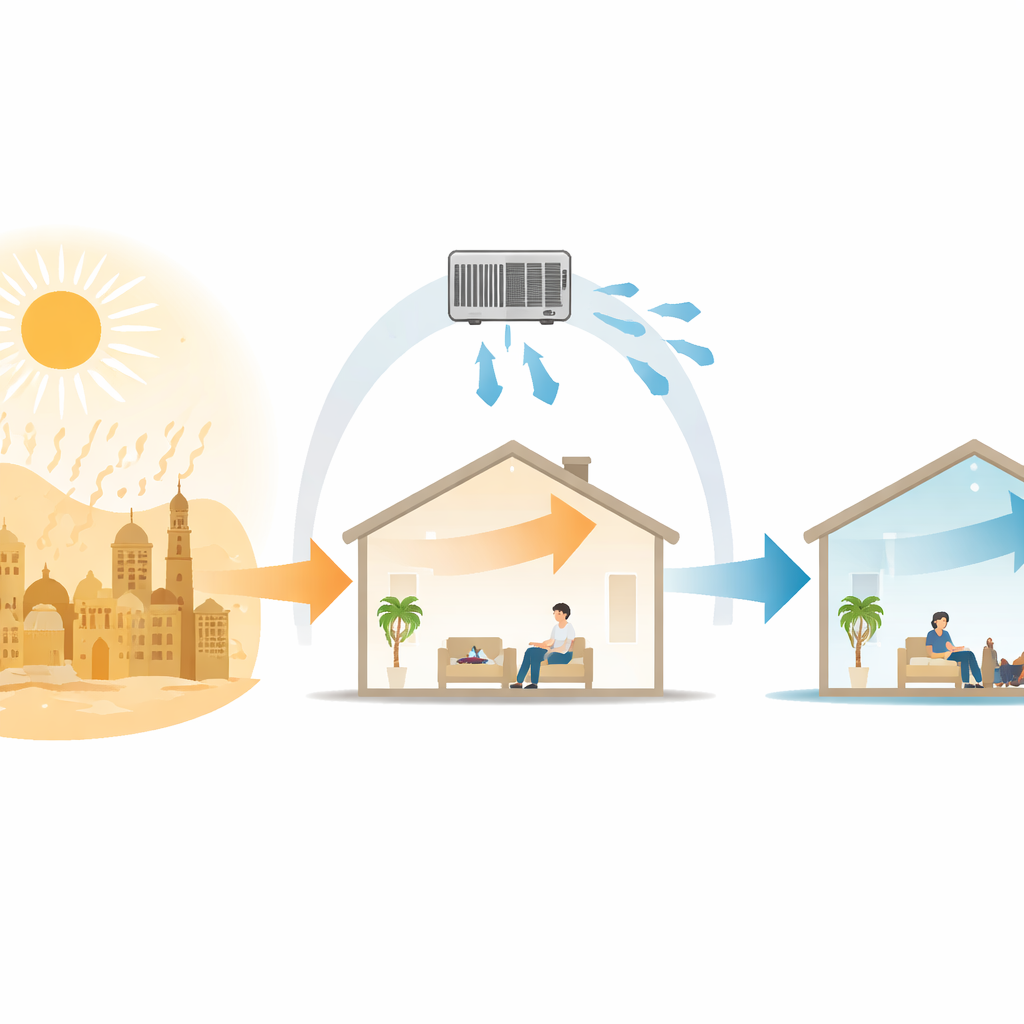
Testing Realistic Homes in Three Cities
To move beyond theory, the team simulated a typical single‑room Iraqi home in Baghdad, Basrah, and Mosul over the peak hot season from May to September. They compared two situations: one where the room received only outdoor air pushed inside by fans, and another where that air was first cooled by a direct evaporative cooler. Using building‑energy software, they tracked indoor temperature and humidity every hour, then converted these into standard comfort scores that reflect how occupants are likely to feel. This allowed them to see not just how much the air cooled, but how often conditions fell into a range most people would consider thermally comfortable.
When Evaporation Helps—and When It Hurts
The results show that simply blowing outdoor air into buildings does little to protect people in such extreme climates. Under mechanical ventilation alone, only about 23–25% of summer hours in Baghdad and Mosul, and a mere 5–6% in Basrah, fell into the comfort zone. Adding evaporative cooling changed this picture dramatically. In Baghdad and Basrah, the share of comfortable hours jumped by roughly 41% and 54%, respectively; in Basrah, comfort rose from about 5–6% to around 60% of summer hours. Mosul, which starts out cooler, also benefited but saw a smaller net gain because the cooled air occasionally became too cool for comfort. A key trade‑off emerged: while the systems lowered indoor temperatures into a more pleasant range, they also raised humidity. In Baghdad and Basrah, moisture levels sometimes exceeded recommended limits, which can make people feel muggy and reduce the body’s ability to shed heat. 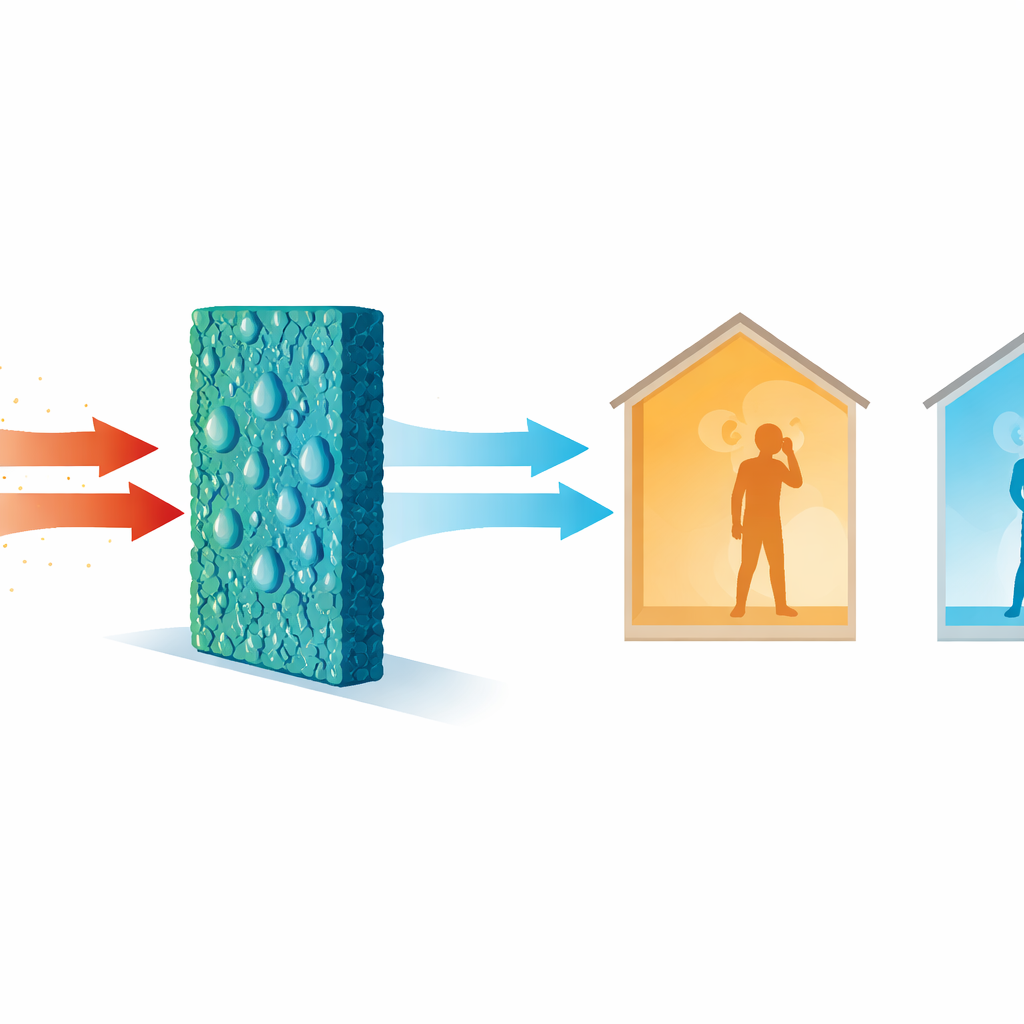
Why Local Climate Shapes Comfort
By overlaying climate maps, hourly weather data, and comfort scores, the study shows that evaporative cooling performs best in extremely hot but relatively dry conditions, where the air can still absorb water. Basrah, with high heat and humidity, proved the most vulnerable city, experiencing dangerous outdoor heat‑stress levels during most summer hours and the poorest indoor comfort when relying on fans alone. Yet it also gained the most from evaporative cooling, as even partial relief made a large difference. Mosul’s drier, cooler climate meant that evaporative cooling could bring air into a comfortable band without overstressing humidity as often, pointing to strong potential in similar semi‑arid regions.
What This Means for Everyday Life
For non‑specialists, the key message is that using water‑based cooling systems can make a meaningful difference to comfort and health in very hot climates while using far less electricity than standard air conditioners. The study finds that, when carefully matched to local climate and combined with good building design and possibly hybrid systems, direct evaporative cooling can turn many unbearable summer hours into tolerable ones. At the same time, it warns that in humid or already stressed cities, extra attention must be paid to managing indoor moisture. Overall, the research points to climate‑aware, low‑energy cooling as a promising path to safer, more sustainable living in regions facing intensifying heat.
Citation: Al-Jubainawi, A., Mohammad, O.A.M., Al-Maidi, A.A.H. et al. Sustainable thermal comfort assessment of evaporative cooling systems in hot and arid climates. Sci Rep 16, 14047 (2026). https://doi.org/10.1038/s41598-026-43175-7
Keywords: evaporative cooling, thermal comfort, hot arid climate, sustainable building, Iraq