Clear Sky Science · en
Aerodynamic performance optimization of the archimedes spiral wind turbine: combined experimental and CFD analysis of step ratio and blade number effects
Why a New Kind of Wind Turbine Matters
As cities search for cleaner energy, wind power seems like an obvious choice. Yet the tall, three-bladed turbines common in open fields struggle in crowded urban landscapes, where winds are slower, more chaotic, and constantly changing direction. This paper explores a different kind of machine—the Archimedes Spiral Wind Turbine—that is shaped like a twisted spiral shell. The researchers ask a practical question: how should this turbine’s spiral geometry and number of blades be tuned so it works efficiently and reliably in real-world, low-speed city winds?

A Spiral Turbine Built for City Winds
The Archimedes Spiral Wind Turbine (ASWT) is a compact horizontal-axis turbine whose blades wrap around the central shaft in a smooth spiral, rather than extending straight outward. This shape allows it to catch the wind from many directions and start spinning even when gusts are weak and unsteady—conditions typical between buildings. However, the same spiral and multi-blade design that helps at low speeds can also increase air resistance and structural loads, limiting peak efficiency. The study focuses on finding a sweet spot where the turbine still starts easily and runs smoothly, yet converts as much of the wind’s energy into useful power as possible.
Tuning the Shape of the Spiral
One key design feature of this turbine is how quickly the spiral “unwinds” along the shaft, controlled by two lengths called Step 1 and Step 2. Their ratio (S1/S2) determines whether the blades are more tightly curved or more stretched out. To study this without mixing in other effects, the team kept the overall size and proportion of the rotor fixed, changing only S1/S2 across six versions. They built 3D computer models, ran detailed airflow simulations, and then tested matching physical models in a wind tunnel at realistic wind speeds between 5 and 10 meters per second. All versions reached their best performance at a similar rotational regime, but a mid-range configuration (named PR-5) clearly stood out, achieving the highest power output by guiding the air more smoothly along the blade without causing excessive drag.
Finding the Right Number of Blades
With the spiral shape fixed at this optimal setting, the researchers next examined how many blades the turbine should carry—testing two, three, four, five, and six blades. More blades provide a larger surface for the wind to push on, which helps the turbine start turning at low speeds and produce steady torque. But packing in too many blades also thickens the rotor, increasing turbulence and friction in the air, which can sap efficiency once it is spinning faster. The simulations and wind-tunnel measurements showed a clear pattern: a three-bladed version delivered the best overall balance, reaching a maximum power coefficient of about 0.264 at a moderate tip-speed ratio, while versions with more blades suffered from added drag and messy wakes behind the rotor. The two-blade model did somewhat better at higher rotational speeds but was less capable at low wind.
Looking Inside the Flow
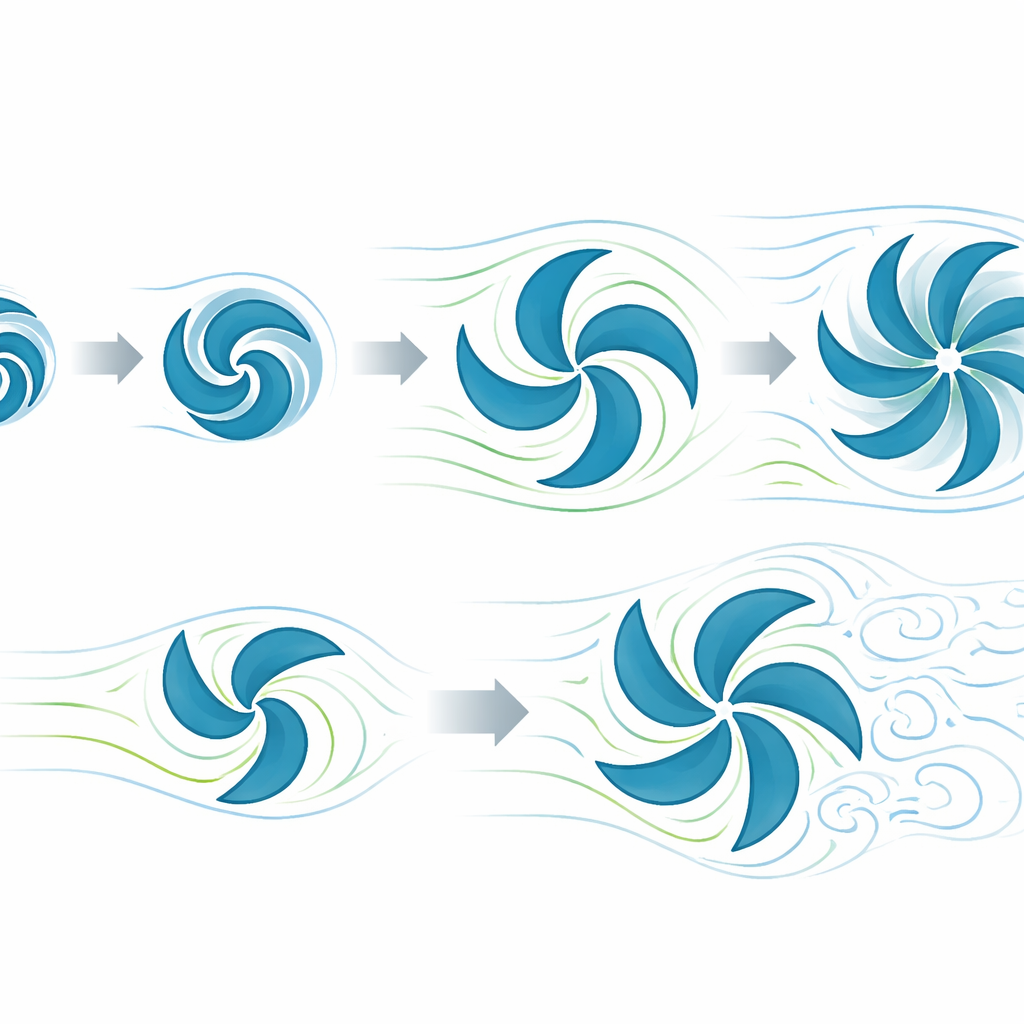
To understand why these differences arise, the team examined detailed maps of pressure and velocity around the blades. In the most successful three-blade design, the air sped up smoothly on the suction side of each blade and slowed on the opposite side, creating a strong, even pressure difference that drives rotation. The wake behind the turbine remained compact and relatively orderly, signaling efficient energy extraction with modest turbulence. In contrast, the two-blade rotor showed weaker and patchier loading, while rotors with five or six blades produced overlapping pressure zones and broad, slow-moving wakes—signs that the air was being overworked and much of the extra blade area was actually getting in the way rather than helping.
What This Means for Urban Wind Power
In everyday terms, the study shows that the Archimedes spiral turbine can be tuned to work well where conventional big-tower turbines struggle: in low, shifting city winds. By carefully setting how quickly the spiral opens (the S1/S2 ratio) and choosing a three-blade layout, designers can achieve a compact rotor that starts easily, runs stably, and converts a respectable share of the wind’s energy into electricity—without complex steering systems. While its peak efficiency is still lower than that of large field turbines, this optimized spiral design offers a promising option for rooftops and small-scale, distributed power, and provides a solid blueprint for future refinements in shape, structure, and materials.
Citation: Faisal, A.E., Lim, C.W., Al-Quraishi, B.A.J. et al. Aerodynamic performance optimization of the archimedes spiral wind turbine: combined experimental and CFD analysis of step ratio and blade number effects. Sci Rep 16, 13455 (2026). https://doi.org/10.1038/s41598-026-43165-9
Keywords: urban wind turbine, Archimedes spiral rotor, blade number optimization, computational fluid dynamics, small-scale wind energy