Clear Sky Science · en
Prediction of body weight and ethnicity using anthropomorphic measurements of the hand in two different populations
Why Your Hands Reveal More Than You Think
Most of us think of our hands as tools for everyday tasks, but they also carry a quiet record of who we are. This study explores a surprising idea: by carefully measuring the size and proportions of the hand and fingers, scientists can estimate a person’s body weight and even tell whether they are more likely to be Egyptian or Saudi. That may sound like a party trick, but it has serious uses in medicine and forensic science, where bodies are sometimes incomplete or people cannot be weighed directly.
Looking at Hands When Scales Are Impossible
In many real-world situations, stepping on a bathroom scale is not an option. Doctors may need to dose powerful drugs for patients who are unconscious or cannot stand. Forensic teams may be working with damaged or partial remains after disasters or crimes. In these cases, experts turn to proxy measurements—features of the body that can stand in for missing information like weight. Hands are especially promising because bones and soft tissues in the hand are relatively robust and can often be measured even when other parts of the body are unavailable.
Measuring Every Segment of the Hand
To test how useful hands are as a source of information, the researchers studied 160 healthy university students aged 20 to 27, split evenly between Egyptians and Saudis, and between men and women. For each person, they recorded body weight and a detailed set of measurements from the right hand: overall hand length and width, palm length, and the total length of every finger. They then went further, breaking each finger (except the thumb’s middle section, which is absent) into its small bones—called phalanges—and measuring the base, middle, and tip segments separately. Using repeated measurements by different examiners, they confirmed that these values could be taken very precisely and consistently. 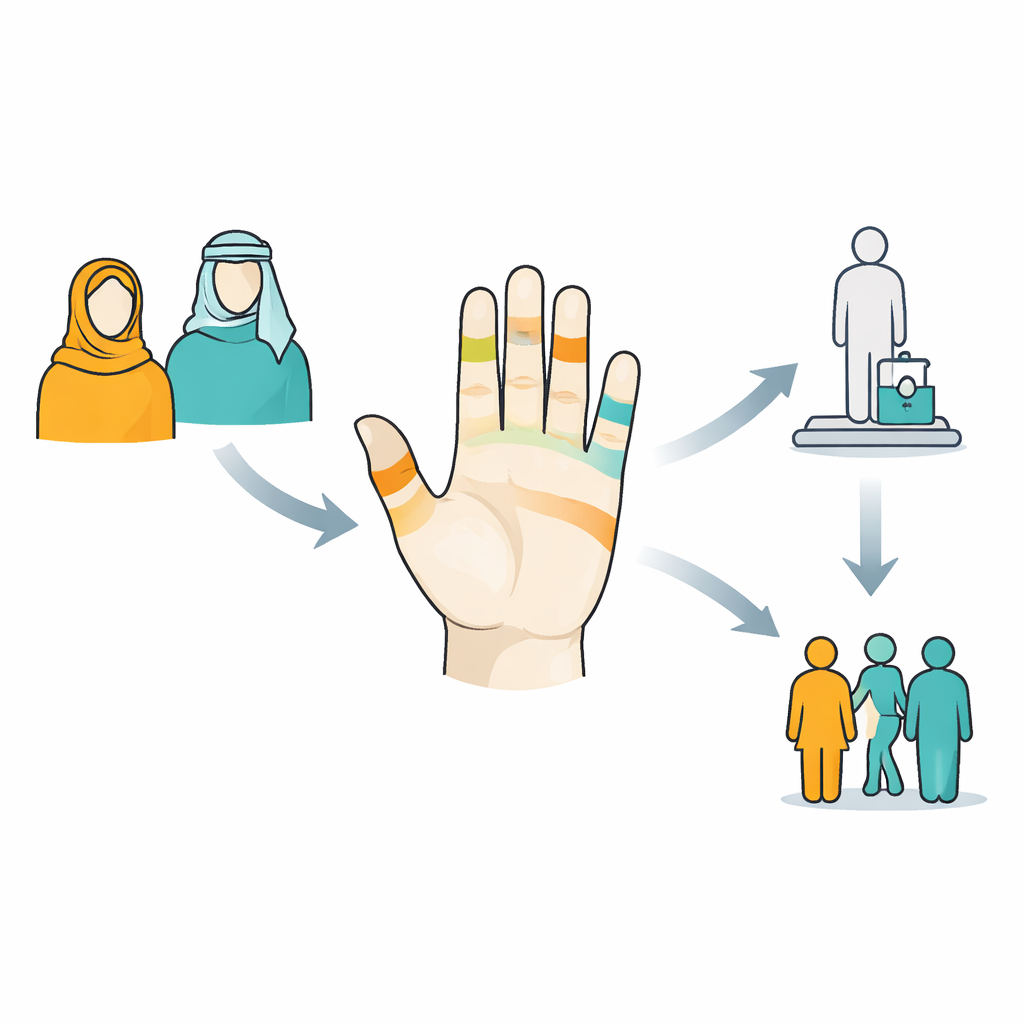
Finding Patterns That Link Fingers to Body Weight
With this catalog of hand measurements, the team used statistical models to see which features best tracked body weight within each of the four subgroups: Egyptian men, Egyptian women, Saudi men, and Saudi women. They found that larger hands and fingers generally went along with higher body weight, but the exact pattern differed by sex and nationality. For Egyptian men, hand width and the middle segment of the index finger were especially informative. Egyptian women’s weight was best reflected in the tip and base of the index finger and in parts of the middle finger. Among Saudi men, hand width and one segment of the index finger again stood out, while for Saudi women, the full lengths of the middle, ring, and little fingers were the strongest indicators. When several measurements were combined in a single equation, the estimates became much more accurate than when relying on any one dimension alone, especially for Saudi women, whose little finger measurements predicted weight with only a few kilograms of typical error.
Hands as Clues to Ancestry
The researchers also asked whether the same hand data could help distinguish Egyptians from Saudis. Using a technique that assesses how well a measurement separates two groups, they found that certain hand dimensions carried clear ethnic signals. In men, the length of the base segment of the index finger and hand width were the most telling, though the separation was only moderate. In women, differences were sharper: hand breadth, overall hand length, the base of the index finger, and the total length of the little finger all helped identify whether a participant was Egyptian or Saudi with reasonably good accuracy. These results fit with a growing body of work showing that hand shape varies among populations because of genetic background, environment, and lifestyle. 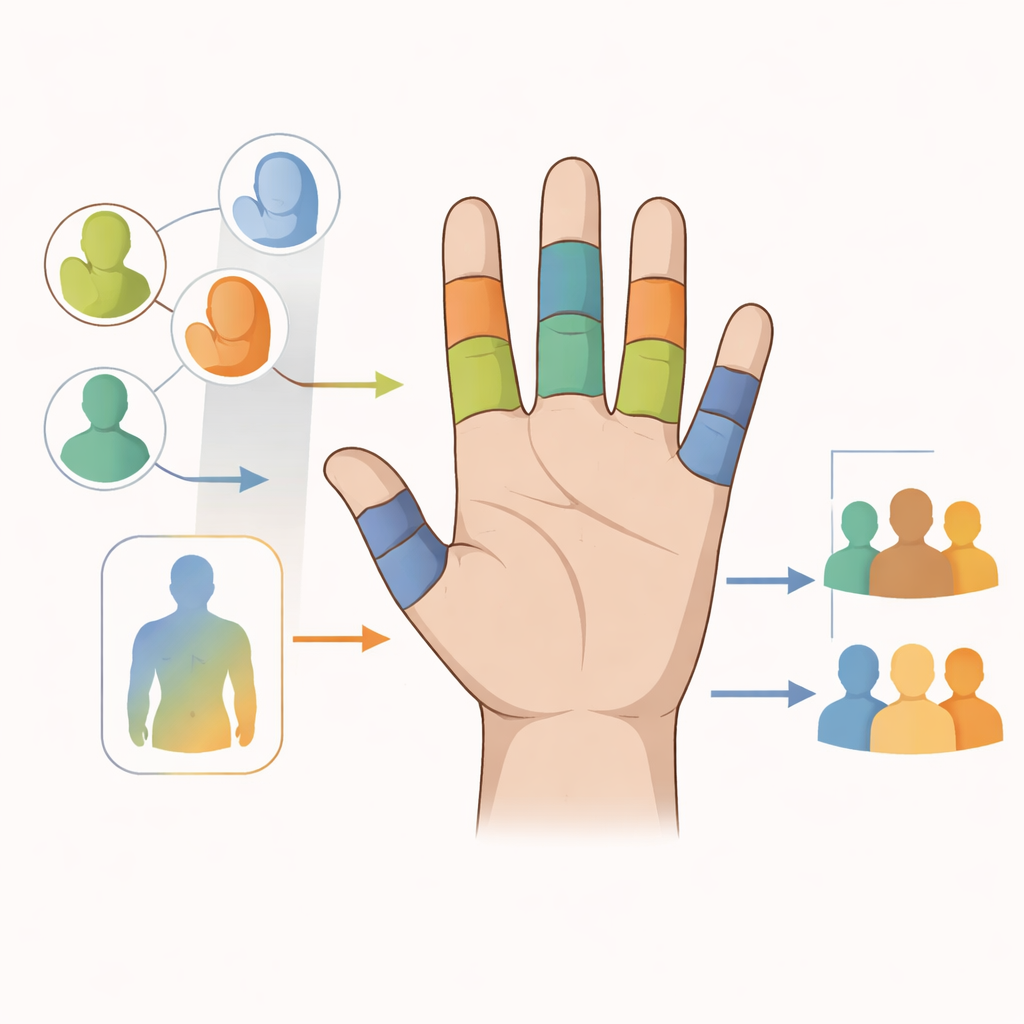
What This Means for Real-World Work
Beyond its curiosity value, this research offers practical tools. The authors provide regression formulas—essentially mathematical recipes—that forensic scientists and clinicians can use to estimate weight from hand and finger measurements in young Egyptian and Saudi adults. In legal investigations, such formulas may help identify bodies when records are scarce. In hospitals, they could support dosing decisions when a patient cannot be weighed. At the same time, the authors stress that these equations are population-specific and age-specific; they should not be applied uncritically to older adults, children, or people from very different backgrounds. Still, the broader message is clear: our hands quietly encode information about our build and origins, and with careful measurement, that information can be read.
Citation: Hussein, H.A.S.M., Mohamed, O.I. & Khedr, R.I. Prediction of body weight and ethnicity using anthropomorphic measurements of the hand in two different populations. Sci Rep 16, 11609 (2026). https://doi.org/10.1038/s41598-026-43161-z
Keywords: hand anthropometry, body weight estimation, forensic identification, Egyptian and Saudi populations, finger measurements