Clear Sky Science · en
Machine learning-based method for determining regional parameters of the HSS model: a case study of Qingdao, China
Why city excavations need smarter tools
When engineers dig deep pits for basements, subway stations, or underground garages in crowded cities, even a few millimeters of unexpected ground movement can crack nearby buildings or damage buried pipes. To keep people and infrastructure safe, engineers rely on computer models that predict how the soil will deform as they excavate. This paper shows how machine learning can sharply reduce the time and cost needed to tune one of the most advanced soil models for a coastal city in China, while still matching real‑world measurements with remarkable precision. 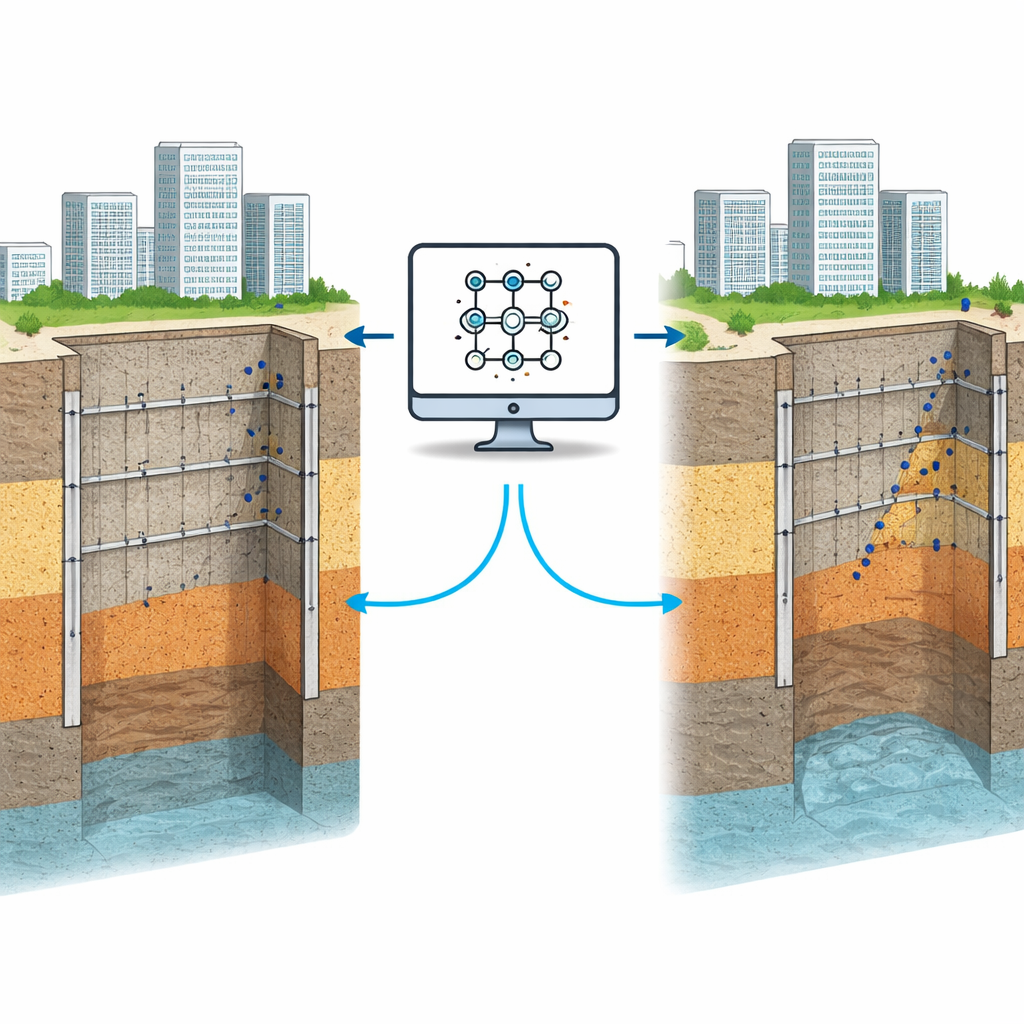
How engineers normally guess how the ground will move
Modern construction sites often use the finite element method, a numerical technique that divides the ground and supporting structures into many tiny elements and computes how each one deforms as loads change. To work well, this approach needs a realistic description of the soil’s behavior, especially for deep pits surrounded by high‑rise buildings and underground utilities. A widely respected option is the “hardening soil small‑strain” model, which captures how soil stiffness changes with stress history and with very small movements. However, this model requires many input parameters, and some of them vary strongly from place to place. Traditionally, these parameters are obtained from specialized laboratory tests on soil samples, which are both expensive and time‑consuming. As a result, the most accurate models are often underused in everyday projects.
Finding which soil numbers really matter
The authors first combed through published test data from several Chinese cities to understand which parameters of the advanced soil model truly control how a deep excavation deforms. They compared key stiffness values to a more familiar quantity, the compression modulus, and looked at these ratios for common soil types such as plain fill, silty clay, and medium‑fine sand. Two stiffness measures linked to routine compression behavior turned out to hover close to a one‑to‑one ratio with the compression modulus and showed low sensitivity to the pit’s movement. In contrast, two other stiffness measures – one tied to how soil springs back when loads are removed, and one related to its behavior at very tiny strains – varied widely between regions and had a strong influence on predicted displacements. This insight allowed the team to treat some parameters as nearly fixed while focusing their attention on the few that truly govern local deformation.
Teaching a neural network to read the pit’s behavior
Armed with this knowledge, the researchers used a deep foundation pit in Qingdao as a training ground. The site’s soils included plain fill, silty clay, and medium‑fine sand resting above weathered granite. They designed a systematic set of parameter combinations for the two sensitive stiffness values in each soil layer and ran a series of three‑dimensional computer simulations of the excavation. For each combination, they recorded how much the retaining walls bent and how the ground surface settled at selected monitoring points. These paired inputs and outputs formed a dataset for training a back‑propagation neural network, a simple machine learning model that learns to link causes to effects. After training, the network could take a few measured wall and ground movements from the real site and rapidly infer which soil stiffness parameters must have produced them. 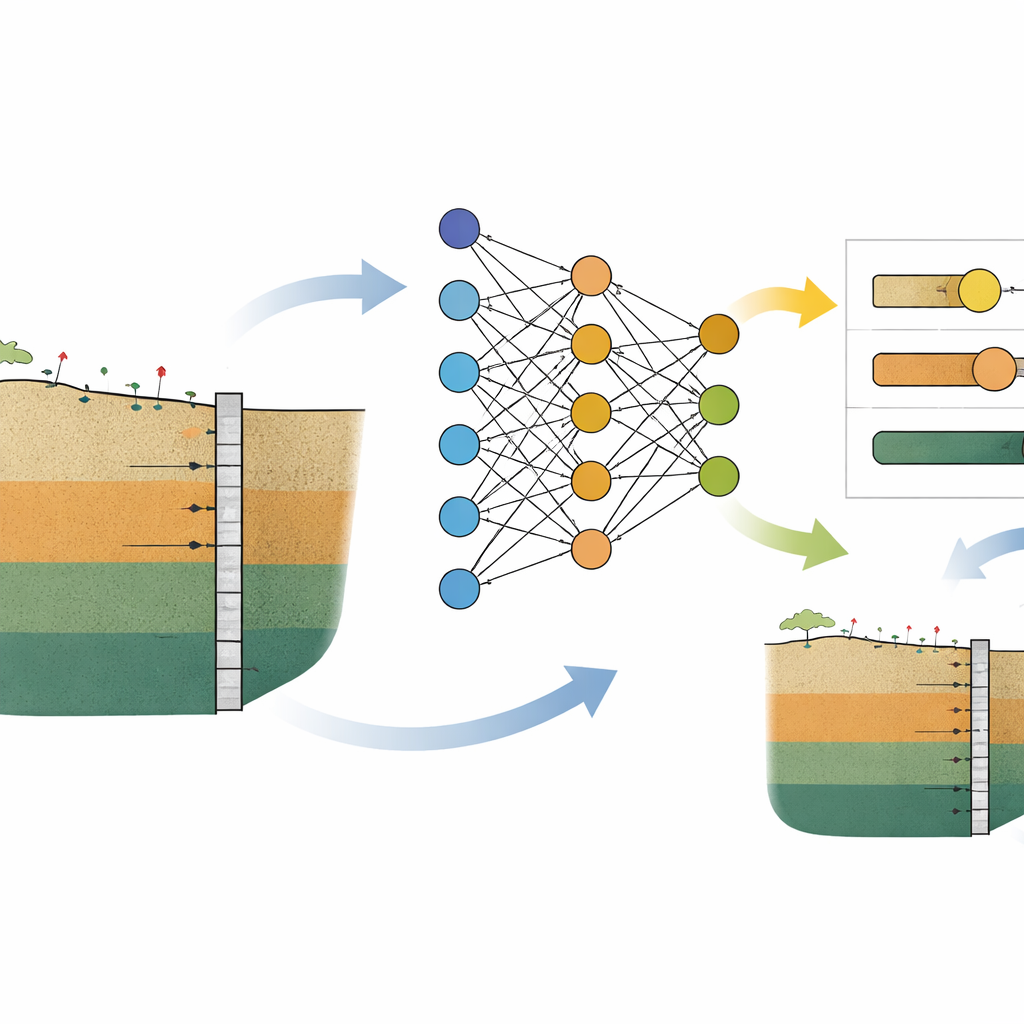
Checking the method on real construction projects
To see whether this virtual “soil detective” was trustworthy, the authors applied the inferred stiffness values to two independent deep excavation projects in Qingdao that used pile and anchor supports. They built numerical models with the newly obtained parameters and compared the predicted wall deflections and surface settlements to field monitoring data collected during construction. The differences were impressively small: typical mean absolute errors were below half a millimeter, and root mean square errors were similarly tiny. In other words, the simulations reproduced the observed behavior of the pits with a level of accuracy that is more than sufficient for engineering safety checks and design refinement.
What this means for safer and cheaper underground building
For non‑specialists, the key message is that the study shows how a modest amount of site monitoring, combined with carefully designed simulations and a neural network, can replace many rounds of costly laboratory testing. By isolating the few soil properties that matter most and letting machine learning tune them to match real‑world deformations, engineers can deploy more sophisticated ground models without prohibitive effort. For Qingdao’s typical soils, the authors even provide ready‑to‑use ratios between the sensitive stiffness parameters and standard compression measures, giving designers a practical shortcut. More broadly, the approach points toward a future in which underground construction is guided by data‑driven, locally calibrated models that improve safety margins while keeping project costs and timelines under control.
Citation: Yuan, C., Zhang, Q., Feng, H. et al. Machine learning-based method for determining regional parameters of the HSS model: a case study of Qingdao, China. Sci Rep 16, 13124 (2026). https://doi.org/10.1038/s41598-026-43150-2
Keywords: deep excavation, soil modelling, machine learning, neural networks, ground deformation