Clear Sky Science · en
Investigation of the propagation behavior of hydraulic fractures and its influencing mechanisms in fractured reservoirs based on a hydromechanical coupling numerical model
Why breaking rocks matters for energy
Modern oil and gas production increasingly relies on hydraulic fracturing—pumping fluid into deep rock to crack it open and let hydrocarbons flow. But real rocks underground are already crisscrossed with tiny natural cracks and layers, and engineers still struggle to predict how new, man‑made fractures will weave through this hidden maze. This study uses advanced computer simulations to show how artificial fractures grow, bend, and connect within naturally fractured reservoirs, and how adjusting field parameters can either create a rich web of cracks that drains more rock or a few long, simple fractures.
Building a digital rock under pressure
The researchers constructed a detailed numerical model that couples how rock deforms with how fluid flows through it. In their virtual reservoir, the rock is represented as two interacting parts: a solid matrix and a network of pre‑existing fractures that are mechanically weaker and more permeable. The model incorporates how stress builds up, how cracks initiate and extend when the rock’s strength is exceeded, and how fluid pressure feeds this growth. They implemented the model using finite element methods together with a discrete description of fractures, and verified it against laboratory experiments on sandstone blocks, showing that simulated fracture paths and pressure changes closely match real tests.
Watching fractures find their way
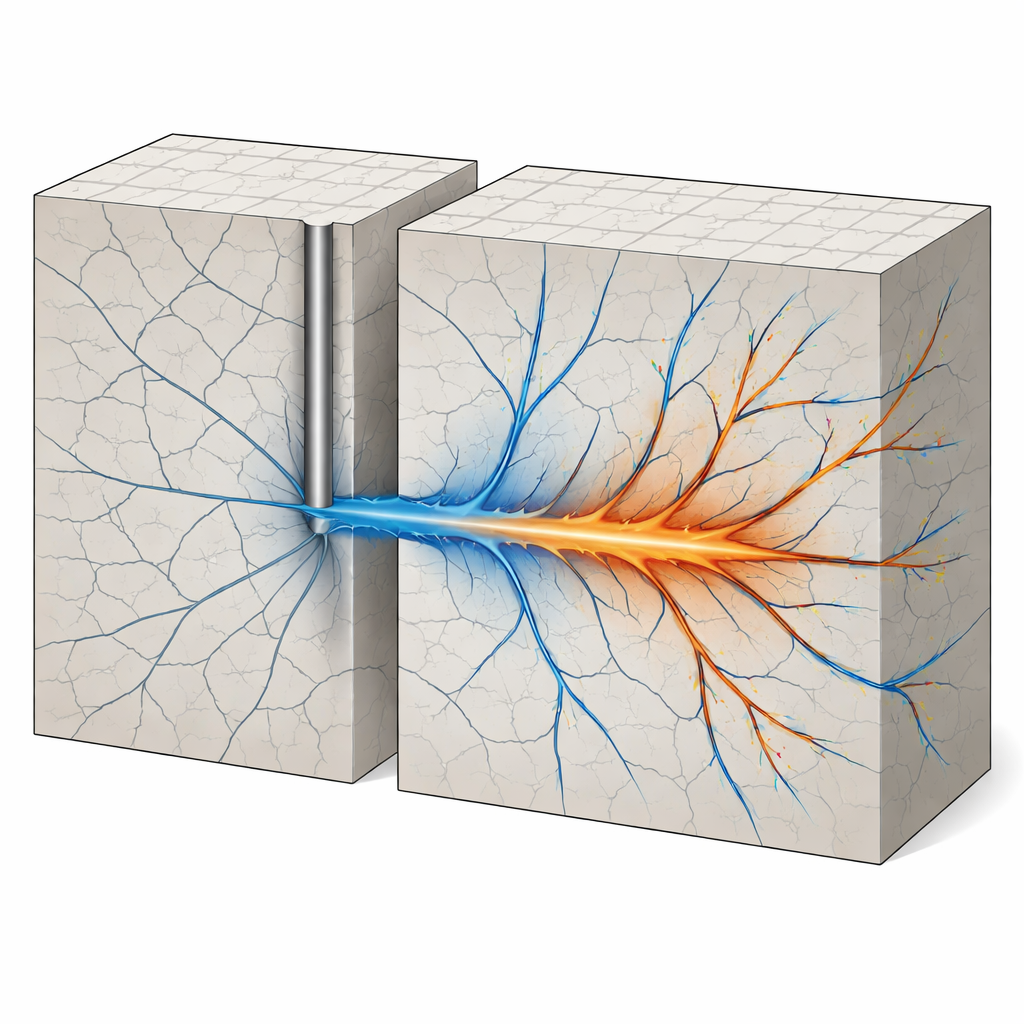
With the model in place, the team explored how a hydraulic fracture spreads in a square block of rock seeded with many natural fractures at different angles. In the simulations, fluid is injected through a central well and the new fracture initially grows along the direction of the greatest underground squeezing. As it approaches natural fractures, its path becomes more complex: the fluid can be diverted into those pre‑existing cracks, briefly changing direction before the overall growth re‑aligns with the dominant stress. This process connects once‑isolated cracks into a larger fracture network, effectively increasing the volume of rock that can be drained.
How rock strength and underground stress steer cracks
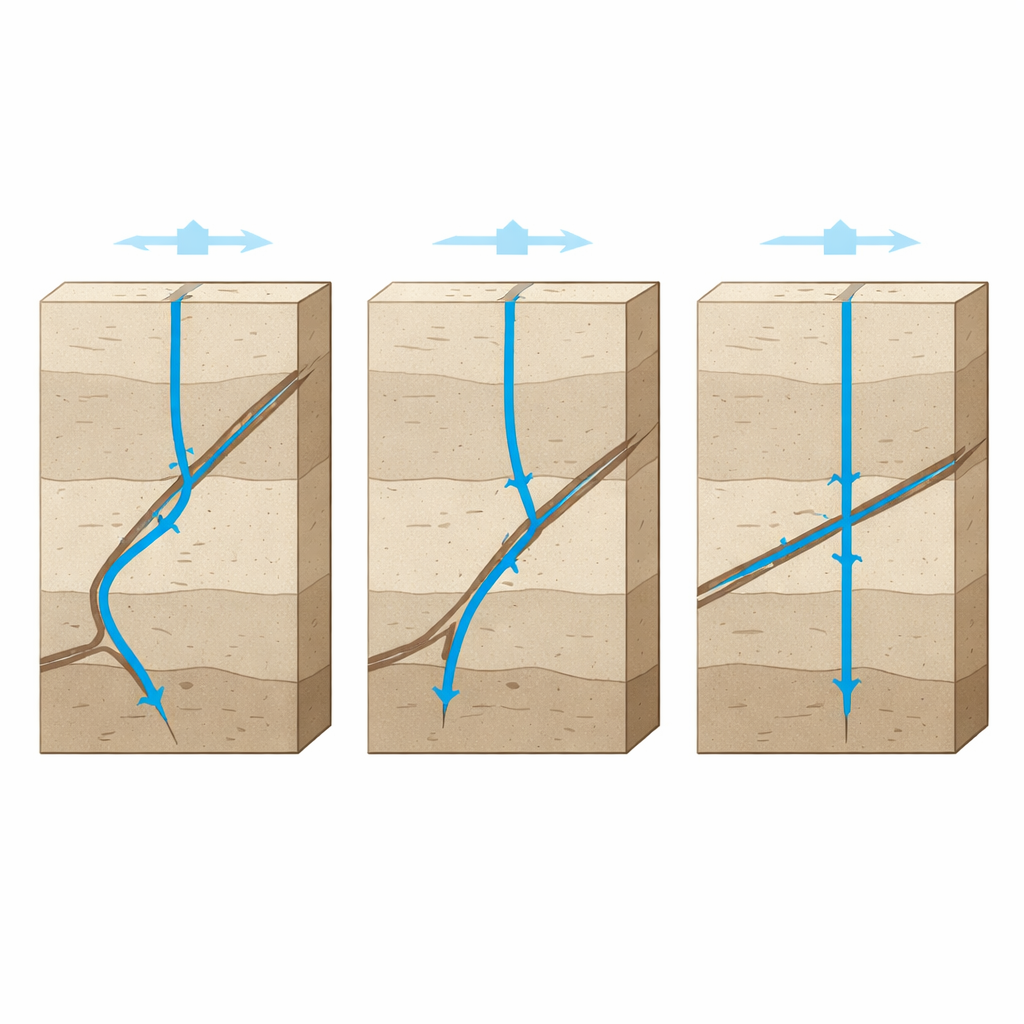
The model shows that the contrast in stiffness between the intact rock and its natural fractures strongly controls fracture patterns. When the surrounding rock is much stiffer than the natural fractures, the new hydraulic fracture prefers to turn and run along these weaker planes, activating more of the existing network and creating a more intricate web of cracks. In contrast, the state of in‑situ stress tends to straighten things out. As the difference between the largest and smallest horizontal stresses grows, the hydraulic fracture is more likely to cut straight across natural fractures rather than be diverted by them, producing a simpler, longer, and more continuous main fracture. At the same time, a larger stress difference lowers the pressure needed to break the rock and speeds up the onset of fracturing.
What the injected fluid brings to the table
The properties of the injected fluid itself further tilt the balance between complexity and simplicity. Thicker (more viscous) fluids carry more energy and can transport more solid particles that hold cracks open, helping the main fracture punch through natural fractures instead of turning along them. Likewise, higher injection rates push fluid harder into the rock, favoring straighter, longer fractures that bypass much of the natural fracture network. Lower viscosities and gentler injection rates, by contrast, allow the fluid to leak more readily into existing cracks, promoting branching and a denser fracture network that touches more of the reservoir.
Designing better ways to tap the rock
For a general reader, the key message is that underground rock does not break in a simple straight line, and that engineers can deliberately nudge the fracture pattern toward either a fine, web‑like network or a few long cracks by tuning rock‑independent parameters. This study’s simulations suggest that when a reservoir already has abundant natural fractures, using moderately low fluid viscosity and modest injection rates encourages the man‑made fracture to connect those natural cracks, enlarging the effectively drained rock volume. Conversely, high stress contrasts, thicker fluids, and aggressive pumping tend to carve clean, straight fractures but leave more of the natural network untouched. These insights offer a physics‑based guide for tailoring fracturing jobs to get more energy out of the same rock while potentially reducing wasted effort and cost.
Citation: Liu, Y., Gong, X. & Ma, X. Investigation of the propagation behavior of hydraulic fractures and its influencing mechanisms in fractured reservoirs based on a hydromechanical coupling numerical model. Sci Rep 16, 11984 (2026). https://doi.org/10.1038/s41598-026-43148-w
Keywords: hydraulic fracturing, natural fractures, fractured reservoirs, numerical simulation, fracturing design optimization