Clear Sky Science · en
A TCN-Attention fusion model for fault prediction and remaining useful life estimation of large-scale mining equipment
Why smart care for mining machines matters
Modern mines run on fleets of giant trucks and excavators that work almost nonstop in punishing conditions. When one of these machines fails without warning, production can grind to a halt and workers may be put at risk. This article presents a new way to use streams of sensor data and advanced artificial intelligence to spot problems early and estimate how much useful life a machine has left, turning surprise breakdowns into predictable, manageable events.
From fixing after failure to planning ahead
For decades, heavy equipment was often repaired only after something went wrong, or according to fixed schedules that did not fully reflect real wear and tear. As mines have become more instrumented, engineers now collect huge amounts of vibration, temperature, pressure, and operating data from critical parts like gearboxes and hydraulic pumps. Traditional models and simpler machine learning methods can use some of this information, but they struggle with the complex, shifting behavior of real machines in harsh environments. The authors argue that a more flexible approach is needed—one that can learn patterns of slow degradation over months and still react to sudden changes.
A layered data nerve system for big machines
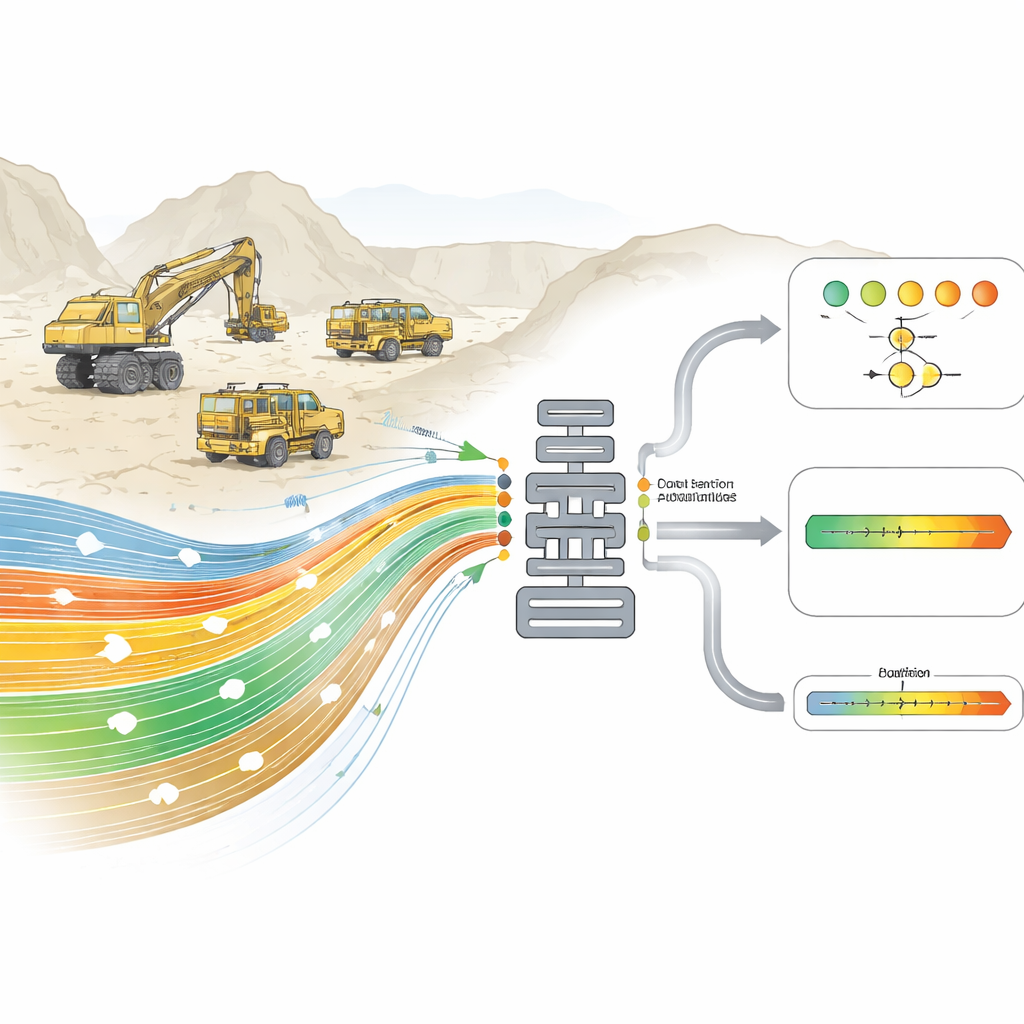
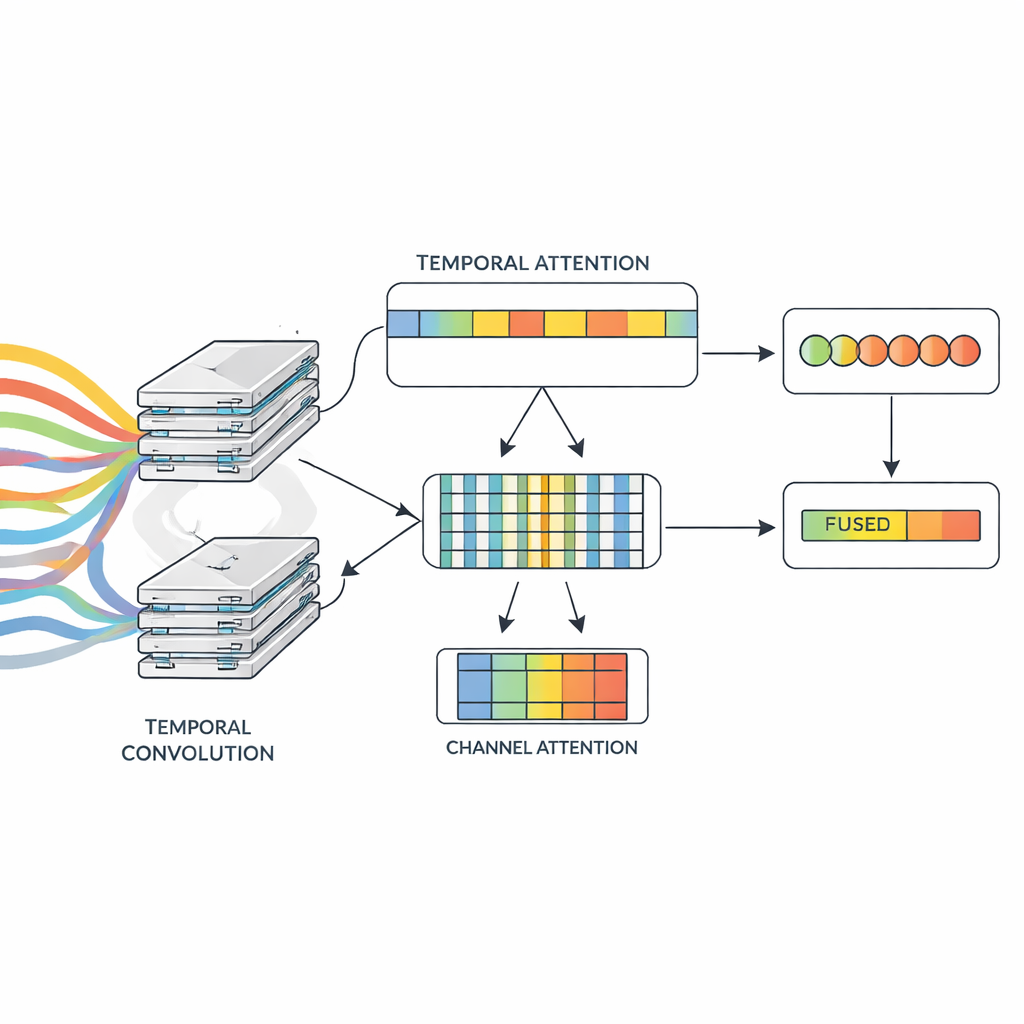
The core of the study is a deep learning model that acts like a nervous system for mining equipment. It takes in multichannel time series data—dozens of sensor readings tracked over time—and passes them through a temporal convolutional network. This network looks at many past time steps at once, using carefully spaced filters that can capture both quick jolts and long-term trends without having to process the data one moment at a time. On top of this backbone, the authors add a dual attention module with two branches: one that learns which moments in a machine’s history matter most, and another that highlights which sensors are especially informative. In everyday terms, the model learns to “replay” and “zoom in on” the most telling episodes and measurements when judging the machine’s health.
Predicting both health state and remaining life
Rather than building separate tools, the researchers design the system to answer two questions at once: What condition is the equipment in right now, and how long can it keep running before it is likely to fail? One output branch classifies the current health into four levels, ranging from normal operation to imminent failure. The other branch estimates the remaining useful life in hours. The two tasks share most of the internal representation, and the training procedure automatically adjusts how much emphasis to place on each objective based on the uncertainty of its errors. This shared learning lets the model use clues from one task to improve the other—for example, recognizing that signals typical of serious degradation should coincide with a short remaining life.
Testing on real trucks and excavators
To see how well the method works, the team applies it to a rich dataset from an open-pit copper mine in China. Over 18 months, they monitored 12 large haul trucks and excavators with up to 21 sensors each, capturing more than 800 recorded faults and complete run-to-failure histories. After careful cleaning, balancing of rare fault cases, and feature extraction, they compared their model to a range of alternatives, including classic techniques and recent deep learning approaches such as LSTM networks, transformers, and other temporal convolution systems. The new model achieved the highest fault prediction accuracy (about 92 percent) and the lowest error in remaining life estimates, explaining over 90 percent of the variation in true lifetimes. It also held up well when the authors simulated missing sensors and noisy measurements, degrading more gracefully than competing methods.
What this means for mines and beyond
In practical terms, the study shows that combining temporal convolutions with attention across time and sensors can turn raw monitoring data into reliable early warnings and time-to-failure estimates for very large machines. For mine operators, this can translate into fewer unexpected stoppages, better planning of maintenance windows, more efficient spare parts management, and improved safety. More broadly, the work suggests a template for predictive maintenance in any industry where complex equipment generates streams of sensor data—from wind turbines to factory robots—offering a path toward smarter, more resilient infrastructure.
Citation: Mao, J., Xu, W., Li, D. et al. A TCN-Attention fusion model for fault prediction and remaining useful life estimation of large-scale mining equipment. Sci Rep 16, 13746 (2026). https://doi.org/10.1038/s41598-026-43145-z
Keywords: predictive maintenance, mining equipment, remaining useful life, deep learning, sensor data