Clear Sky Science · en
Chemical profiling and enhanced antifungal activity of the origanum hybrid (Origanum majorana × O. syriacum var. bevanii) essential oil against Sclerotinia sclerotiorum
Natural Plant Oils as Crop Bodyguards
Farmers worldwide battle fungi that rot stems and ruin harvests, often relying on synthetic fungicides that can harm the environment and lose effectiveness over time. This study explores whether natural essential oils distilled from oregano-like herbs could offer a cleaner way to shield tomatoes from a destructive fungus called white mould, and shows how careful plant breeding can make these natural defenses much stronger.
A Common Herb with Hidden Power
The plants at the heart of this work belong to the familiar oregano and marjoram clan, long used in Turkey not only as kitchen spices but also as folk remedies. Their fragrance comes from essential oils packed with small aromatic molecules. Two of these, called carvacrol and thymol, are already known to punch holes in the outer layers of microbes, causing them to leak and die. Because these oils are biodegradable and already intertwined with food and medicine, scientists are keen to see whether they can double as crop protectants in sustainable agriculture.
Breeding a Stronger Oil
Instead of simply testing existing plants, the researchers worked with two parent species—sweet marjoram (O. majorana, labeled Oma) and Syrian oregano (O. syriacum var. bevanii, Osyr)—and a new hybrid line created from them, called M4. They distilled essential oils from dried leaves of each parent, from the hybrid, and from a simple 1:1 mixture of the two parental oils. Using a technique that separates and weighs the different molecules in the oil vapors, they compared the chemical “fingerprints.” Marjoram oil was dominated by gentler alcohol- and terpene-type compounds, while Syrian oregano oil was rich in the sharper phenolic molecules carvacrol and thymol. The hybrid’s oil shifted dramatically toward an even higher level of carvacrol than either parent, suggesting that the cross had reshuffled the plant’s chemistry rather than producing a mere halfway blend. 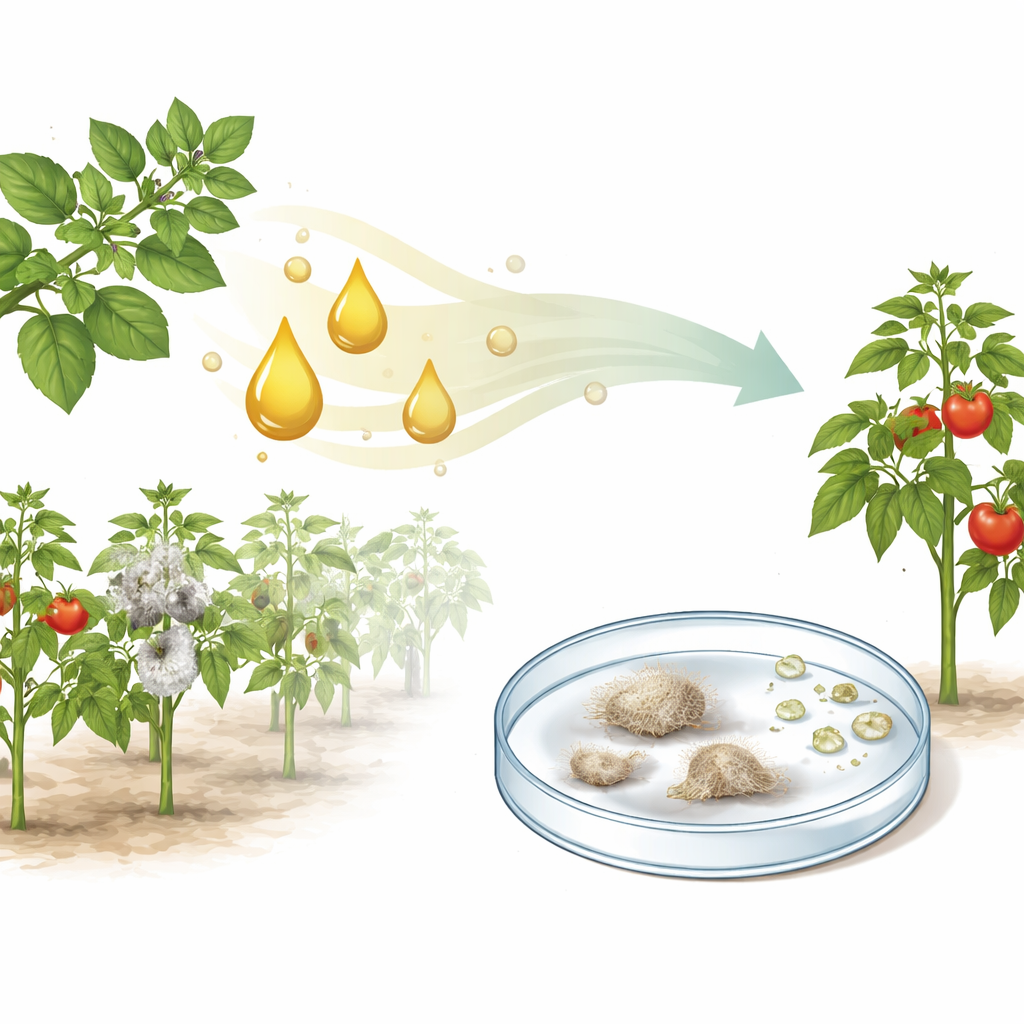
Putting the Fungus to the Test
To see how these oils performed against disease, the team turned to Sclerotinia sclerotiorum, the fungus that causes white mould in tomatoes and many other crops. In laboratory dishes, they placed a small plug of actively growing fungus on nutrient gel, then exposed it to increasing amounts of each oil in the vapor phase—essentially surrounding the fungus with the oils’ fumes. They measured how far the fuzzy fungal colony could grow and calculated the percentage of growth blocked by each dose. All oils had some effect, but they differed dramatically in potency. The hybrid M4 oil completely stopped fungal growth at a tiny dose, while Syrian oregano oil and the parental oil mixture needed roughly double that amount. Marjoram oil lagged far behind, requiring more than ten times the hybrid dose to fully halt growth.
Why the Hybrid Wins
The results lined up neatly with chemistry. Oils richer in carvacrol and thymol were far more lethal to the fungus, supporting earlier work showing that these phenolic molecules wedge into fungal cell membranes, destabilize them, and cause the cell contents to spill out. Statistical analyses confirmed that concentration of oil was the dominant factor controlling fungal growth, and that the M4 hybrid’s oil gave the steepest and strongest response. Interestingly, the simple physical blend of the two parental oils was less effective than the oil from the bred hybrid plant, even though it contained the same basic components. This indicates that genetic hybridization can fine-tune the proportions and interactions of many minor molecules in ways that mixing finished oils cannot easily reproduce. 
From Lab Bench to Farm Field
For growers and consumers, the most promising message is that a carefully bred oregano hybrid can yield an essential oil powerful enough to rival synthetic fungicides against a serious tomato disease, yet arises from a culinary herb. At the same time, the authors stress that moving from petri dishes to farm fields is not straightforward. Essential oils evaporate quickly and do not dissolve well in water, so they must be formulated into stable sprays or tiny capsules that release the active ingredients slowly and safely on crops. The study outlines next steps such as using plant-based emulsifiers and biodegradable capsules to carry the oil, and testing these preparations on real plants for both disease control and any side effects. In essence, the work shows that by combining plant breeding with smart formulation, natural oregano oils could become practical, environmentally friendly tools for keeping crops healthy.
Citation: Soylu, S., Oğuz, M., Soylu, E.M. et al. Chemical profiling and enhanced antifungal activity of the origanum hybrid (Origanum majorana × O. syriacum var. bevanii) essential oil against Sclerotinia sclerotiorum. Sci Rep 16, 13069 (2026). https://doi.org/10.1038/s41598-026-43142-2
Keywords: oregano essential oil, biological fungicide, white mould, carvacrol thymol, sustainable crop protection