Clear Sky Science · en
Frequency-constrained robust unit commitment via physics-guided piecewise-linear nadir surrogates and adaptive virtual inertia
Why keeping the lights on is getting harder
As power systems around the world add more wind and solar farms, they quietly lose a property that used to come for free: the stabilizing “weight” of big spinning generators. When something goes wrong on the grid, this loss of physical inertia can make the system’s frequency plunge faster and deeper, raising the risk of blackouts. This paper shows how grid operators can plan day-ahead which plants, batteries, and renewables to use so that electricity stays both affordable and frequency‑stable, even when bad luck strikes.
From slow machines to fast electronics
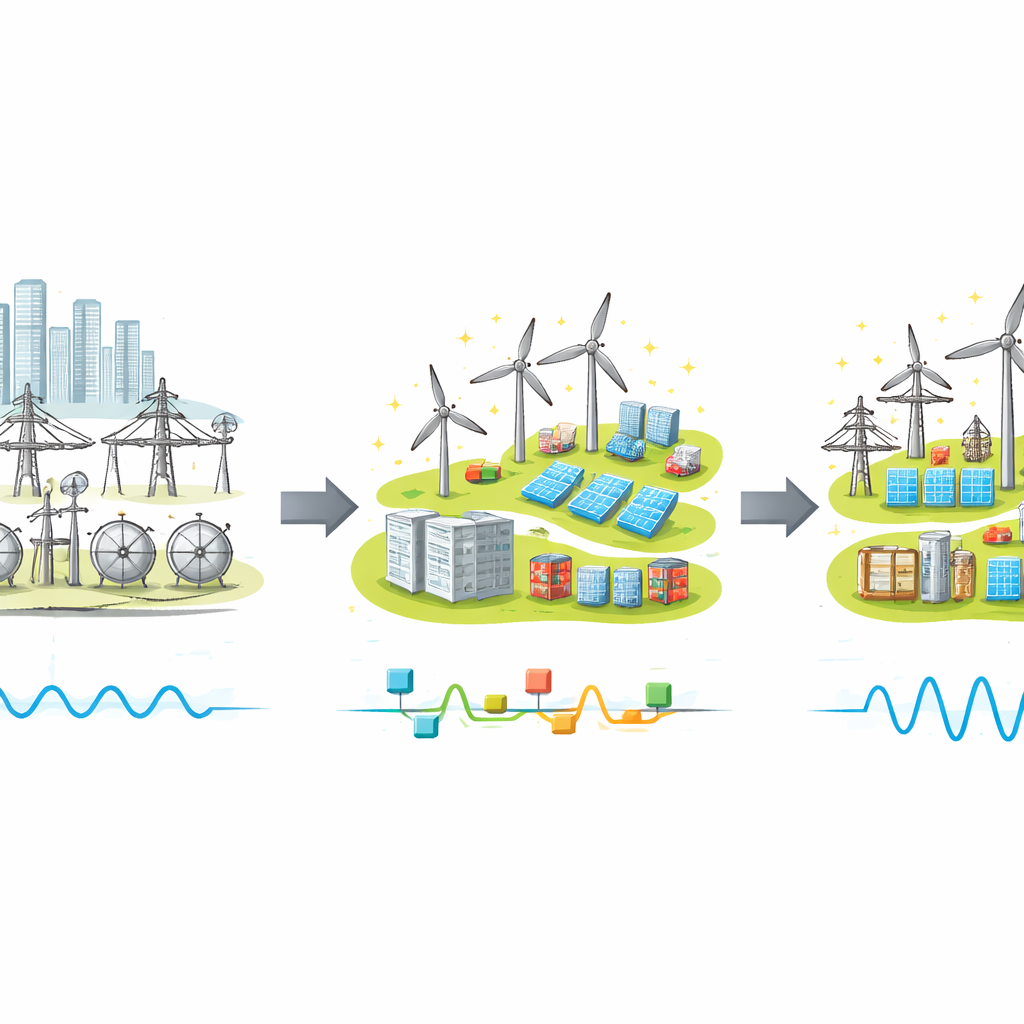
Traditional power grids rely on large steam and gas turbines whose heavy rotating parts naturally resist sudden changes in speed, and therefore in electrical frequency. Inverter-based resources like wind turbines, solar panels, and battery systems connect through power electronics instead of spinning shafts. They can ramp up and down extremely quickly, but they do not automatically provide inertia. As the share of these inverter-based generators grows, the grid becomes more sensitive to shocks such as a major plant or line outage. The authors focus on three critical indicators: how quickly frequency initially drops, how low it falls at its worst point (the “nadir”), and what level it settles at after control actions have kicked in.
Planning ahead for the worst hour
Electricity markets typically schedule which generators run every hour using a process called unit commitment. Classic versions mainly ensure that total power supply matches forecasted demand at least cost. They do not explicitly check whether the schedule can survive large disturbances without breaking frequency limits, especially under uncertainty in wind, solar, and demand, or when several components fail at once. This work reformulates the scheduling problem so the chosen plan must remain secure for the worst credible combination of forecast errors and outages. The model considers that, in any hour, multiple lines, generators, or renewables might go down, but limits how many can fail at once to keep the problem realistic.
Teaching the computer a safe shortcut
Accurately simulating how frequency behaves after a disturbance requires solving complex nonlinear equations at millisecond time steps, which is too slow to embed directly into a day‑ahead planning tool. Instead of relying on crude simplifications or black‑box machine‑learning schemes, the authors design a “physics‑guided” surrogate model that provides a conservative estimate of how large a power shock the system can withstand without violating the nadir limit. They approximate this limit with a set of simple straight‑line pieces that depend on key physical features such as total inertia, natural damping, conventional frequency reserves, and the fast headroom available from wind, solar, and storage. These pieces are constrained to behave monotonically in physically meaningful ways and are tuned with Bayesian optimization so that the approximation is always on the safe side.
Making virtual inertia real
Fast support from renewables and batteries is only useful if there is actual power headroom to inject when trouble hits. The framework therefore ties any promised “virtual inertia” or fast frequency response to concrete limits: how much wind and solar power has been deliberately held back, how quickly power converters can ramp, and how much energy is stored in batteries. In effect, the model co‑optimizes energy production, reserves, and synthetic inertia so that frequency‑support promises made on paper can be delivered in reality. A specialized solution method iteratively searches for the most damaging disturbance scenarios and adds just enough new constraints to keep the problem tractable for large networks.
Cheaper, cleaner, and still stable
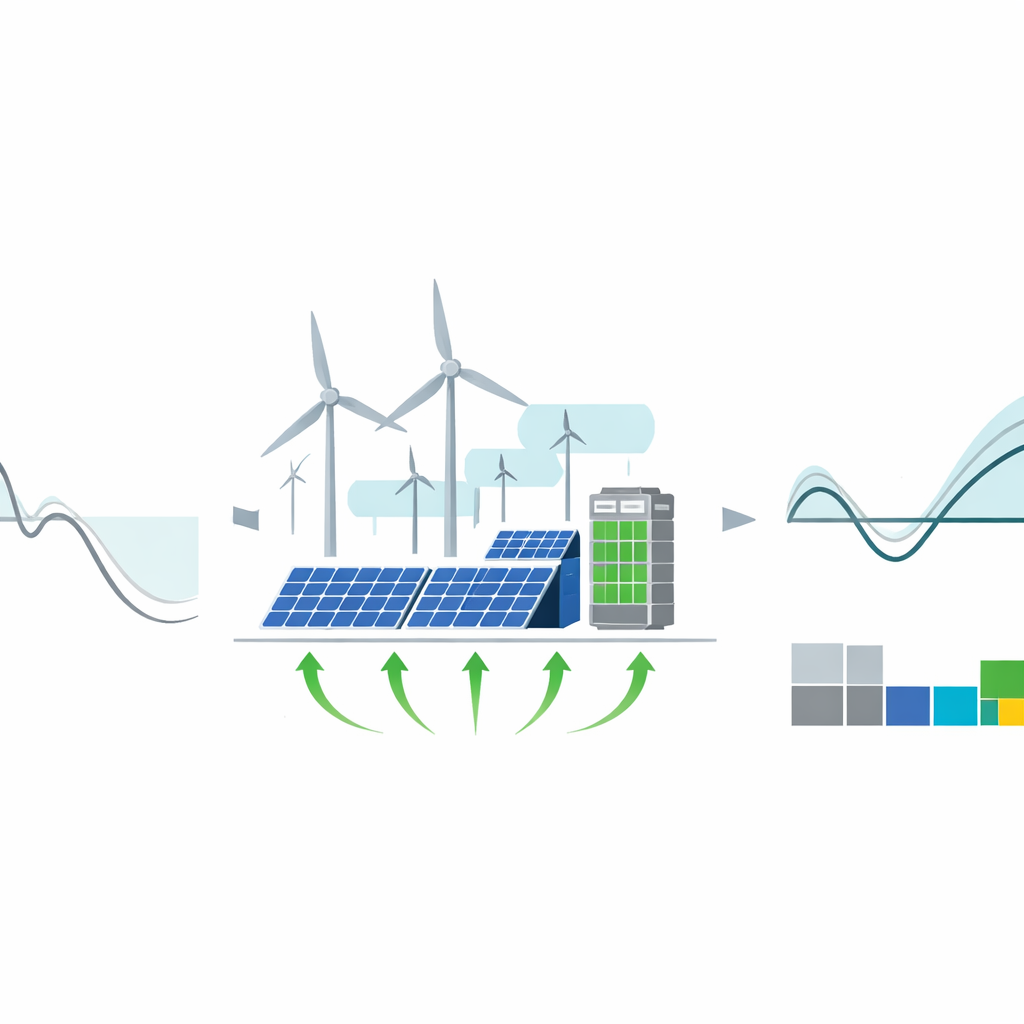
Using standard test grids, including a 118‑bus network with high renewable penetration, the authors show that their method keeps all frequency limits within bounds while cutting operating costs by roughly a quarter compared with a conservative analytical baseline. The scheduler can safely rely more on wind, solar, and batteries, and avoid running extra conventional units solely “just in case.” By blending a physics‑aware surrogate for frequency behavior with rigorous worst‑case planning, the study demonstrates a practical path to grids that are both low‑carbon and robust, where the invisible heartbeat of the system—its frequency—remains steady even as the underlying technology changes.
Citation: Fard, S.H.B., Shakarami, M.R. & Doostizadeh, M. Frequency-constrained robust unit commitment via physics-guided piecewise-linear nadir surrogates and adaptive virtual inertia. Sci Rep 16, 14305 (2026). https://doi.org/10.1038/s41598-026-43137-z
Keywords: power system frequency, renewable integration, virtual inertia, unit commitment, grid stability