Clear Sky Science · en
Mechanical response analysis of tunnels crossing reverse faults under non-uniform seismic inputs
Why underground routes matter in earthquakes
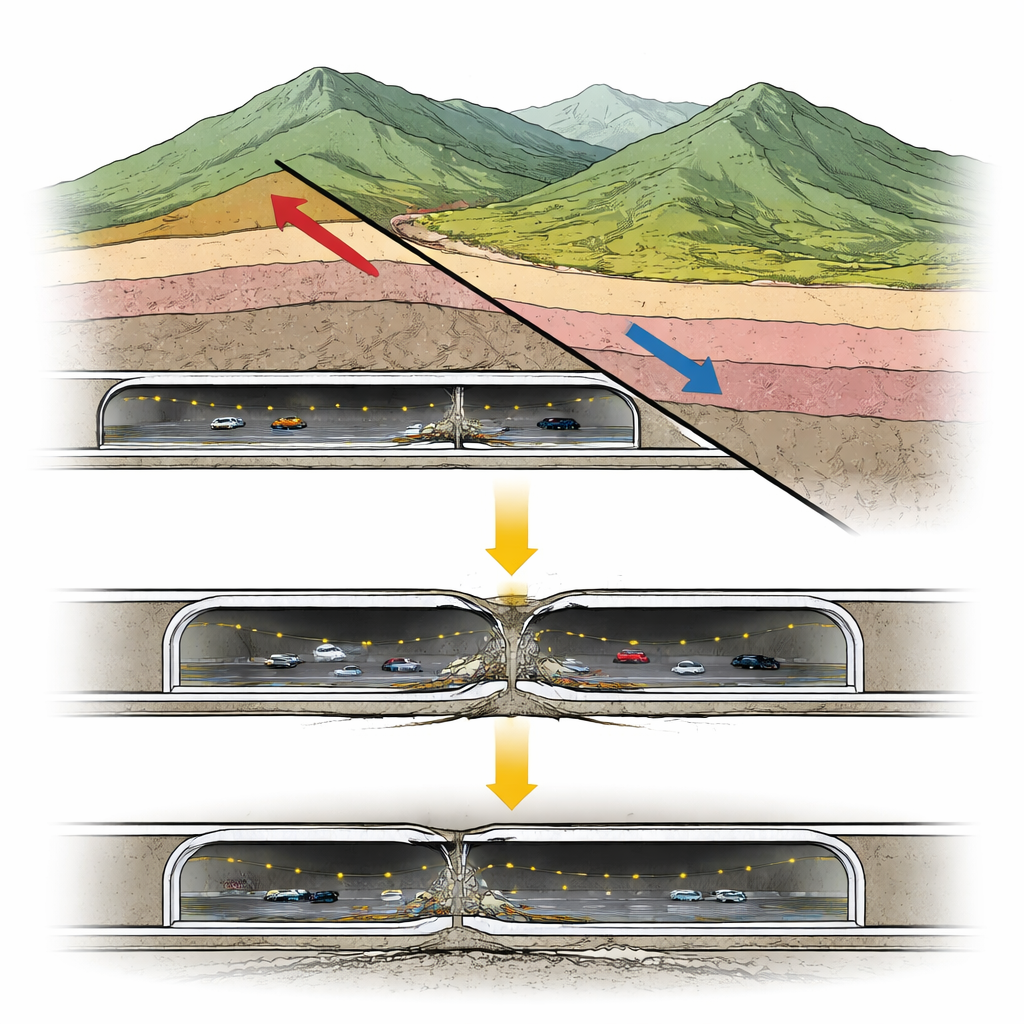
As cities and countries build longer tunnels through mountains to carry highways and rail lines, more of these buried routes must cross active earthquake faults. When the ground slips during a quake, the rock around a tunnel can shift unevenly, crushing or tearing the concrete shell that keeps the passage open. This study looks at how such cross-fault tunnels behave when a reverse fault moves during an earthquake, and what design choices can make these structures safer for the people who depend on them.
A real mountain tunnel as a testbed
The research is rooted in a major project in China’s Tianshan Mountains: the Tianshan Shengli Tunnel, a twin highway tunnel more than 22 kilometers long that cuts through several active faults in a region with strong shaking and high in‑situ rock stresses. Past earthquakes in China and Japan have shown that tunnels crossing faults can suffer vault collapses, floor heaving, wide cracks, and broken pavement when the fault slips. To understand and prevent such failures, the authors built a detailed three‑dimensional computer model that includes intact rock, the weaker fault zone, and the concrete lining, all arranged to match one of the key faults intersecting this tunnel alignment.
Shaking the ground unevenly
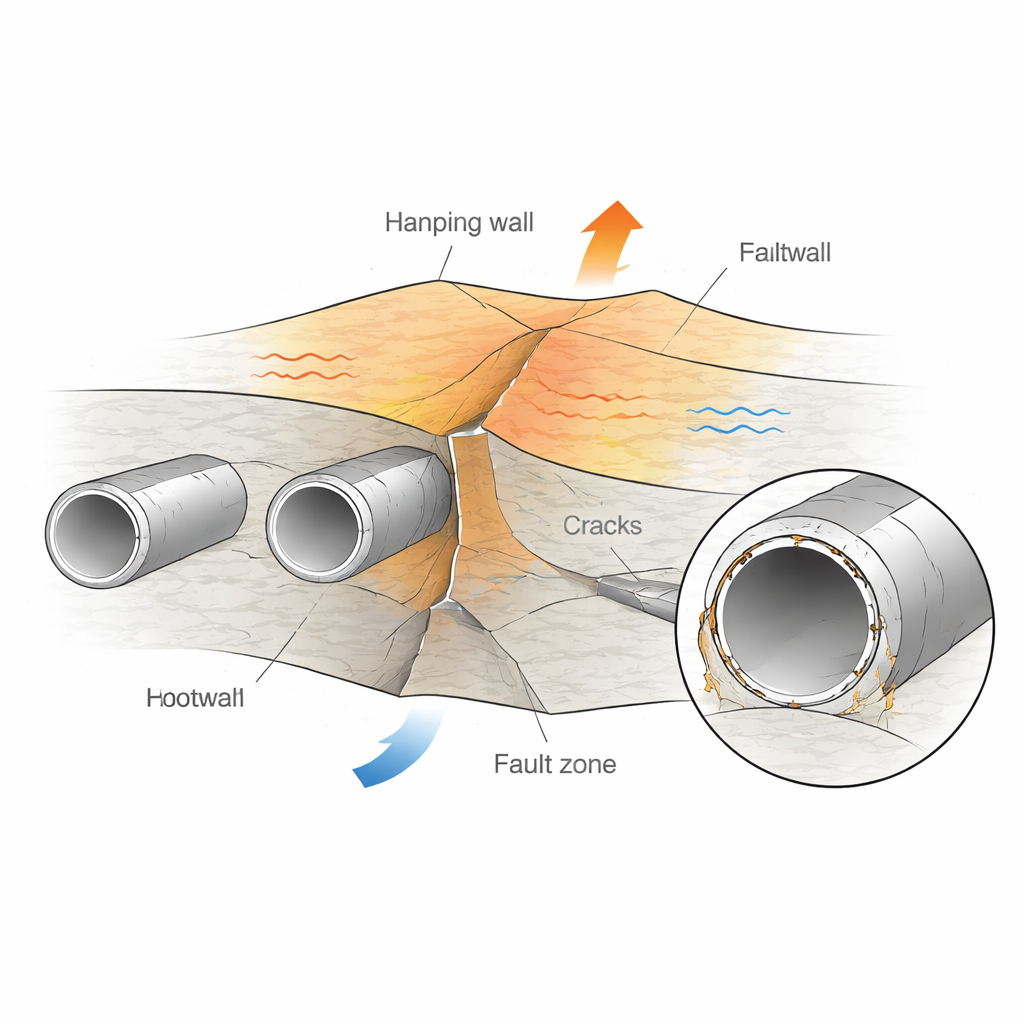
Most previous studies assumed that an earthquake shakes the ground beneath a tunnel in the same way everywhere. In reality, the side of a fault that moves upward (the hanging wall) can experience different motions and permanent shifts than the lower side (the footwall). Here, the researchers created a pair of synthetic seismic waves based on records from a large California earthquake. One wave included a permanent offset to mimic the ground being dragged along by the fault, while the other did not. They applied the motion with permanent displacement to the hanging wall and the simpler motion to the footwall, allowing the model to capture how differing inputs on either side of the fault combine with the slow but large slip of the fault plane itself.
Where and how the tunnel gets hurt
The simulations show that damage concentrates in and near the fault core—the narrow, most broken part of the fault zone—and particularly in the haunches, the curved shoulders where the tunnel wall transitions into the roof. As fault slip grows, a measure of damage in the concrete lining rapidly approaches the level associated with wide, through‑going cracks and even crushing. These high‑damage zones spread outward from the fault core into the surrounding rock, and they are consistently worse on the hanging‑wall side, which is squeezed and sheared more strongly in a reverse fault. Strain patterns reveal that the tunnel cross‑section is stretched and squeezed around its perimeter, especially at the haunches, while lengthwise deformation along the tunnel’s axis stays relatively modest under typical conditions.
Role of fault width and fault angle
The team also explored how the thickness of the fault zone and the angle of the fault plane affect damage. A wider fault zone, represented by a higher relative stiffness ratio between the fault rock and the surrounding rock, spreads deformation more gently and improves how well the rock mass and lining move together. This reduces peak damage in the tunnel by as much as about 45 percent, even though the lining inside the fault core still suffers serious cracking. Changing the fault’s dip angle produces a threshold effect: when the fault is moderately inclined (up to about 60 degrees), overall damage patterns change little. At steeper angles, however, damage in the fault core itself lessens while damage at the interface between the fault and the hanging wall grows, and axial strains—those that stretch or compress the tunnel along its length—rise in several key parts of the cross‑section.
Design lessons for safer tunnels
For engineers, the study’s main message is that the amount of fault slip is the dominant driver of tunnel damage, more so than fault width or dip angle. The haunch regions emerge as the most vulnerable and therefore the most important targets for reinforcement. The authors suggest measures such as pre‑strengthening the rock ahead of excavation with small pipes and deep grouting, and locally thickening the lining and adding more steel in the haunches where stress concentrates. Although the model simplifies some construction details, its results—checked against real damage from a recent Chinese tunnel struck by fault movement—offer practical guidance for designing cross‑fault tunnels that can better survive future earthquakes and keep critical transport links open when they are needed most.
Citation: Yang, Y., Li, X., Liu, J. et al. Mechanical response analysis of tunnels crossing reverse faults under non-uniform seismic inputs. Sci Rep 16, 13348 (2026). https://doi.org/10.1038/s41598-026-43120-8
Keywords: tunnel earthquake damage, reverse fault tunneling, seismic tunnel design, fault-crossing infrastructure, underground seismic response