Clear Sky Science · en
Numerical optimization of natural hybrid fiber reinforced composite overwrapped pressure vessel
Why lighter, safer tanks matter
From hydrogen cars to high‑pressure gas cylinders in hospitals and factories, modern life depends on containers that can safely hold fluids under extreme pressure without weighing too much. Replacing thick steel walls with strong, fiber‑wrapped shells can slash weight, but engineers must be sure these new designs will not burst unexpectedly. This study explores how to design such lightweight pressure tanks using a mix of aluminum and natural plant fibers, aiming to keep people and equipment safe while also reducing environmental impact.
Building a strong shell with plant fibers
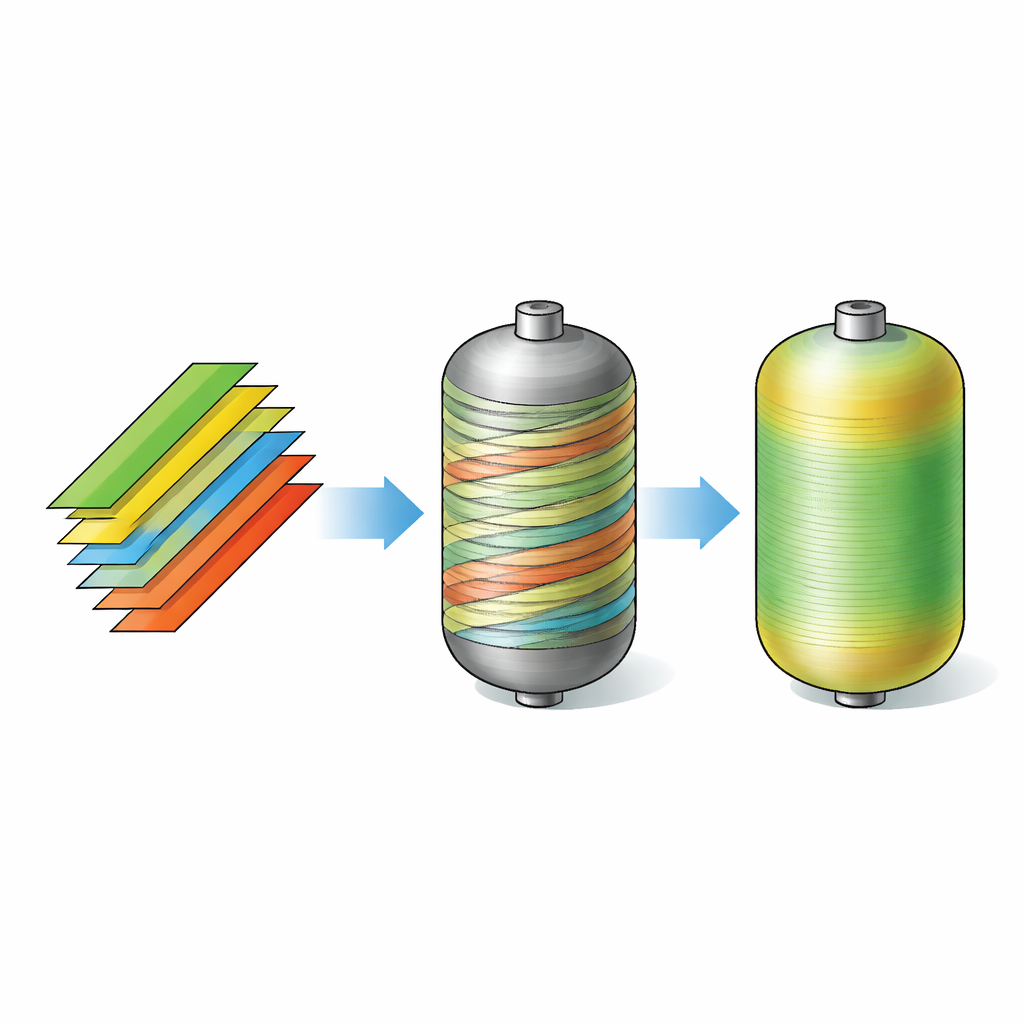
The vessels examined in this work are composite overwrapped pressure vessels, or COPVs. Inside each tank is a thin aluminum liner that keeps gas from leaking and helps share the load. Around this metal core, layers of fiber and resin are wound like thread on a spool to form a tough outer shell. Instead of relying solely on synthetic fibers such as carbon or glass, the authors focus on a hybrid shell made from flax and sisal, two plant‑based fibers. These natural fibers are lighter, cheaper, and renewable, but engineers need to understand whether they can still withstand high internal pressures without failing.
Simulating burst before it happens
To answer that question, the researchers did not simply build and burst dozens of test tanks. Instead, they used advanced computer simulations to predict how the vessels behave as pressure rises. In their virtual model, the metal liner and fiber shell are given realistic material properties, and internal pressure is slowly increased until failure is expected. The key design choices they vary are the angle at which the fibers are wound around the vessel and how many layers are stacked. Different patterns, such as helical paths running along the length and hoop‑like turns around the middle, are tested. Two widely used failure checks, known as Tsai‑Hill and Tsai‑Wu criteria, flag the point at which the material can no longer safely carry the load.
Finding the sweet spot in angle and layers
Across sixteen different designs, the simulations reveal that fiber orientation has a powerful effect on how much pressure the tanks can survive. Winding the flax‑sisal fibers at about 24.5 degrees to the vessel’s axis in a repeated plus‑minus pattern gives particularly good results. For a design with ten such layers wrapped over a 4 mm aluminum liner, the predicted burst pressure reaches about 10.3 megapascals—comparable to some synthetic‑fiber designs, but with lower weight and a greener material choice. Adding many more layers does not keep increasing strength; beyond the optimum, burst pressure can actually fall, showing that more material is not always better if the layout is not tuned correctly.
Where stresses concentrate and how failure develops
The simulations also map out where stresses and strains are highest as the vessel is pressurized. Most of the shell experiences fairly uniform loading, but the region around the polar boss—the thickened ends where fittings and valves attach—emerges as the most critical hotspot. There, stress builds faster and drives the early stages of damage. By tracking how different failure measures grow over time, the study shows a gradual accumulation of damage rather than a sudden, unexplained rupture. Among the failure checks, the Tsai‑Wu approach proves more conservative and reliable for predicting when the hybrid shell will give way, especially for complex combinations of stress.
What this means for cleaner, safer pressure storage
For non‑specialists, the key takeaway is that carefully arranged plant fibers, wrapped at the right angle over a thin metal liner, can form pressure tanks that are both strong and relatively eco‑friendly. The study demonstrates that a specific winding pattern—fibers crossing at about 25 degrees with ten layers—strikes a good balance between strength, weight, and material use. While these natural‑fiber vessels deform more under load than carbon‑fiber versions, they still reach useful burst pressures when properly designed. This work provides designers with guidelines for choosing fiber angles, layer counts, and safety checks, helping future tanks for hydrogen cars, industrial gases, and other applications become lighter, greener, and more reliable.
Citation: Warkina, R., Regassa, Y. & Girshe, N. Numerical optimization of natural hybrid fiber reinforced composite overwrapped pressure vessel. Sci Rep 16, 13683 (2026). https://doi.org/10.1038/s41598-026-43118-2
Keywords: composite pressure vessels, natural fiber composites, burst pressure, filament winding, hydrogen storage