Clear Sky Science · en
Simultaneous spectrophotometric eco-friendly analysis of triple-drug H.pylori regimen (Vonoprazan, Amoxicillin, Metronidazole) for quality control and in vitro dissolution testing
Why testing ulcer medicines in a greener way matters
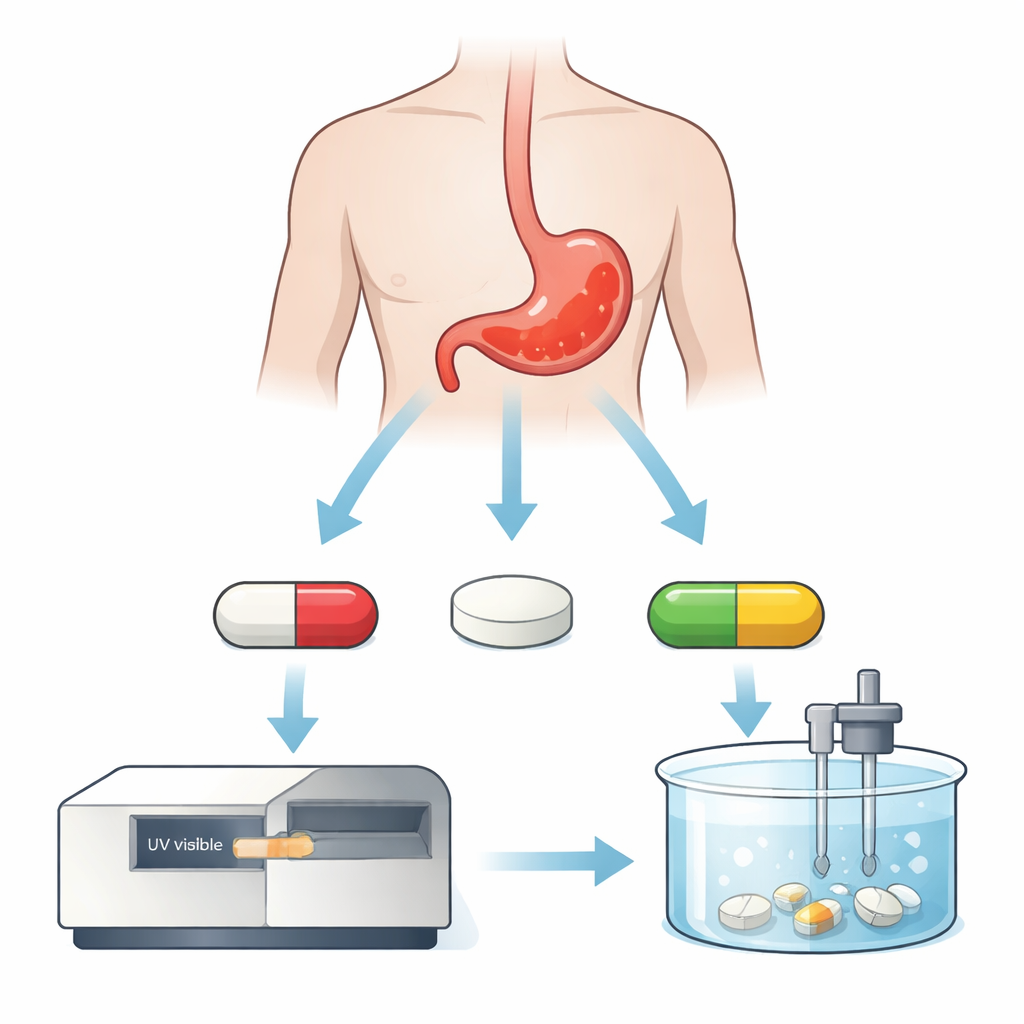
Stomach infections caused by the bacterium Helicobacter pylori are a major trigger of ulcers and even stomach cancer. A powerful treatment uses three drugs together—vonoprazan, amoxicillin, and metronidazole—to knock out the infection. But before these medicines reach patients, manufacturers must prove that every batch contains the right amount of each drug and that all three are released properly in the stomach. This paper presents new laboratory techniques that can check all three drugs at once in a simpler, safer, and more environmentally friendly way than many current tests.
The stomach germ and the triple-drug cure
H. pylori hides in the protective mucus lining of the stomach, where it makes enzymes that neutralize acid and let it survive for years. Infection rates are slowly falling worldwide thanks to better hygiene and treatment, but they remain high in many regions, and drug resistance is an increasing concern. One of the most promising treatment strategies is a "triple therapy" regimen. Vonoprazan reduces stomach acid by blocking the pump that secretes it, creating a less acidic environment that helps antibiotics work better. Amoxicillin, a broad-spectrum penicillin-type antibiotic, kills many common bacteria, while metronidazole targets microbes that thrive without oxygen. Together, these three medicines form a strong second-line option when earlier treatments fail.
The challenge of seeing three drugs at once
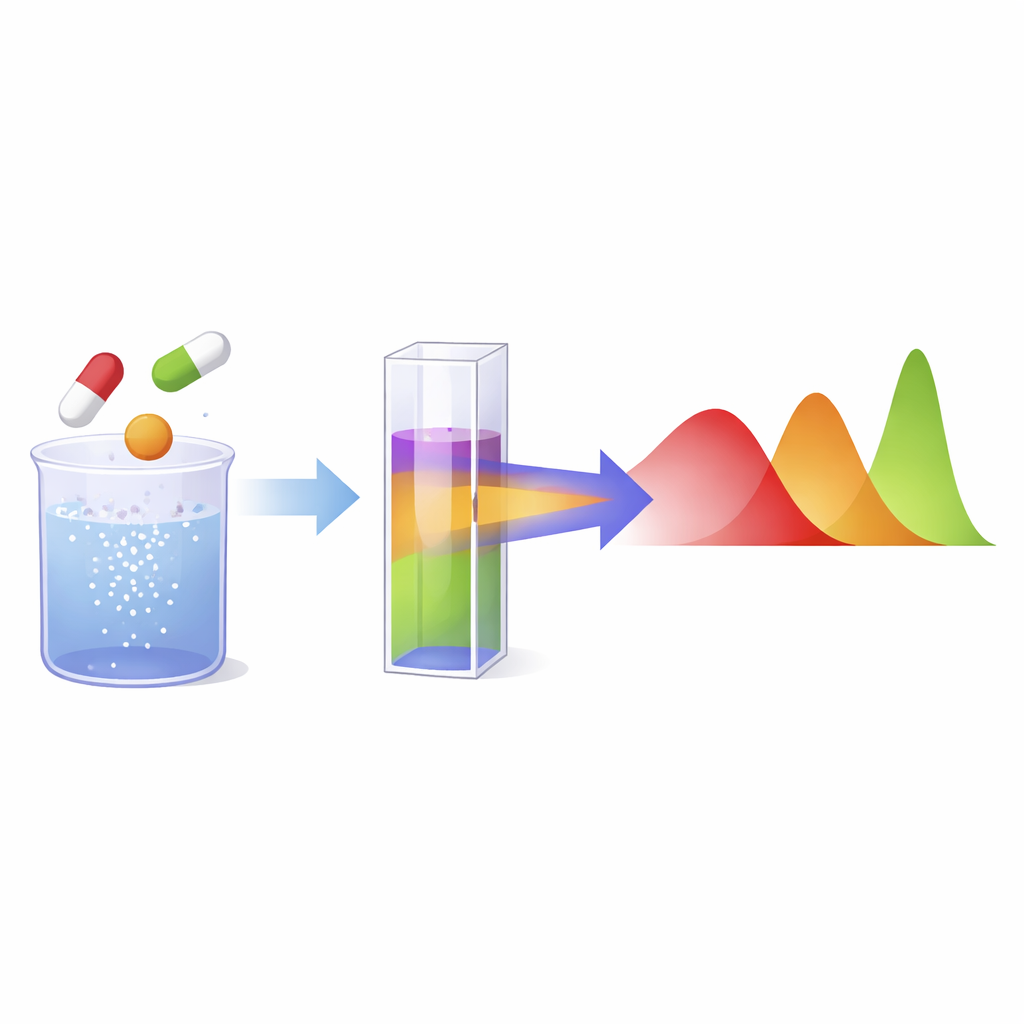
To check medicine quality quickly, many labs use ultraviolet (UV) light to measure how strongly a drug solution absorbs specific wavelengths. The problem here is that vonoprazan, amoxicillin, and metronidazole all absorb UV light in very similar ways. Their signals overlap so much that ordinary measurements cannot tell how much of each drug is present in a mixture. Higher-order mathematical tricks on the raw signals usually add noise and reduce accuracy. As a result, quality control has often relied on slower, more complex liquid chromatography methods or separate measurements for each drug.
Smart light-based tricks to untangle the mixture
The researchers developed three related UV-based approaches that use clever mathematical processing to separate the signals of the three drugs, even though their spectra overlap strongly. All three begin with simple UV measurements of the mixture in a solution that mimics gastric fluid. In the first approach, called dual-wavelength ratio analysis, the spectrum of the mixture is divided by that of a reference solution and pairs of wavelengths are chosen where two of the drugs cancel each other out. The difference in light absorption between those two wavelengths then reflects only the third drug. The second and third approaches build on this idea by dividing by the combined spectrum of two drugs and then applying either derivatives or mean-centering calculations. These steps enhance subtle differences in the shapes of the curves so that each drug produces its own clean, concentration-dependent signal.
Putting the methods to the test
The team checked how well these techniques worked across a wide range of concentrations relevant to real tablets and capsules. They measured sensitivity, accuracy, repeatability, and robustness according to international guidelines. The new methods could detect very small amounts of each drug and gave nearly perfect straight-line relationships between signal and concentration. They were also able to measure the three components in laboratory-prepared mixtures and in a commercial triple-therapy product without interference from other tablet ingredients. In dissolution tests, which imitate how tablets release their contents in the stomach, the methods tracked how more than 97 percent of each drug dissolved over 150 minutes, showing that they are suitable for real-world quality control.
Cleaner chemistry for routine medicine checks
A key advantage of these approaches is that they use a water-based, simulated gastric fluid rather than organic solvents, reducing hazards to workers and the environment. Independent "green" scoring tools confirmed that the new UV methods have a smaller environmental footprint than comparable chromatographic techniques. In statistical comparisons, their results agreed closely with an established liquid chromatography method, but with simpler equipment, lower cost, and less waste. For non-specialists, the take-home message is that manufacturers can now verify this important triple-drug therapy more efficiently and sustainably, helping ensure that patients receive safe, effective, and reliably formulated treatments for stubborn H. pylori infections.
Citation: Hamdy, A.M., Abu-Bakr, R.I., El-Hay, S.S.A. et al. Simultaneous spectrophotometric eco-friendly analysis of triple-drug H.pylori regimen (Vonoprazan, Amoxicillin, Metronidazole) for quality control and in vitro dissolution testing. Sci Rep 16, 12793 (2026). https://doi.org/10.1038/s41598-026-43116-4
Keywords: Helicobacter pylori, triple therapy, spectrophotometry, drug quality control, green analytical chemistry