Clear Sky Science · en
Quantitative trait loci associated with drought stress tolerance in wheat primed with zinc oxide nanoparticles at seed germination and seedling stages
Why Thirsty Wheat Matters to Everyone
Wheat sits at the heart of the global food supply, feeding billions of people every day. But as droughts become more frequent and severe, young wheat plants often struggle to germinate and take root, threatening future harvests. This study explores an emerging solution that sounds futuristic but is surprisingly simple: bathing wheat seeds in tiny particles of zinc oxide before they sprout. The researchers show how this "nano-priming" can help seedlings get off to a strong start under dry conditions, and they pinpoint the regions of wheat DNA that control this drought resilience.
Giving Seeds a Head Start
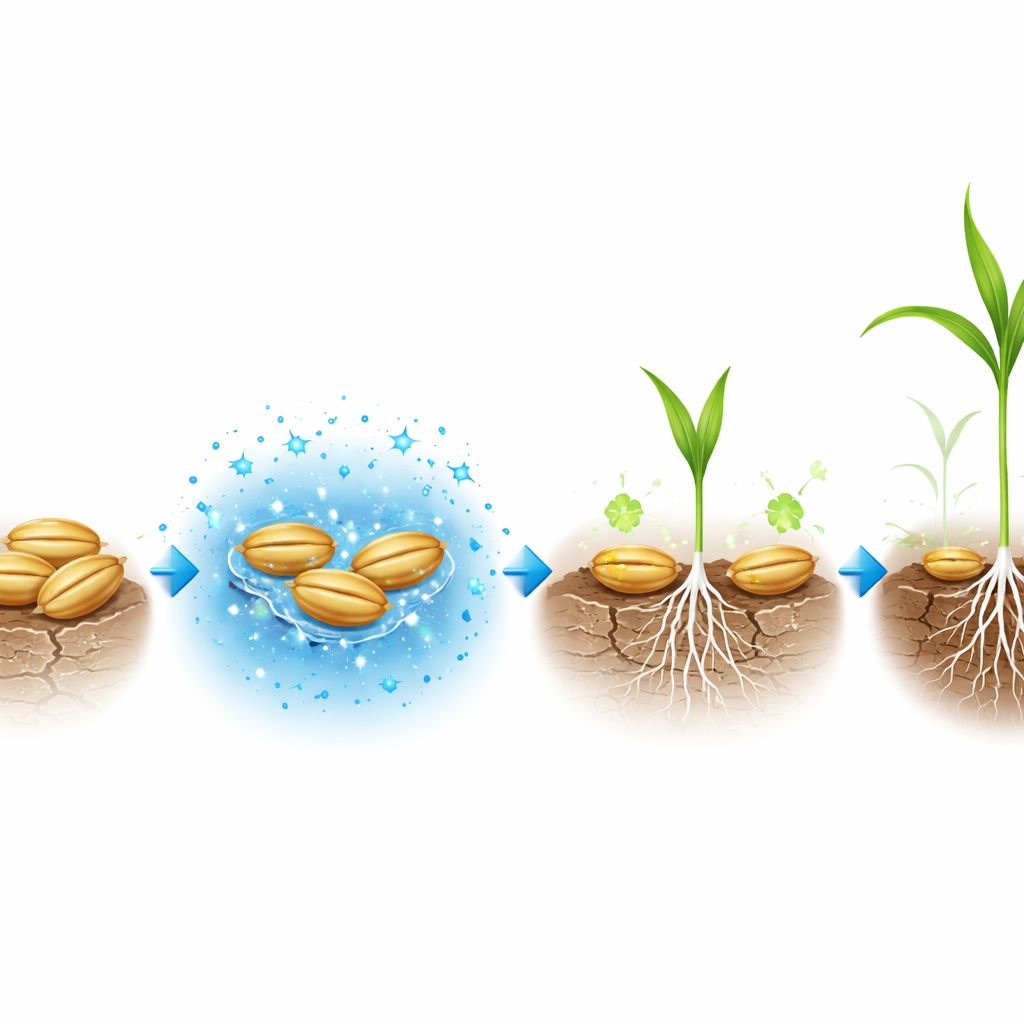
To understand how to help wheat cope with water shortage, the team worked with 65 closely related wheat lines derived from two parent plants, one drought-tolerant and one drought-sensitive. They exposed seeds to four conditions in a growth chamber: normal water, simulated drought created with a solution that makes water harder for plants to absorb, zinc oxide nanoparticle priming under normal water, and nanoparticle priming followed by drought. Before planting, some seeds were soaked for six hours in a carefully chosen zinc oxide nanoparticle solution, fine-tuned in earlier tests so that it boosted performance without triggering premature germination. The scientists then tracked 22 different traits during germination and early seedling growth, such as how quickly and uniformly seeds sprouted, how long the shoots and roots grew, and how much fresh weight the seedlings produced.
How Nano-Priming Changes Young Plants
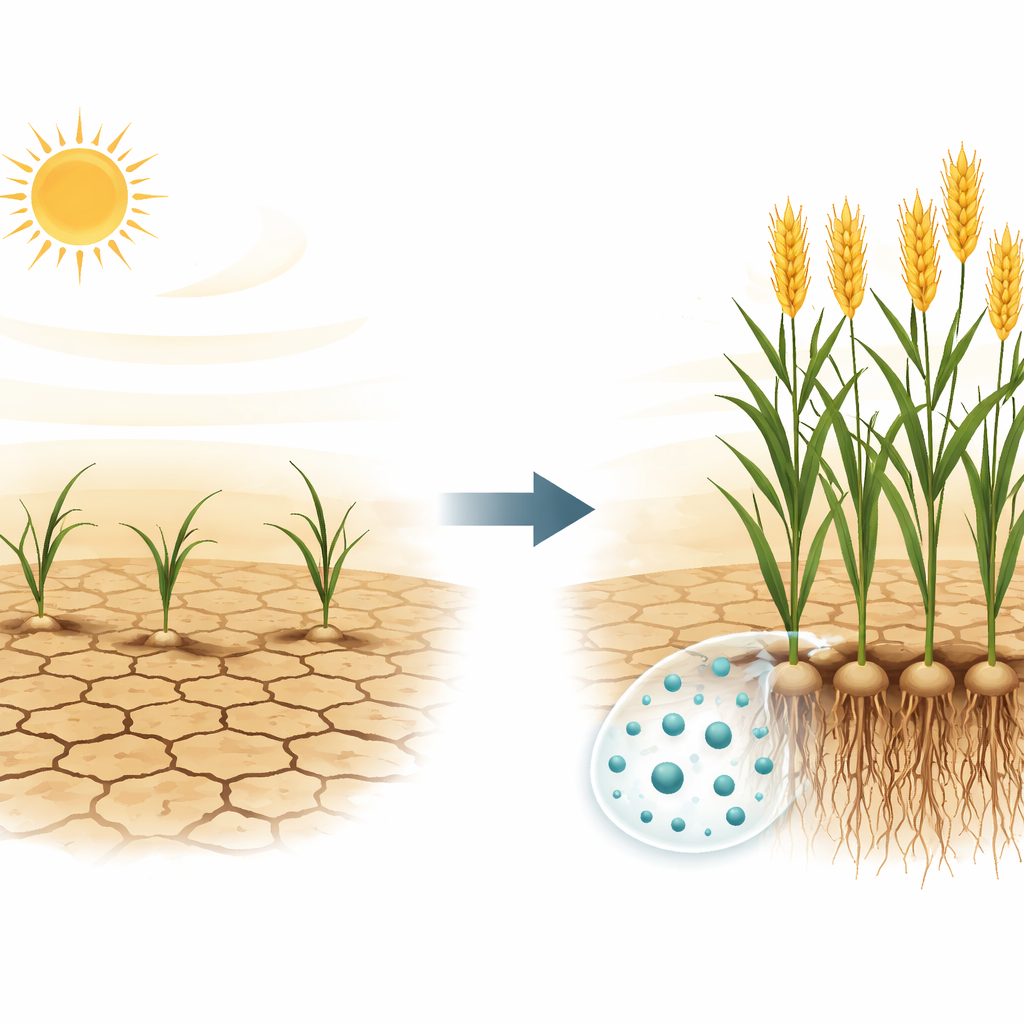
Drought alone sharply reduced almost every measure of seed and seedling performance: fewer seeds germinated, they sprouted more slowly and unevenly, and the resulting shoots and roots were shorter and lighter. Nano-priming, however, softened these blows. Under drought, primed seeds generally germinated faster and more synchronously, and produced seedlings with longer roots, more balanced shoot-to-root growth, and greater overall vigor compared with unprimed seeds. Statistical tests showed that these traits had very high heritability, meaning differences among wheat lines were strongly genetic rather than random. Correlation and principal component analyses revealed that traits related to rapid, uniform germination tended to move together, and that better early growth under drought was closely tied to higher drought tolerance indices and smaller yield losses in key seedling traits.
Finding the Best Lines and Their Hidden DNA Regions
Because drought tolerance depends on many overlapping characteristics, the researchers used a multi-trait index called MGIDI to rank lines not by a single trait but by their overall resemblance to an "ideal" drought-tolerant plant. This approach identified sets of particularly robust lines under drought, with and without nano-priming, and also highlighted the most sensitive lines that could serve as checks in future experiments. Intriguingly, some lines that were originally very vulnerable to drought moved into the top-performing group after nano-priming, showing that the treatment can dramatically reshape how certain genotypes respond to water stress. The team then combined these performance data with a dense map of over 3,500 DNA markers to search for quantitative trait loci (QTLs) – stretches of the genome that consistently tracked with better germination, root and shoot growth, and drought tolerance indices across environments.
Genes Behind Tough Seedlings
The mapping work uncovered 12 QTLs spread across seven chromosomes, with several located in genomic "hotspots" that also influence yield, plant height, root depth, and grain quality in other studies. Some QTLs were detected only when seeds were nano-primed, suggesting that the treatment switches on or amplifies particular genetic programs. Within these regions the researchers cataloged nearly 200 candidate genes, narrowing to about 30 that were closely linked to the markers. These genes fall into functional groups involved in controlling gene activity, stress signaling, metabolism, and protection of cellular structures. Notable clusters included sulfotransferase enzymes that fine-tune plant hormones, redox enzymes that manage damaging reactive molecules, and transcription factors that orchestrate drought responses. Gene-expression data from public databases confirmed that many of these genes are switched up, down, or held steady under drought, sketching a coordinated network that underlies resilient early growth.
What This Means for Future Bread
For non-specialists, the take-home message is straightforward: soaking wheat seeds in a solution containing zinc oxide nanoparticles can help them germinate more reliably and grow stronger seedlings even when water is scarce. This boost is not just a quick chemical trick; it aligns with specific stretches of wheat DNA and stress-related genes that the study has now mapped. Those genetic regions and top-performing lines provide powerful tools for breeders aiming to develop new, drought-hardy wheat varieties. If validated in larger field trials, combining seed nano-priming with smart, DNA-informed breeding could help keep wheat yields stable in a warming, drying world, contributing to more secure food supplies without relying solely on increased irrigation or agrochemicals.
Citation: Mahmoud, M.R.I., Sallam, A., Karam, M.A. et al. Quantitative trait loci associated with drought stress tolerance in wheat primed with zinc oxide nanoparticles at seed germination and seedling stages. Sci Rep 16, 11612 (2026). https://doi.org/10.1038/s41598-026-43113-7
Keywords: wheat drought tolerance, seed nano-priming, zinc oxide nanoparticles, germination and seedling vigor, quantitative trait loci