Clear Sky Science · en
Intracellular calcium handling dysfunction contributes to behavioural deficits leading to mortality of honey bees after acute contact exposure to the insecticide cyantraniliprole
Why this matters for bees and people
Honey bees are vital partners in our food production, pollinating many of the crops we rely on every day. At the same time, farmers increasingly use new generations of insecticides to protect yields. This study looks at one such product, cyantraniliprole, and asks a simple but pressing question: what does brief skin contact with this chemical do to bees, and could the same type of damage also occur in mammals? By following both bee behavior and the inner workings of their muscle cells, and by comparing them with mouse muscles, the researchers uncover a hidden form of toxicity that current safety tests may miss.
A new kind of bug killer on the rise
Cyantraniliprole belongs to a family of modern insecticides called anthranilic diamides. These compounds are designed to act on special channels inside cells that release calcium, a key signal that controls muscle movement, nerve activity, and the heartbeat. Because these channels in insects differ from those in mammals, the products have been marketed as highly selective and safer for vertebrates. Yet their use has expanded rapidly, and mounting evidence from earlier work already suggested they can disturb the hearts, muscles, and nerves of honey bees at low doses. The present study focuses on cyantraniliprole, now widely used in Europe, and examines both how deadly it is to adult bees on contact and how it alters their movement long before they die.
Where the chemical touches the bee matters
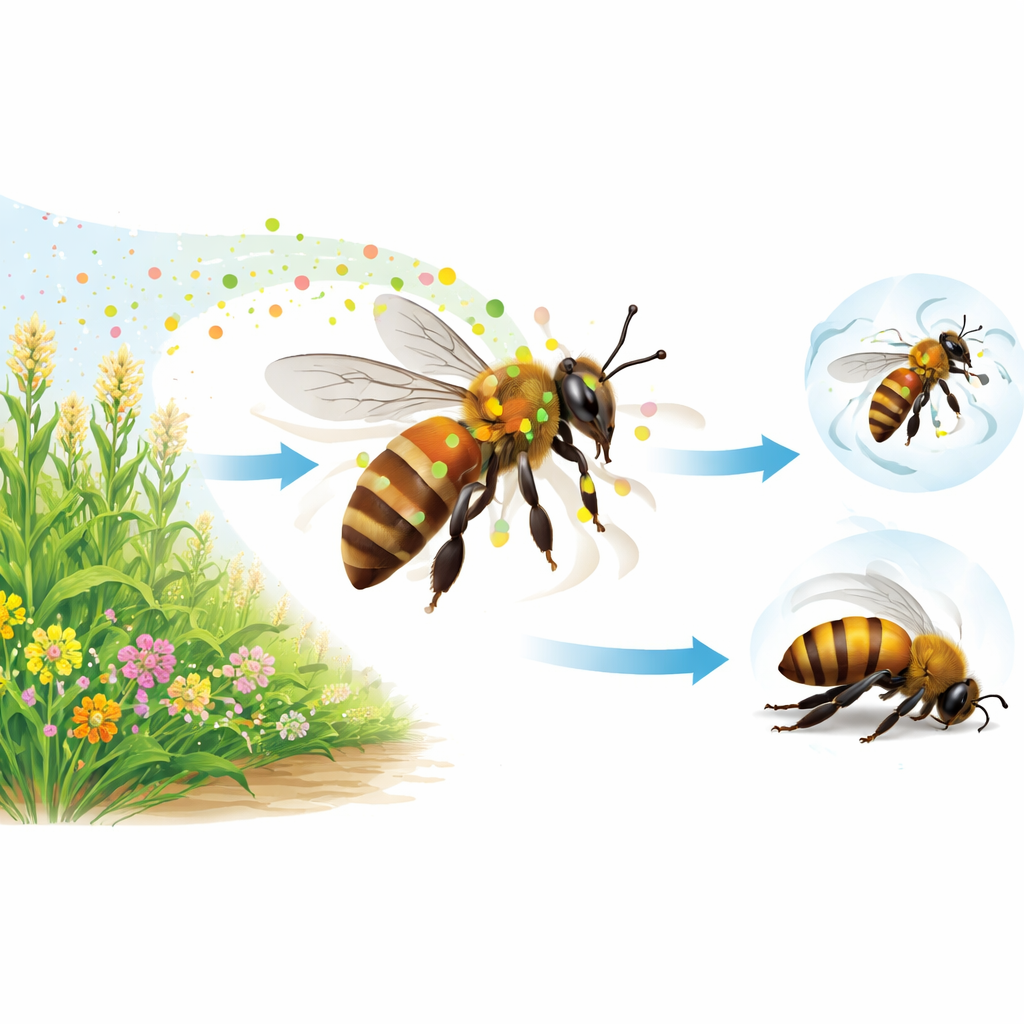
The authors exposed young worker bees to small droplets of cyantraniliprole placed on different body regions: the back of the abdomen near the heart, the antennae that sense smells and tastes, the upper thorax over the flight muscles, and the underside of the thorax over the main nerve centers. Mortality after a single contact depended strongly on where the droplet landed. Doses in the range of tens of nanograms per bee were already highly toxic when applied to the abdomen, antennae, or underside of the thorax, whereas the traditional test site used in regulations—the upper thorax—was noticeably less sensitive. Even when bees survived the first day after exposure to the thorax, higher doses still killed many of them later on, indicating delayed effects not captured by short-term tests.
Slower, weaker, and less able to move
To see how sublethal exposure alters daily functioning, the team recorded the movement of individual bees for 21 hours in small arenas. Under control conditions, young bees gradually became more active and faster, reflecting their normal development of walking skills. Bees that received modest thoracic doses of cyantraniliprole showed a clear, dose-dependent drop in top speed and total distance traveled, even though they ate normally and spent roughly the same fraction of time moving. When the same low dose was applied to different body zones, behavioral problems were most striking after antennal exposure, which cut total distance by about half. This suggests that not only the muscles but also sensory processing and the bee’s ability to respond to environmental cues are compromised, potentially affecting foraging, navigation, and colony tasks.
Inside the cells: disturbed calcium sparks in bees and mice
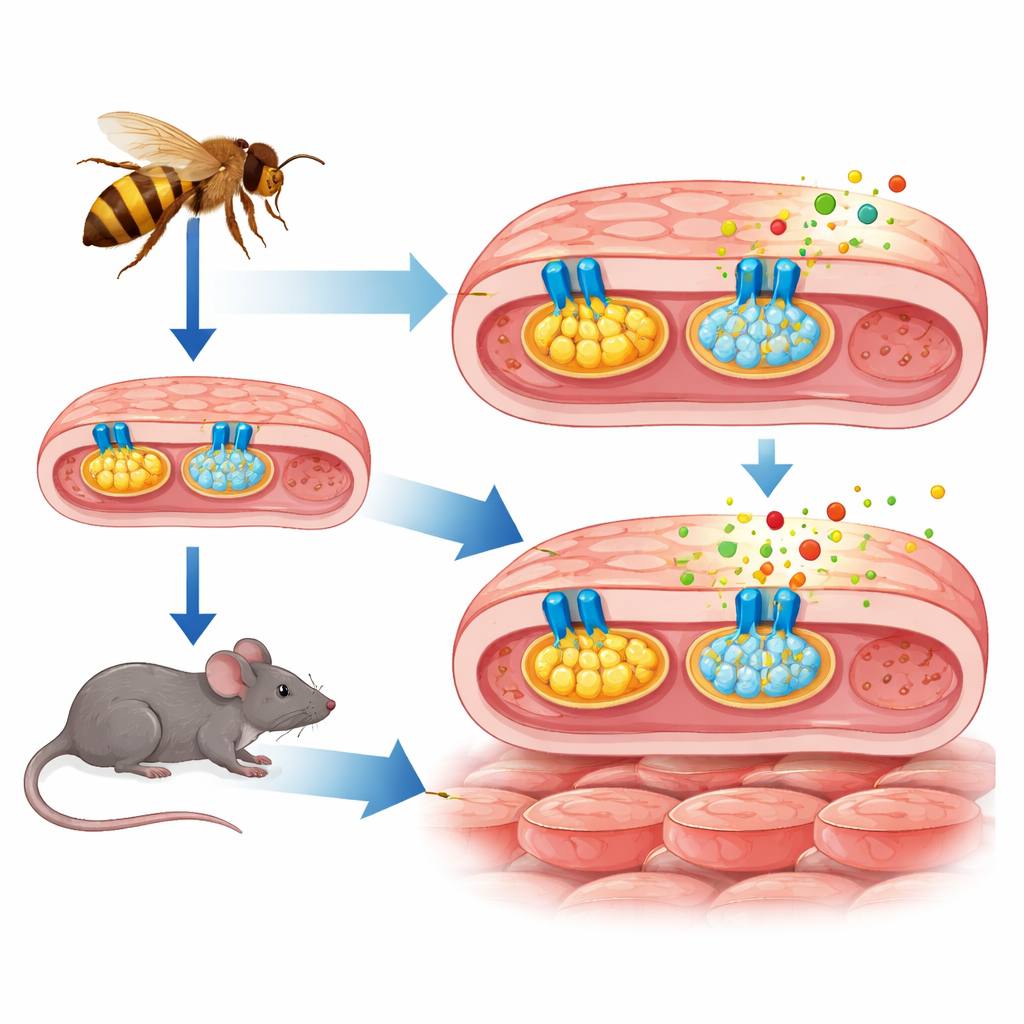
At the cellular level, the researchers isolated skeletal muscle fibers from bee legs and loaded them with a fluorescent dye that glows when calcium rises inside the cell. Brief exposures to increasing concentrations of cyantraniliprole caused progressively larger bursts of internal calcium, and at the highest level some cells contracted abnormally. The team then asked whether a similar disturbance occurs in mammals. They performed parallel experiments on adult mouse muscle fibers, including fibers from a mouse strain carrying a mutation that mimics a human disorder called malignant hyperthermia, which makes muscles unusually sensitive to triggers. In these mouse cells, both cyantraniliprole and its older relative chlorantraniliprole provoked calcium surges and, in the mutant fibers, strong contractures. Although higher concentrations were needed than in bees, the core effect—anarchic calcium release from internal stores—was the same in both species.
What this tells us about risk
Taken together, the findings show that cyantraniliprole is more dangerous to bees than suggested by current standard tests, which focus on a single, relatively insensitive exposure site and mainly count deaths. Even short-lived contact can quietly damage the bees’ internal calcium control system, leading to weaker movement and likely impairing vital tasks long before individuals die. The observation that similar calcium disruptions occur in mouse muscle, especially in a model of an inherited human muscle disease, raises questions about how safe these compounds truly are for mammals carrying mutations in the same type of channel. The authors argue that anthranilic diamides should be reassessed with more realistic exposure routes and with special attention to subtle behavioral changes and to vulnerable human and animal populations.
Citation: Charreton, M., Mutterer, J., Pélissier, M. et al. Intracellular calcium handling dysfunction contributes to behavioural deficits leading to mortality of honey bees after acute contact exposure to the insecticide cyantraniliprole. Sci Rep 16, 13281 (2026). https://doi.org/10.1038/s41598-026-43110-w
Keywords: honey bee, insecticide, cyantraniliprole, calcium signaling, pollinator health