Clear Sky Science · en
SMC ensures efficient chromosome replication and oriC positioning during Streptomyces spore germination
How tiny soil dwellers keep their DNA in line
Streptomyces bacteria, famous for producing many of our antibiotics, grow like microscopic fungi: they wake from hardy spores and spin out long, branching filaments. To do this successfully, they must copy and position their DNA with exquisite precision. This study uncovers how a protein called SMC, a DNA “organizer,” helps Streptomyces manage this challenge during the very first moments after a spore wakes up, ensuring that growth starts on a solid genetic footing.
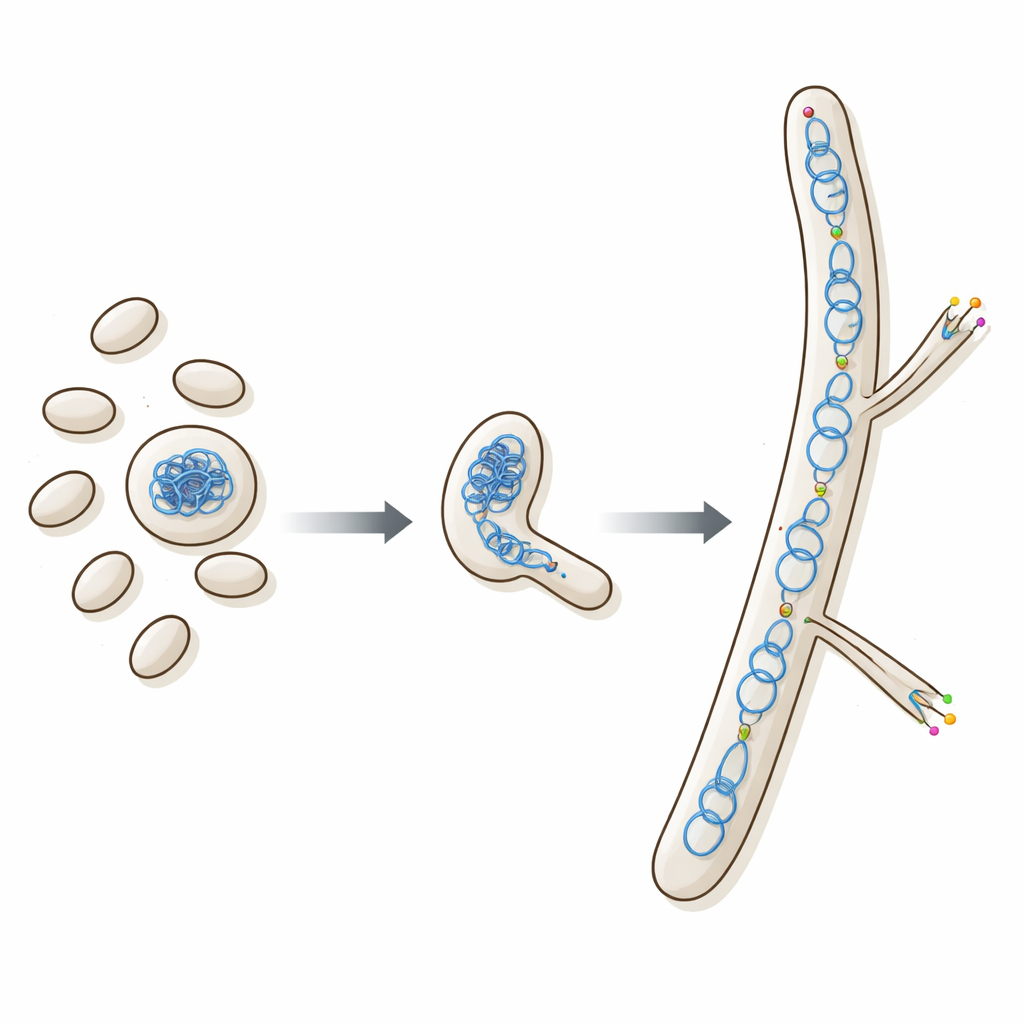
Waking up from a microscopic sleep
Streptomyces spores are dormant, single-copy “seeds” that can survive harsh conditions in soil. When conditions improve, a spore swells and sprouts a thin tube—the germ tube—that grows into a long filament, or hypha. Before this tube even appears, the spore quietly begins copying its chromosome several times. These DNA copies are then sent into the emerging germ tube so that the growing filament is well supplied with genetic material. Earlier work showed that SMC proteins compact and align the chromosome inside spores, but it was unclear whether this architecture also shaped how DNA is copied and positioned during germination.
A DNA organizer under scrutiny
To probe SMC’s role, the researchers compared normal Streptomyces venezuelae with strains lacking the smc gene and with a strain in which smc was reintroduced. They measured how quickly spores formed germ tubes and how actively their chromosomes were replicating, using quantitative DNA tests that compare the region near the replication starting point (oriC) with more distant chromosomal arms. They also followed fluorescent tags attached to oriC, to replication machinery, and to selected genes, using time-lapse microscopy and reporter assays to see how both DNA movement and gene activity changed when SMC was missing.
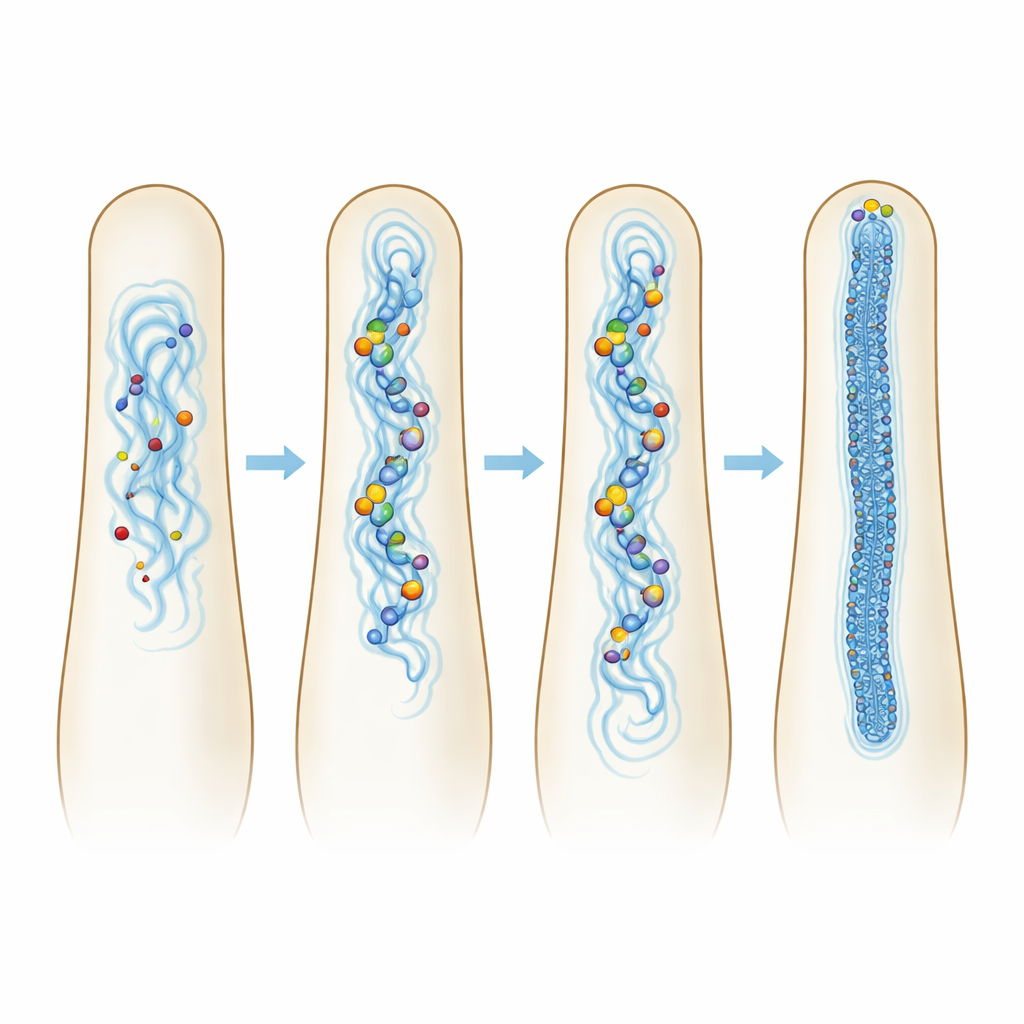
When DNA architecture goes off track
Surprisingly, spores without SMC germinated slightly more often and a bit earlier than normal, but their chromosomes behaved abnormally. The ratio of oriC to chromosomal arms roughly doubled in these mutants, suggesting that replication was either initiated too frequently or that the copying process stalled, leaving more DNA near the start point. Microscopy revealed that in cells lacking SMC, both the arrival of oriC and the replication machinery in the germ tube were delayed, even though the tube itself was growing. In early vegetative filaments, oriC copies accumulated more densely along the cell, yet overall multiplication of chromosome copies and filament extension were slower than in normal cells. This mismatch—more oriC signals but sluggish growth—points to disorganized and inefficient replication rather than healthy DNA expansion.
Keeping the chromosome tip-anchored
In normal Streptomyces, the leading chromosome in each filament is arranged so that oriC sits right at the tip-facing edge of the DNA mass and close to the cell pole, where it can interact with specialized positioning proteins. The team measured distances from oriC to both the hyphal tip and the edge of the DNA region and compared these to positions of chromosomal sites farther away from oriC. Without SMC, oriC shifted noticeably away from the tip and from the front edge of the nucleoid, while more distant sites hardly changed. This shows that SMC specifically organizes the oriC-proximal region, enforcing a lengthwise layout of the chromosome (often called an ori–ter arrangement) that keeps the replication starting point poised at the growing end of the cell.
Why this microscopic choreography matters
For a layman, the key message is that SMC acts like a molecular “cable manager” for bacterial DNA during the fragile transition from spore to growing filament. By looping and aligning DNA near the replication starting point, SMC helps chromosomes copy smoothly and ensures that the first copies are delivered to the germ tube tip on time and in the right place. When SMC is removed, the chromosome becomes disorganized: replication is perturbed, DNA takes longer to reach the new growth zone, and the crucial starting region drifts away from its anchor point. This work shows that proper DNA architecture is not just about packing the genome tightly—it is also essential for kick-starting growth and for the reliable inheritance of genetic information in these antibiotic-producing soil microbes.
Citation: Pawlikiewicz, K., Strzałka, A., Nurek, A. et al. SMC ensures efficient chromosome replication and oriC positioning during Streptomyces spore germination. Sci Rep 16, 13557 (2026). https://doi.org/10.1038/s41598-026-43107-5
Keywords: Streptomyces, chromosome organization, spore germination, SMC protein, DNA replication