Clear Sky Science · en
The time-dependent reliability of CRTS III slab ballastless track structures based on direct probability integral method
Keeping High-Speed Trains on Track
As high-speed rail lines expand across China and around the world, the smooth concrete slabs that support the rails must remain safe and stable for decades. This paper explores how the newest Chinese slab track system, called CRTS III, gradually ages under trains, temperature swings, and bridge movement—and introduces a smarter way to predict when its safety or riding comfort might be at risk. The findings can help railway operators plan timely maintenance so passengers keep enjoying fast, reliable, and comfortable journeys.
Why Modern Tracks Are Different
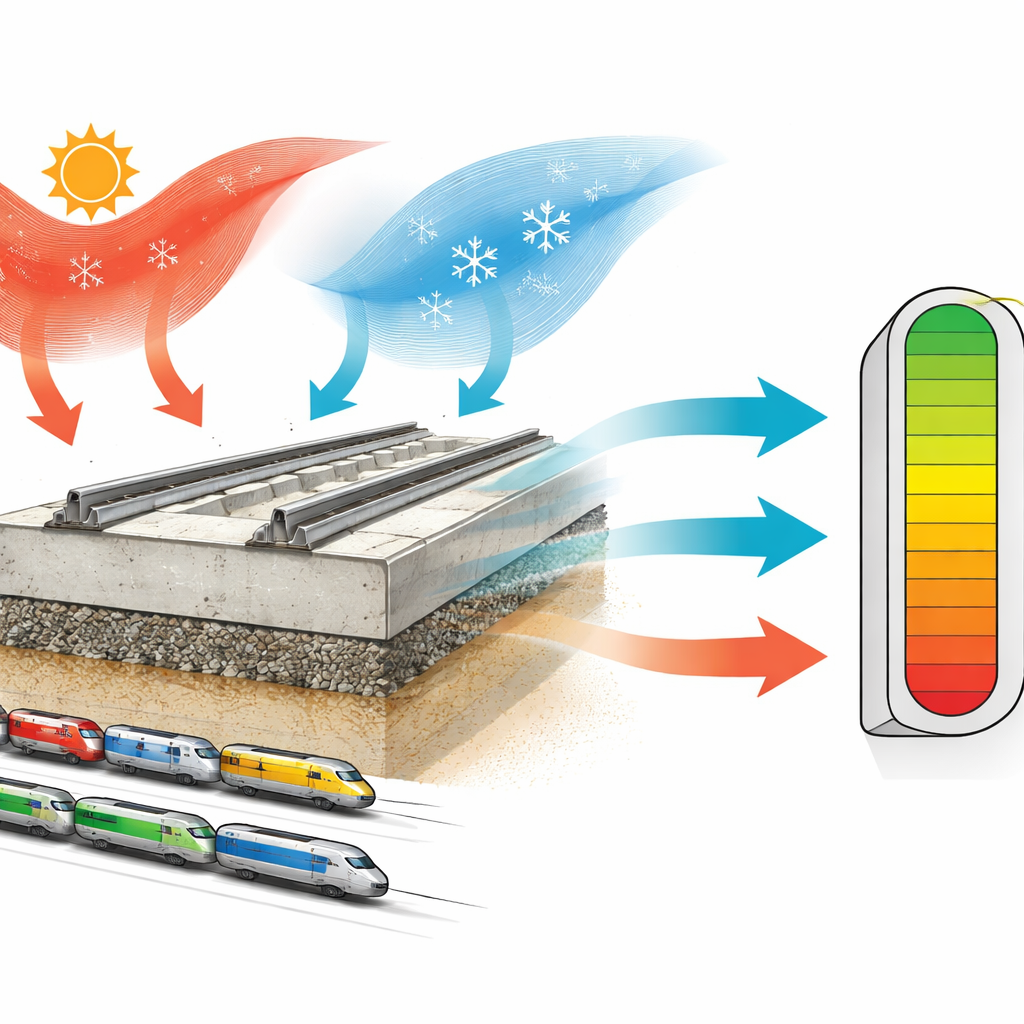
Unlike traditional tracks that rest on loose stones, CRTS III is a multilayer concrete structure: steel rails sit on a stiff slab, which is tied to supporting concrete layers and an isolation layer above the bridge or subgrade. This design offers a smoother ride and lower day-to-day maintenance, which is why it has been widely adopted on China’s high-speed network. But the same stiffness also means that cracks, debonding between layers, and steel yielding can build up silently over years of intense use and harsh weather. The authors note that these defects threaten not only structural safety—avoiding breakage or collapse—but also “applicability,” a practical measure of whether the track still provides acceptable comfort and durability, such as keeping crack widths within limits.
Looking at Many Ways a Track Can Fail
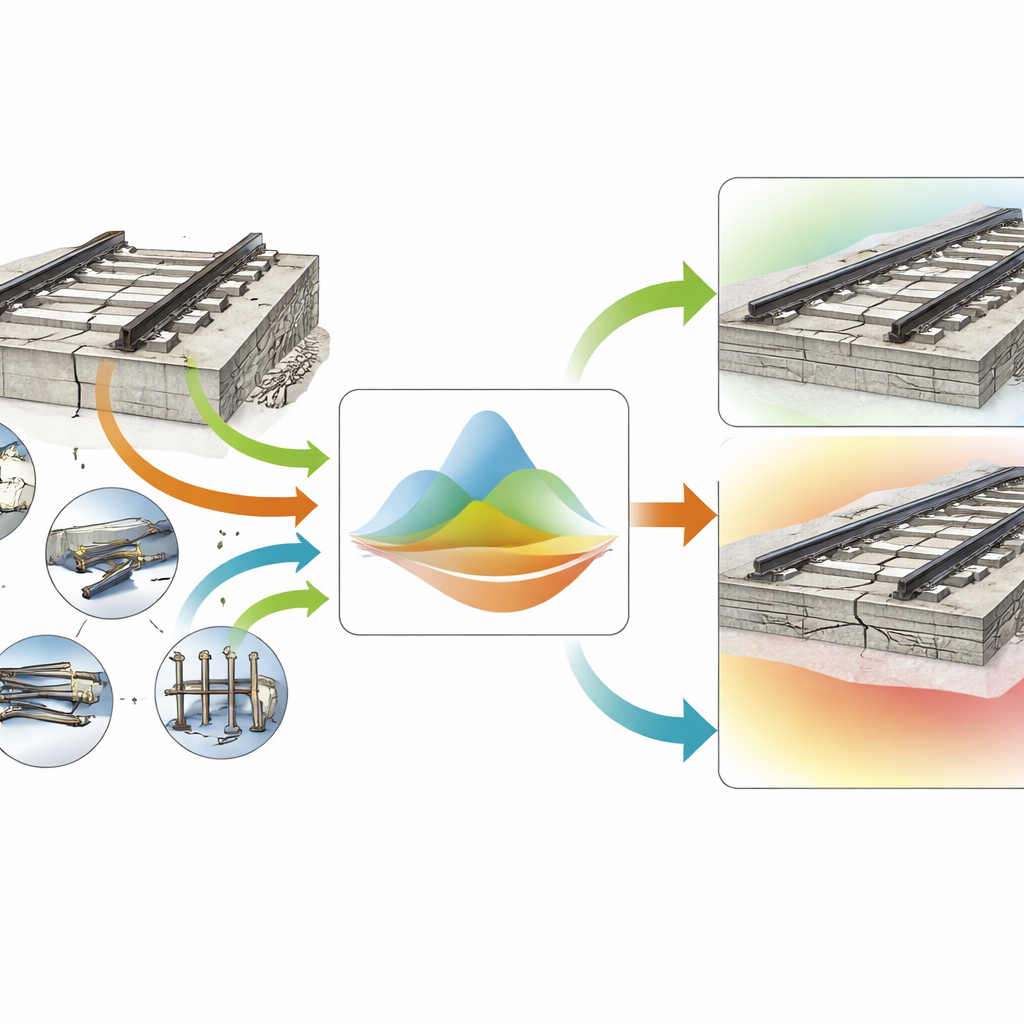
Earlier studies usually examined one problem at a time—say, the risk of a particular bending failure or one type of cracking. In reality, a CRTS III track can fail in several interconnected ways: longitudinal and transverse bending of the slab, yielding of steel in the base slab, and different kinds of cracks in both slab and base. The authors treat all these as parts of a combined system, some acting like “series links” where one weak element can bring down the whole, and others like “parallel links” where multiple defenses exist. To make these very different behaviors comparable, they reformulate each performance measure into a common, dimensionless form that simply expresses how close the track is to its limit. This regularization allows all modes to be combined into one overall picture of system health.
A Faster Way to Measure Risk Over Time
To track reliability through a service life of up to 80 years, the team adopts a numerical technique called the direct probability integral method (DPIM). Instead of relying on brute-force Monte Carlo simulations with huge numbers of random samples, DPIM cleverly divides the space of uncertain inputs—such as material strength, temperature gradient, or train load—into representative points and smooths the resulting probability distribution. This cuts the computational effort dramatically while still capturing how the chance of failure grows over time. By comparing DPIM with classic Monte Carlo results for key bending failures, the authors show that DPIM reproduces the same trends and probabilities but with far fewer calculations, making it practical for full-system, time-dependent assessments.
What Really Wears Tracks Down
Using their framework, the researchers explore how different influences—environment, traffic, and material aging—shape long-term reliability. Environmental factors, especially temperature gradients through the slab thickness, emerge as the dominant drivers of deterioration. Very large temperature differences across the slab height accelerate bending stresses and reduce safety, while strong negative gradients (cooling near the surface) promote wider cracks that undermine applicability. Under severe degradation scenarios, safety reliability can fall below current target levels in about 30 years, and serviceability can drop to its limit even earlier. Train loads matter as well: keeping the average wheel load below roughly 300 kilonewtons significantly improves safety margins, and the risk of both safety and serviceability failures grows sharply after about 30 years of service.
What This Means for Future Rail Travel
For non-specialists, the key message is that modern high-speed tracks do not simply “wear out” in a single obvious way. Instead, different types of damage accumulate at different rates, and the most frequent problem is often loss of service quality—such as excessive cracking—rather than outright structural danger. By unifying all these failure paths into one system view and applying a fast probability-based method, this study offers railway engineers a practical tool to forecast when safety or comfort standards may no longer be met. In plain terms, it shows that careful control of temperature effects and train loads, combined with targeted inspections and maintenance after about 30 years, can help keep high-speed railways both safe and comfortable throughout their intended lifetimes.
Citation: Wenchang, Z., Xiao, L., Junyan, D. et al. The time-dependent reliability of CRTS III slab ballastless track structures based on direct probability integral method. Sci Rep 16, 13166 (2026). https://doi.org/10.1038/s41598-026-43103-9
Keywords: high-speed railway, slab track, structural reliability, temperature effects, probabilistic analysis