Clear Sky Science · en
Silver nanoparticles obtained using cyclodextrin derivatives and pectin as a key component of titanium dioxide-based composites for water purification
Cleaner Water from Tiny Helpers
Many industrial dyes that give color to clothes, plastics, and food can linger in rivers and drinking water, posing risks to ecosystems and human health. This study explores how tiny particles made of common materials—titanium dioxide, silver, and natural sugar- and plant-based molecules—can team up to break down a stubborn dye in water more quickly and efficiently. The work points toward future water treatment systems that use light and smart materials instead of large amounts of chemicals.
Why Color in Water Is a Problem
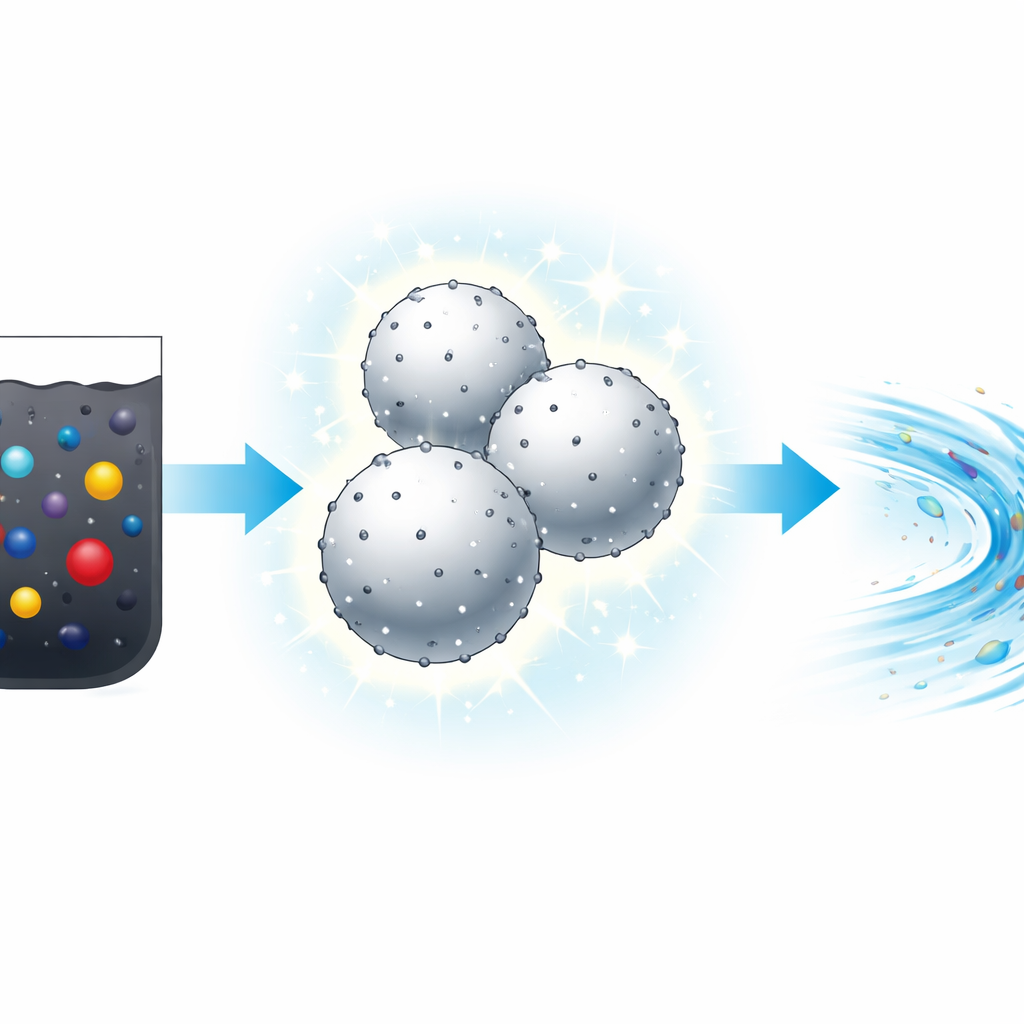
Colored wastewater from textile, printing, leather, and other industries often contains synthetic dyes that are hard to remove and can be toxic. Traditional treatment methods like filtration, adsorption on powders, or chemical oxidation can be costly, create extra sludge, or demand continuous inputs of reagents. A promising alternative is photocatalysis: using light-activated materials to generate reactive species that tear apart dye molecules into simpler, less harmful compounds. Titanium dioxide is one of the best-known light-activated materials because it is cheap, stable, and not toxic, but in its pure form it only works efficiently under ultraviolet light and tends to clump, which limits how well it can contact and destroy pollutants.
Building a Better Light-Driven Cleaner
To overcome these limits, the researchers decorated titanium dioxide particles with extremely small silver particles, creating a composite material that responds better to light and handles dyes more effectively. They used two natural components to help form and stabilize the silver nanoparticles: cyclodextrins, ring-shaped sugar molecules with a water-loving exterior and a water-repelling inner cavity, and pectin, a plant polysaccharide familiar from fruit jellies. These molecules can gently convert dissolved silver ions into solid silver nanoparticles and keep them from clumping, even under relatively mild conditions: near-neutral pH and a low ratio of cyclodextrin to silver compared with what is usually reported. The team also varied the form of the silver salt (nitrate, citrate, and methacrylate) and the type of helper molecule to see which combination yields the most effective photocatalyst.
What the Tiny Structures Look Like
Using a suite of characterization tools, the scientists examined both the free silver nanoparticles and the silver–titanium dioxide composites. Light scattering measurements and electron microscopy showed that the silver particles produced with cyclodextrins or pectin are typically only a few nanometers across—tens of thousands of times smaller than the width of a human hair. When these silver nanoparticles are formed on titanium dioxide, the base particles remain roughly spherical but assemble into larger clusters about 125–140 nanometers across, depending on the recipe. Pectin-based routes gave composites with less clumping and a higher amount of finely distributed silver. X-ray diffraction and infrared spectroscopy confirmed that the underlying titanium dioxide kept its highly active “anatase” crystal form and that silver became closely integrated with its surface, subtly altering the crystal spacing and bond strengths in ways that favor better light-driven performance.
How These Composites Clean Up Dye
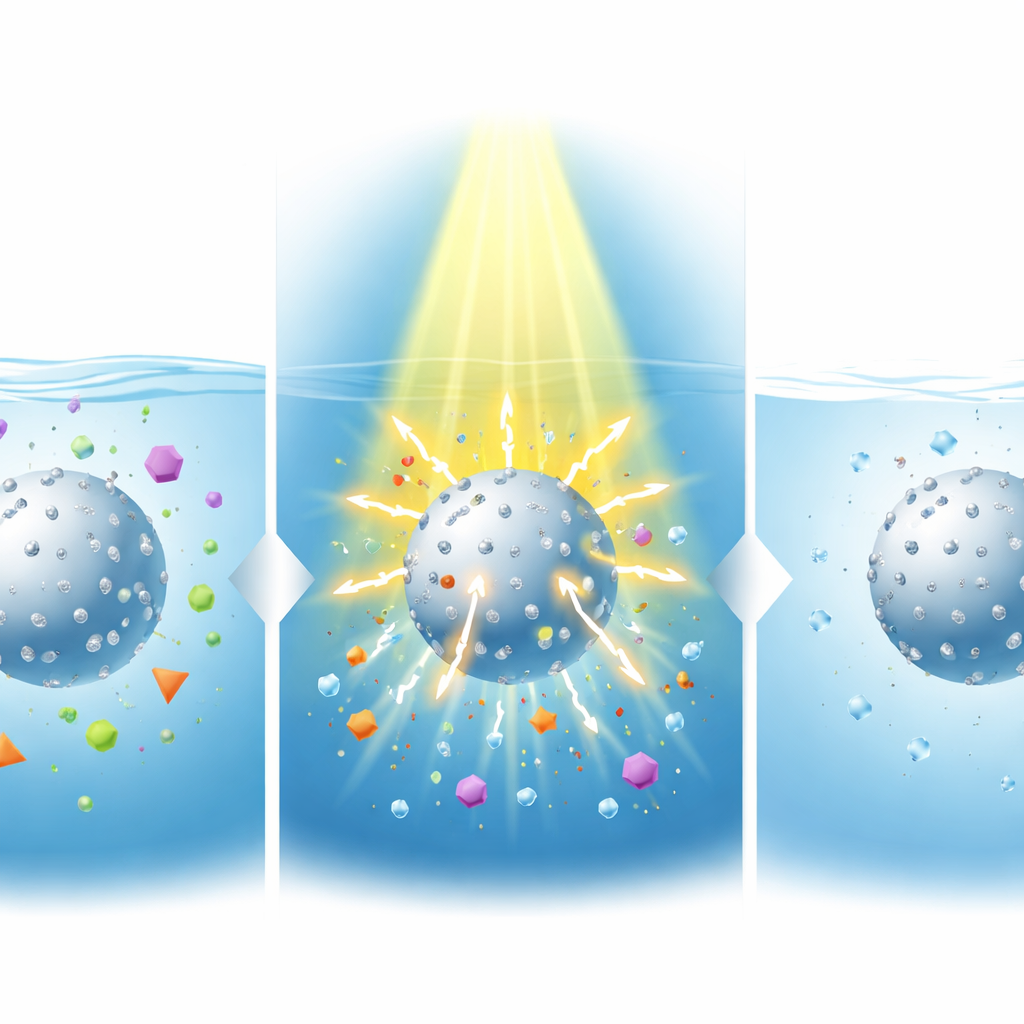
The team then tested how well the various materials could remove methyl orange, a common, hard-to-degrade dye, from water under ultraviolet light. Compared with pure titanium dioxide, all silver-decorated composites broke down the dye faster, both in simple lab solutions and in real water samples from an artesian well and a river. Composites made using silver methacrylate as the silver source were especially effective: in acidic water, they completely removed the dye’s color within about 30 minutes, and even at near-neutral pH they worked in about 70 minutes—roughly 2.5 to 3 times faster than titanium dioxide alone. Measurements of particle surface charge indicated that the presence of pectin and silver helps keep particles well-dispersed and strongly negatively charged, which improves their stability in water and their ability to attract and react with positively charged or polar dye fragments.
What This Could Mean for Real-World Water
For non-specialists, the main message is that carefully engineered combinations of familiar materials—silver, titanium dioxide, sugar-like rings, and fruit-derived pectin—can produce powerful light-activated cleaners for polluted water. By using gentle chemistry to make very small and stable silver particles at mild pH and low additive levels, the researchers created composites that dramatically speed up the breakdown of a problematic dye under UV light, including in real-world water samples. While this work focuses on one model dye, the approach can be extended to other stubborn contaminants, bringing the prospect of more efficient, low-chemical water purification technologies closer to practical use.
Citation: Kobylinskyi, S., Kobrina, L., Polishchuk, S. et al. Silver nanoparticles obtained using cyclodextrin derivatives and pectin as a key component of titanium dioxide-based composites for water purification. Sci Rep 16, 12134 (2026). https://doi.org/10.1038/s41598-026-43099-2
Keywords: water purification, photocatalysis, silver nanoparticles, titanium dioxide, wastewater treatment