Clear Sky Science · en
Enhancing island biogeography: improving identification of potential species pools via environmental filtering
Why island species matter
Islands are natural laboratories for understanding how life spreads and settles. Knowing not just how many species live on an island, but which ones could live there, helps us understand biodiversity, guide conservation, and anticipate future arrivals. This study asks a simple question with wide appeal: given the climate of an island, which species from nearby regions are truly capable of making a home there?
From simple counts to real candidate species
Classic island biogeography theory focuses on how island size and distance from the mainland shape the total number of species. That approach offers elegant rules of thumb but says little about the actual identities of potential colonizers. The authors argue that to grasp how island communities form, we need a practical way to list all species that could plausibly colonize a given island. They call this the source pool, the set of species from surrounding regions that might be able to survive if they arrived.
Building starting lists for nearby life
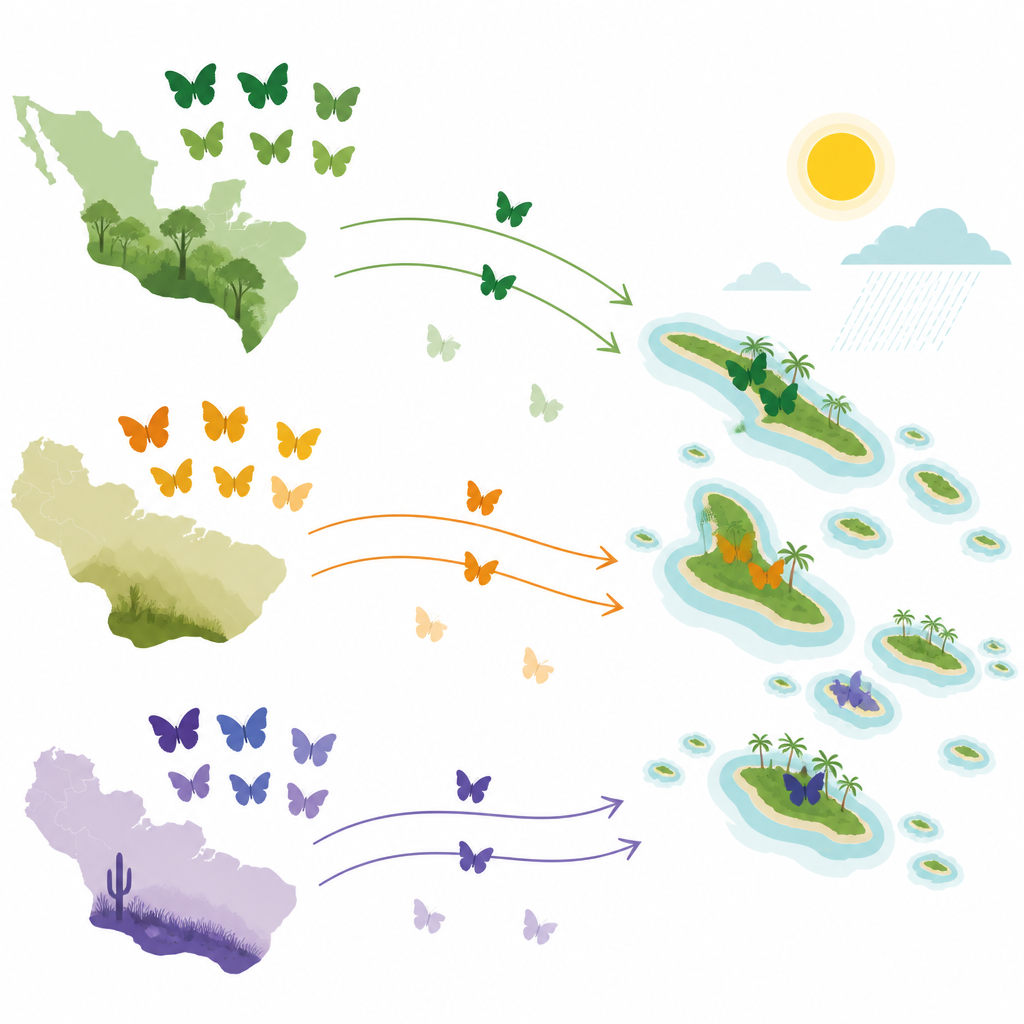
The researchers worked with butterflies in two families, sulphurs and swallowtails, across the Caribbean Islands. First, they created broad starting lists of species in nearby mainland areas using large online biodiversity databases. They defined two versions of the source pool: one based on the countries surrounding the Caribbean Sea, and another based on finer scale ecological regions. From these records they removed doubtful data, temporary visitors, invasive species, and island endemics, leaving only species that are genuine candidates to move from mainland to islands.
Using climate as a natural filter
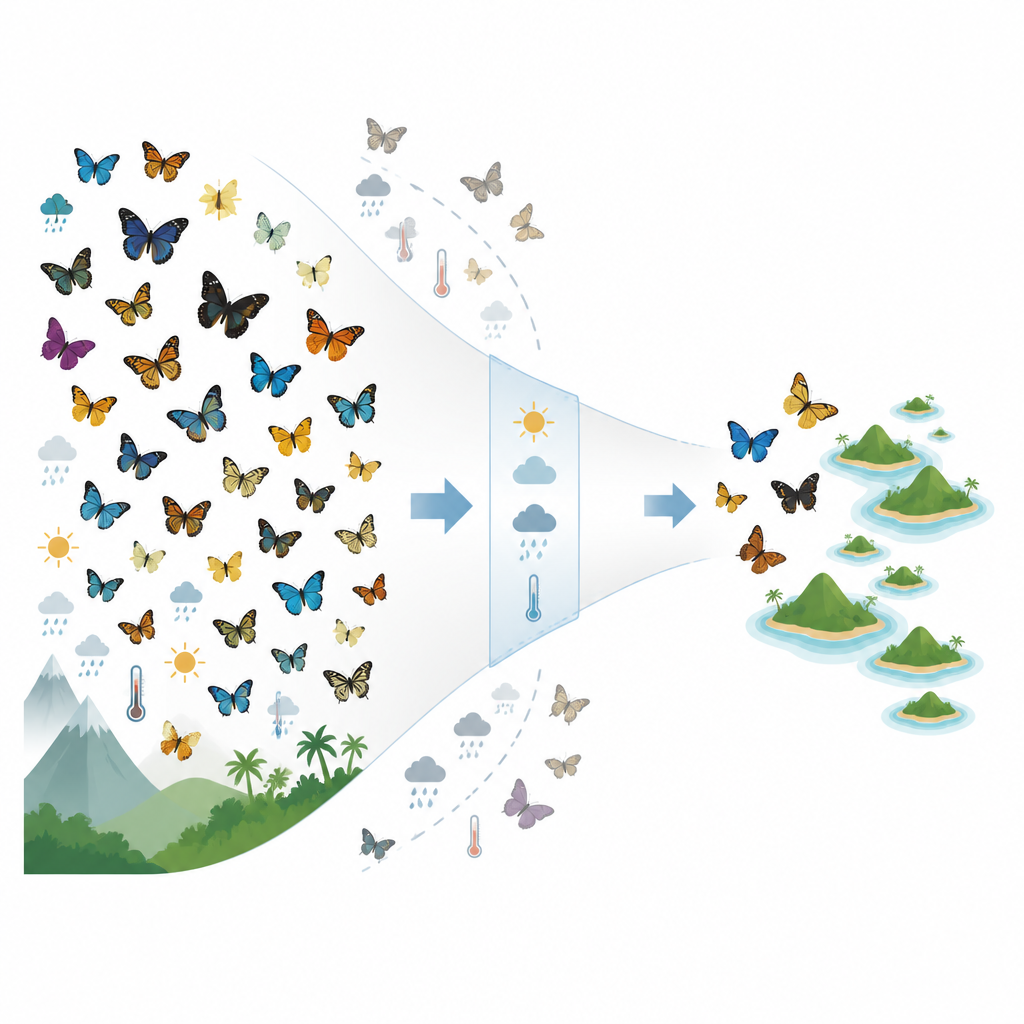
Next, the team used ecological niche modeling to act as an environmental filter. For each butterfly species they described its preferred climate using a simple geometric shape in a space defined by temperature and rainfall. They then checked whether each island’s climate fell inside or outside that shape. If an island’s conditions overlapped a species’ climate space, that species was marked as a potential colonizer for that island. If not, it was removed from the potential pool. This step drastically reduced the initial lists while aiming to keep all species that truly could survive on the islands.
What the models got right and wrong
Comparing their predictions with an authoritative atlas of Caribbean butterflies, the authors found that the filtered lists matched observed patterns very closely. They rarely missed species that are actually present on islands, which means the method keeps omission errors low. However, the models often predicted that many more species could find suitable conditions on islands than are actually there. The authors interpret these so called commission errors as highlighting species that have suitable climates available but have not yet arrived or established, perhaps because of limited dispersal, historical chance, or interactions with other species.
Why this approach is useful
The study shows that climate based filtering can turn vague regional species pools into concrete, testable lists of potential colonizers. It works similarly well whether the starting region is defined broadly by countries or more finely by ecological regions, suggesting that source area size is less critical than expected. For scientists and conservation planners, this method offers a practical way to estimate not only how many species could occupy islands, but which ones they are, helping to anticipate future changes in island biodiversity as climates shift and species move.
Citation: Nuñez-Penichet, C., Soberón, J., Cobos, M.E. et al. Enhancing island biogeography: improving identification of potential species pools via environmental filtering. Sci Rep 16, 15296 (2026). https://doi.org/10.1038/s41598-026-43084-9
Keywords: island biogeography, species pools, ecological niche modeling, Caribbean butterflies, environmental filtering