Clear Sky Science · en
Intraspecific interactions in spring-staging geese reflect mate guarding and proximity to nesting dates
Why goose squabbles matter
Every spring, huge numbers of wild geese pause in wet fields and river valleys on their way to northern breeding grounds. To a casual observer these gatherings look peaceful, but beneath the honking and grazing lies an intense social drama. This study asks a deceptively simple question: when geese jostle and chase one another in these big flocks, are they mostly fighting over food, or are they really protecting their romantic partners as the nesting season approaches?
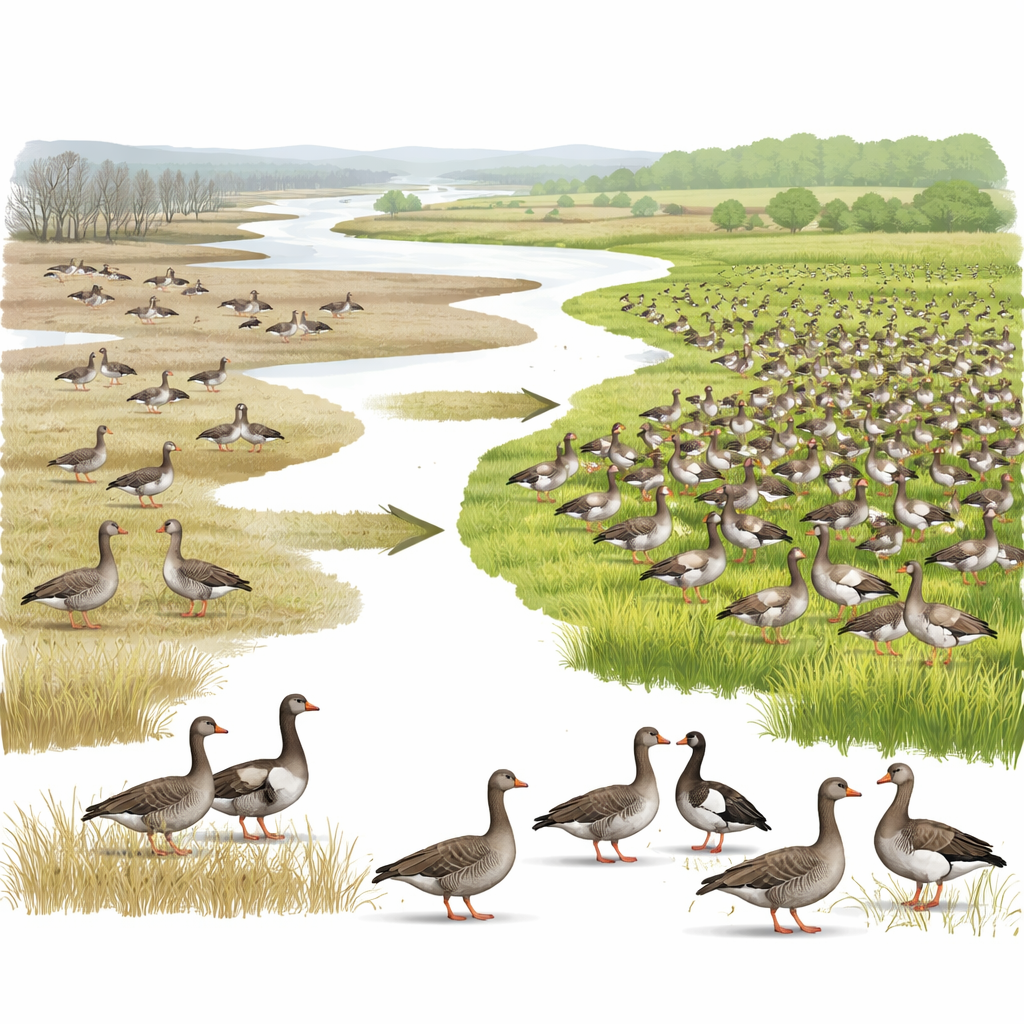
Busy rest stops on a long journey
The researchers focused on the Biebrza Basin in northeastern Poland, a vast floodplain that serves as a crucial “service station” for migrating geese each spring. Four species gather there: Greylag Geese, which nest locally and start laying eggs in March, and three species that continue on to the Russian Arctic, where they breed much later. During the 2024 spring season, observers spent 222 hours watching mixed flocks of up to tens of thousands of birds scattered across grasslands and cereal fields, carefully noting who fought with whom and under what conditions.
Watching every flare-up
To capture rare bursts of conflict in these huge flocks, the team used repeated five-minute scans. In each short session they recorded which species were present, how many individuals of each species were there, where they were feeding, and whether any aggressive encounters took place. Aggression included chasing, hissing, pecking, and the classic low, stretched neck posture that signals an imminent attack. Rather than trying to follow particular birds, they treated each species within each five-minute window as a simple yes-or-no case: did members of that species initiate at least one aggressive act during that bout, or not?
Fights with neighbors, not strangers
Across 662 aggressive episodes, the picture was strikingly one-sided: 97% of all aggression occurred within the same species. Very few conflicts crossed species lines, and none were directed at Greylag Geese from other kinds of geese. As flock size increased, so did the chance of seeing aggression, regardless of species. Yet when the researchers adjusted for how many individuals of each species they had scanned, patterns emerged. Greylag Geese, the early local breeders, showed by far the highest rate of aggression per bird, while Greater White-fronted Geese, the most numerous Arctic breeders, were the least aggressive on a per-bird basis. Importantly, aggression levels did not differ between richer cereal fields and simpler grasslands, even though cereals offer better feeding.
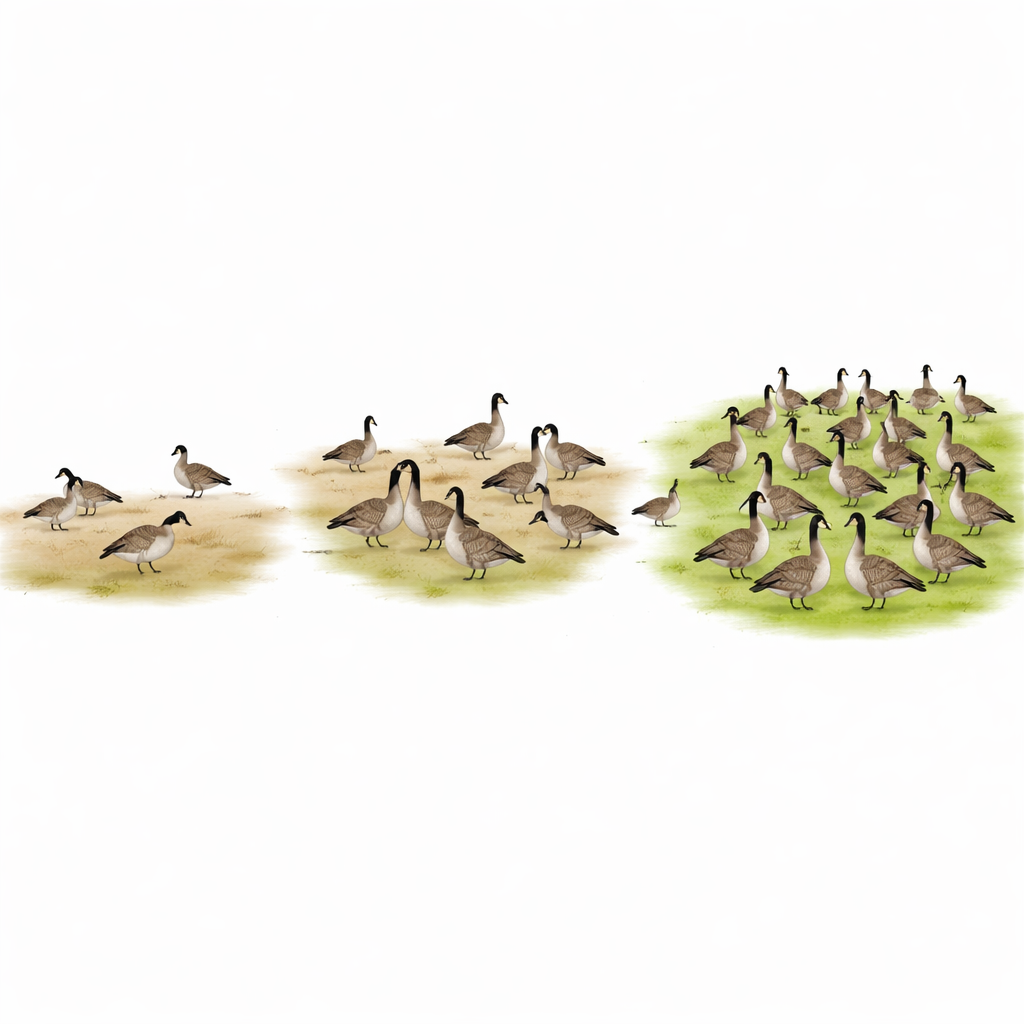
Spring timing and rising tension
The calendar turned out to matter as much as crowding. For Greylag Geese and Barnacle Geese, the likelihood of observing aggression stayed at a high level throughout the season, reflecting their earlier or more imminent breeding. In contrast, Greater White-fronted and Tundra Bean Geese were relatively peaceful in early spring, then ramped up their aggression sharply in the last weeks before they left Poland for Arctic nesting grounds. By that time, their overall aggression levels had climbed to match those of the more consistently combative species. Because this rise tracked each species’ own nesting schedule rather than food conditions, it pointed away from simple competition over feeding spots.
Guarding mates, not defending fields
Putting all these pieces together, the authors argue that most of the pushing and chasing in these spring goose flocks is best understood as mate guarding and close-range social defense. Male geese in long-term pairs need to keep rivals away as their partners build up energy reserves and approach egg-laying, when the risk of extra-pair mating is highest. Larger flocks bring more neighbors into close proximity, increasing opportunities for such clashes. The dominance of within-species conflicts, their strong links to flock size and species-specific nesting dates, and the lack of any detectable effect of habitat quality all support this view. While the study cannot entirely rule out food-related or other motives, it shows that what looks like a simple feeding crowd is also a finely tuned social arena where family bonds and future goslings are at stake.
Citation: Polakowski, M., Jankowiak, Ł. & Fox, A.D. Intraspecific interactions in spring-staging geese reflect mate guarding and proximity to nesting dates. Sci Rep 16, 13608 (2026). https://doi.org/10.1038/s41598-026-43082-x
Keywords: geese behavior, mate guarding, migration stopover, bird aggression, breeding timing