Clear Sky Science · en
Green-synthesized N-acetylcarnosine–loaded gold nanoparticles as a novel ocular nanocarrier for antioxidant therapy and cataract prevention
Why eye clouding matters to everyone
Cataracts, a cloudy change in the eye’s clear lens, are one of the most common causes of vision loss worldwide. Surgery to replace the lens usually restores sight, but it is costly, invasive, and not always easy to access. This study explores a gentler idea: tiny particles made from gold and plant extracts that can carry an antioxidant drug into the eye, with the long-term goal of slowing or preventing cataracts without surgery.
Turning a healing herb into tiny helpers
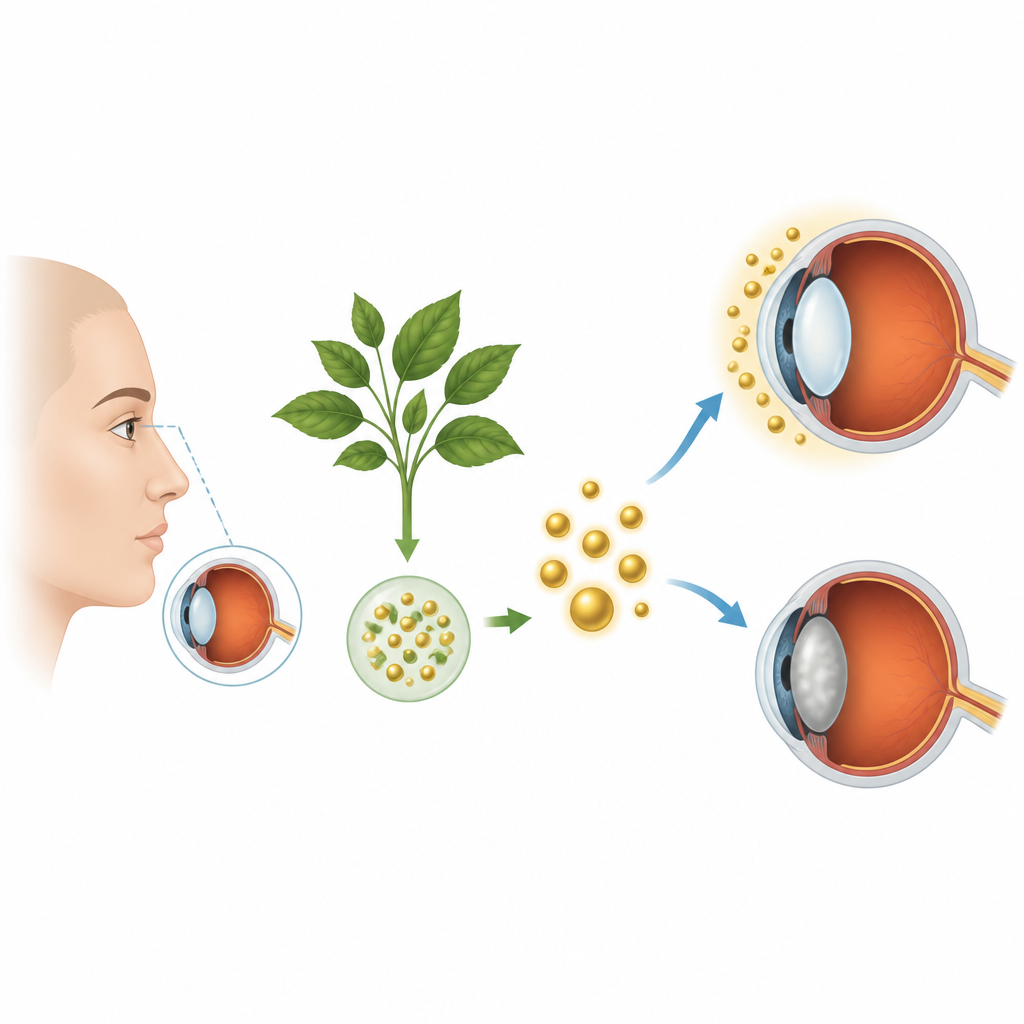
The researchers started with Alchemilla vulgaris, also known as Lady’s mantle, a medicinal plant rich in natural antioxidants. They used its extract to “green synthesize” very small gold particles in water, avoiding harsh chemicals. These gold nanoparticles formed when the plant compounds reduced gold ions and then coated the metal surface, keeping the particles stable and uniform in size. The team carefully measured their structure, charge, and shape using light, X-ray, and surface imaging techniques to confirm that the gold cores were crystalline, roughly 15–35 nanometers across, and well protected by the plant molecules.
Loading the gold carriers with an eye-friendly shield
Next, the team attached N-acetylcarnosine (NAC), a known eye-safe antioxidant, onto the surface of the gold nanoparticles. NAC was chosen because it can neutralize harmful reactive molecules that damage the lens proteins responsible for keeping the lens clear. Tests showed that the particles could hold NAC efficiently, with most of the drug successfully attached, and that NAC was released in a controlled way, especially under slightly acidic conditions similar to stressed eye tissues. Computer modeling suggested that NAC can form stabilizing contacts with key lens proteins, hinting that it might help keep them from clumping into light-scattering aggregates.
Testing safety and lens-clearing power
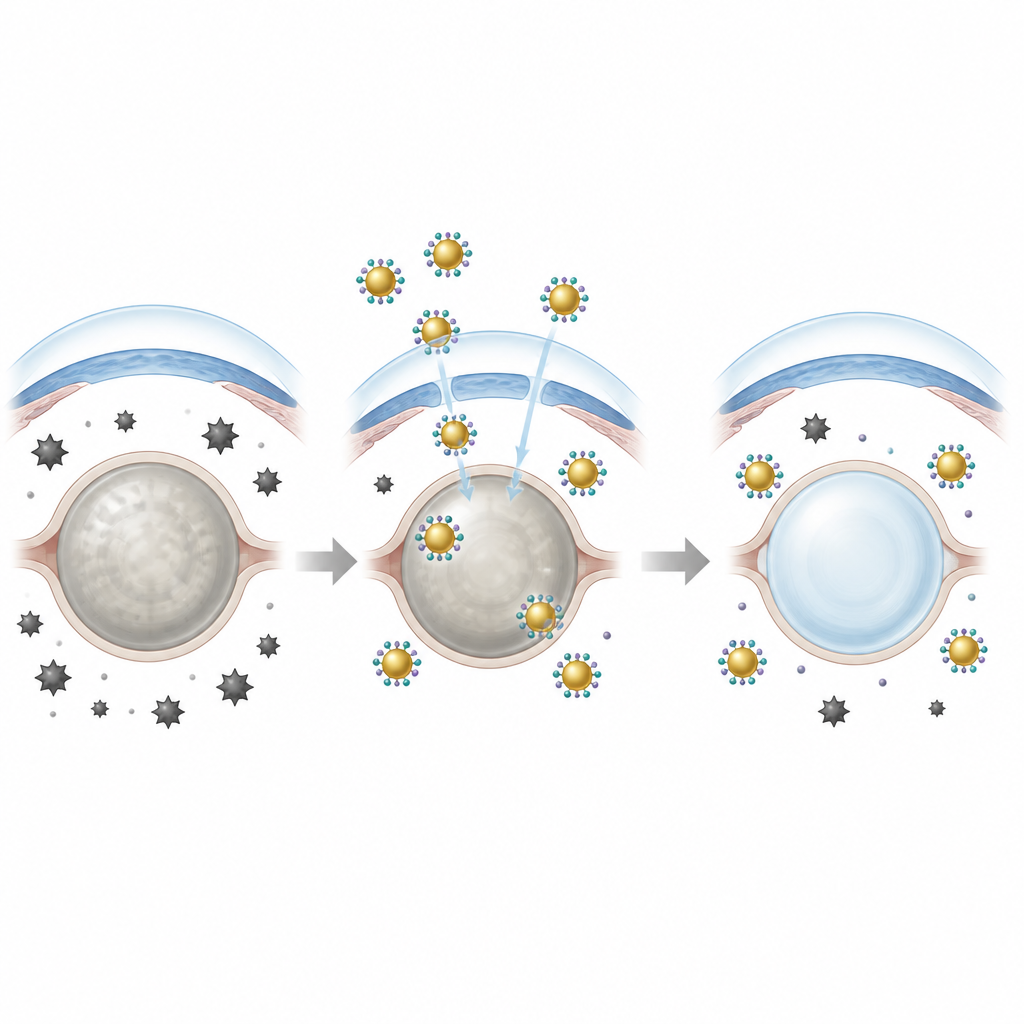
To check safety, the researchers exposed human lens cells grown in the lab to the plant extract, the bare gold particles, and the NAC-loaded particles. Cell survival stayed well above accepted safety limits, even at higher doses, indicating that the formulations were not strongly toxic. They also measured how well the different samples could quench a standard free radical signal and found that NAC-loaded gold particles showed strong antioxidant activity, similar to established antioxidants. The most eye-catching tests used real human cataract lenses, removed during surgery and then soaked in solutions containing various NAC doses carried by the gold particles.
Clearer lenses in the lab
Over a period of up to fifteen days, lenses from patients with diabetes or kidney disease gradually became less cloudy when treated with the NAC-loaded gold suspensions. The improvements were stronger at higher NAC levels, especially around 0.1 to 0.3 millimolar concentration. Images revealed reduced yellowing and more uniform transparency compared with untreated samples. These results suggest that the nanoparticle system helps NAC reach and remain in the lens tissue, where it can counter oxidative damage and protein clumping that drive cataract formation. Importantly, the drug carrier design appears stable and behaves as a sustained-release depot rather than a quick, short-lived burst.
What this could mean for future eye care
For people facing vision loss from cataracts, this work points toward the possibility of eye drops or similar treatments that might delay or reduce the need for surgery. The study shows that gold nanoparticles made with a common herb can safely carry an antioxidant drug, release it gradually, and improve clarity in human cataract lenses outside the body. While these findings are still early and based on lab and ex vivo experiments, they provide a foundation for future animal and clinical studies aimed at developing non-surgical, antioxidant-based strategies to help keep the eye’s lens clear.
Citation: Abid, A.S., Al-Garawi, Z.S. & Öztürkkan, F.E. Green-synthesized N-acetylcarnosine–loaded gold nanoparticles as a novel ocular nanocarrier for antioxidant therapy and cataract prevention. Sci Rep 16, 14861 (2026). https://doi.org/10.1038/s41598-026-43070-1
Keywords: cataract, ocular drug delivery, gold nanoparticles, antioxidant therapy, N-acetylcarnosine