Clear Sky Science · en
The AHEAD-NLR score: a novel inflammatory-comorbidity integrated tool for predicting long-term mortality in patients with heart failure after acute myocardial infarction
Why this matters for people with heart trouble
Surviving a heart attack is only the beginning. Many patients later develop heart failure, a chronic weakening of the heart that sharply raises the risk of dying in the following years. Doctors use scoring tools to estimate this risk and guide treatment, but most do not fully account for the body’s inflammatory response after a heart attack. This study introduces a new, simple bedside score called AHEAD-NLR that blends traditional risk factors with a blood marker of inflammation to better predict which patients are in real danger.

From a classic risk score to an updated tool
Clinicians already use a score called AHEAD in acute heart failure. It adds one point each for five common problems: irregular heartbeat (atrial fibrillation), low red blood cell levels, older age, poor kidney function, and diabetes. More points mean higher risk of death. However, this earlier score was built for a broad group of heart failure patients, not specifically for those whose heart failure follows a heart attack. In that setting, inflammation triggered by damaged heart muscle plays a central role in how the disease progresses, yet AHEAD does not include any direct measure of this process.
Spotlighting inflammation with a simple blood ratio
When heart muscle cells die during a heart attack, they release signals that rally the immune system. White blood cells flood in, and if this reaction is too strong or prolonged, it can worsen scarring and weaken the heart over time. The neutrophil-to-lymphocyte ratio (NLR), calculated from a routine blood count, captures this balance between aggressive and protective immune cells. Higher ratios point to stronger, more harmful inflammation. Previous work had already shown that NLR predicts poor outcomes after heart attacks and in heart failure, making it an attractive candidate to upgrade existing risk scores.
Who was studied and what was measured
The researchers analyzed 840 adults treated for heart attacks complicated by heart failure at a single hospital over five years. Most were men in their early sixties. All had comprehensive records, including heart ultrasound, kidney function, blood cell counts, and markers of clotting and stress on the heart. Patients were followed for up to four years, during which about one in six died from any cause. The team first confirmed that higher AHEAD scores tracked closely with worse heart pumping ability, more kidney damage, more use of powerful water pills, and higher levels of inflammatory and metabolic markers. They then examined how well AHEAD predicted long-term death and tested whether adding NLR would sharpen this prediction.
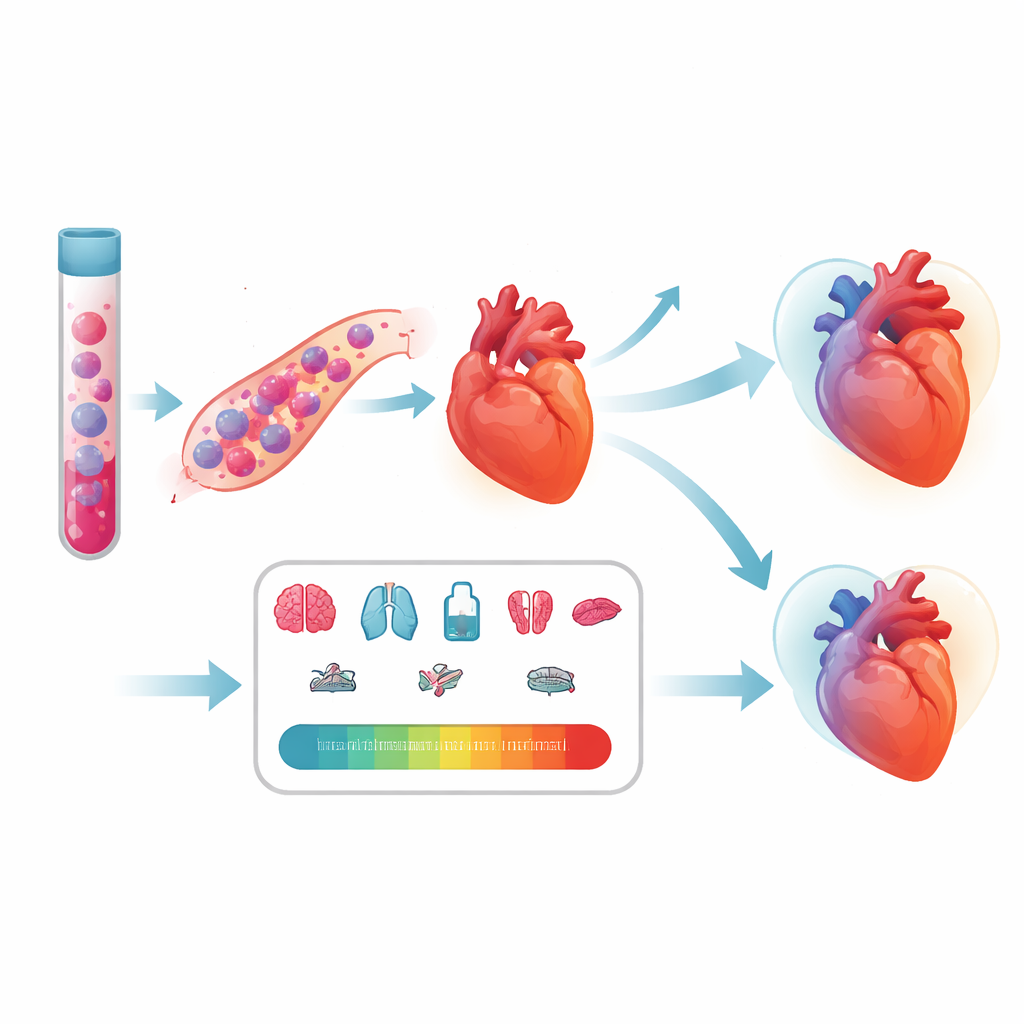
How adding inflammation improved prediction
Even after taking into account age, sex, kidney function, blood chemistry, and heart pumping strength, each one-point rise in the original AHEAD score was linked to a meaningful increase in the chance of dying over four years. But NLR itself was also a strong, independent predictor: patients with higher ratios faced substantially greater risk. The team selected an NLR cut-off of about eight, above which inflammation appeared especially dangerous. They then built the AHEAD-NLR score by simply adding one extra point when NLR exceeded this threshold. Statistical tests showed that this combined score reclassified about one quarter of patients into more accurate risk categories and discriminated better between those who lived and those who died than the AHEAD score alone.
What this means for patients and doctors
For people who develop heart failure after a heart attack, the AHEAD-NLR score offers a more complete picture of risk by marrying long-term health conditions with the immediate inflammatory storm triggered by heart damage. Patients with three or more points on this scale appear to cross an important danger line, signaling the need for closer follow-up and possibly more aggressive treatment. While the study has limits—it was retrospective, from a single center, and has not yet been tested in other hospitals—it suggests that a simple extra number from a standard blood test can help doctors better identify which survivors of heart attacks are most in need of protection in the years that follow.
Citation: Lin, G., Dai, C. & Chen, W. The AHEAD-NLR score: a novel inflammatory-comorbidity integrated tool for predicting long-term mortality in patients with heart failure after acute myocardial infarction. Sci Rep 16, 12436 (2026). https://doi.org/10.1038/s41598-026-43062-1
Keywords: heart failure, acute myocardial infarction, risk prediction score, inflammation biomarker, neutrophil lymphocyte ratio