Clear Sky Science · en
Research on deformation mechanisms in deep excavation tunnels and the application of the pile foundation-unit-type support
Keeping Underground Tunnels Safe
Deep underground tunnels are the arteries of modern coal mines, carrying fresh air, workers, and heavy equipment. But at great depths, the surrounding rock can slowly squeeze in, crack, and buckle the tunnel floor, threatening both safety and productivity. This study looks closely at a deformed transport tunnel in an Inner Mongolia coal mine and tests a new way to hold the rock in place using a combination of piles in the floor and modular supports, working together with conventional rock bolts and cables.
When the Ground Starts to Move
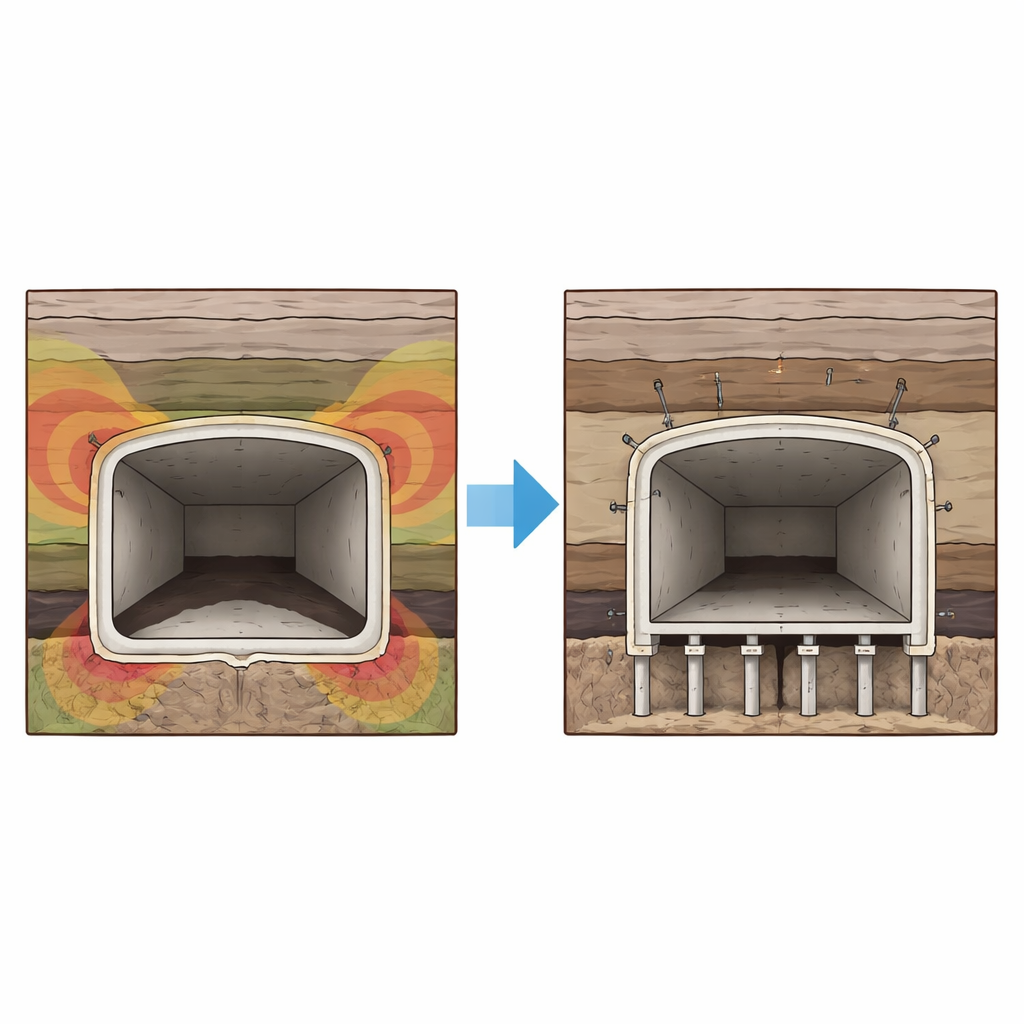
The tunnel examined in this work lies about 420 meters below the surface in a thick and mostly stable coal seam. Even so, the floor had cracked and heaved upward in an uneven way, the roof had sagged, and the ribs—the tunnel sidewalls—had bulged. The most serious problem was floor heave on the solid coal side, which distorted the roadway and endangered vehicles traveling through. The coal pillar side also showed damage, while the roof and solid coal wall were comparatively less affected. These patterns suggested that the original balance of forces in the deep rock had been disturbed by excavation.
How Underground Stresses Break a Tunnel
To understand why the tunnel was deforming, the researchers combined field sampling, lab tests on rock cores, and on-site stress measurements. They found that the natural horizontal stresses in the rock were stronger than the vertical stresses from the overlying weight. Using these measurements, they built a three‑dimensional numerical model of the rock surrounding the tunnel. The simulations showed that digging the tunnel redistributes stress, creating zones of very high compression and areas of tension around the opening and deeper in the rock. The result is a ring‑shaped zone of rock around the tunnel that is pushed beyond its elastic limit, where it begins to deform permanently and crack.
Why the Floor Bows Up Unevenly
The team then used a simplified mechanical model of the tunnel floor, treating it like a beam resting on softer zones at each end. They showed that the amount and position of floor heave depend strongly on two things: how wide the softened “plastic” zones are at each side of the floor, and how much the stress is concentrated there. When both sides are similar, the floor bulges most in the center. But if one side has a wider weakened zone or a higher stress concentration, the largest upward movement shifts toward that side and grows in size. In their case, the solid coal side had the stronger effect, explaining the pronounced asymmetric floor heave observed in the mine.
A New Way to Hold Up the Rock
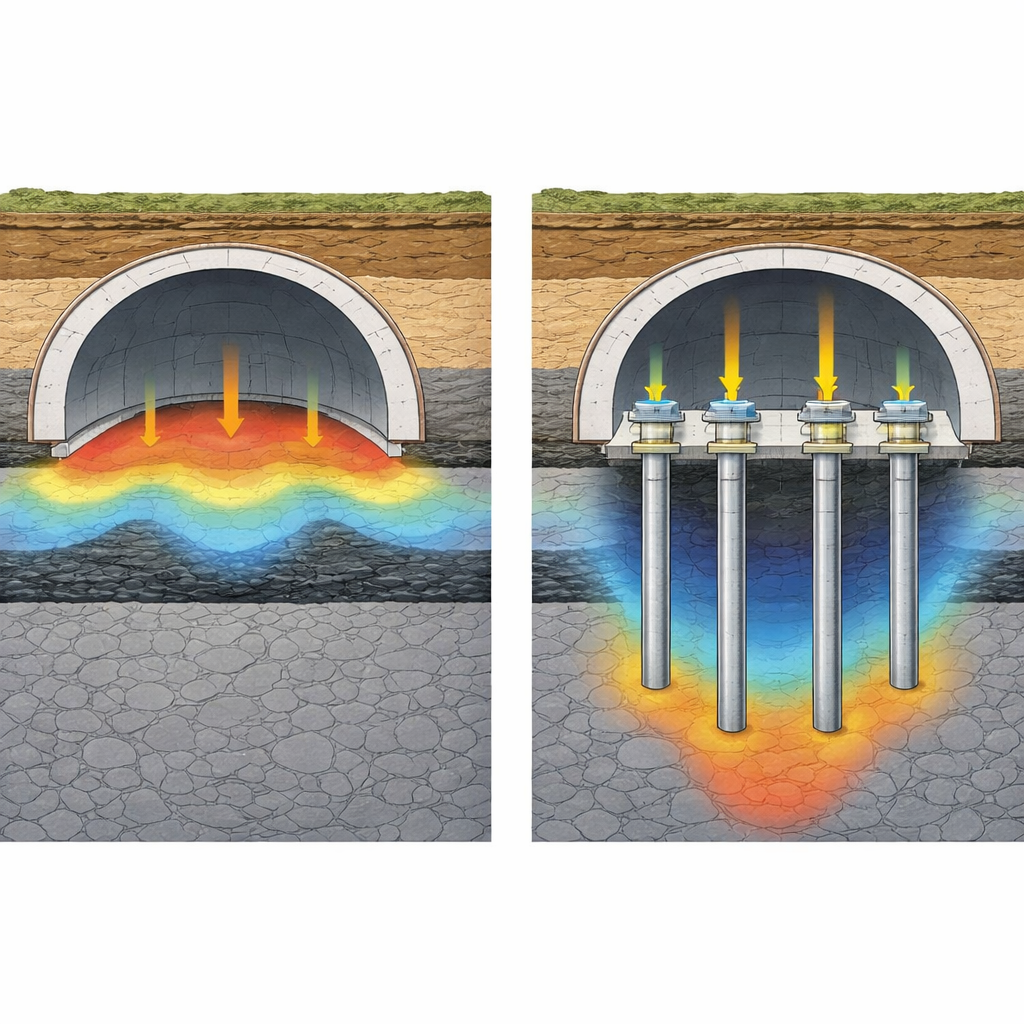
Because conventional bolts and cables alone could not tame the deformation, the researchers proposed a new support concept: pile foundation–unit‑type support. Steel piles are drilled into the tunnel floor and topped with a flat cap that carries modular hydraulic support units. These supports work together with the existing bolts and cables in the roof and walls. The piles improve the stress conditions in the floor, cut off the plastic flow of weakened rock beneath the tunnel, and provide a level, stable base so the supports can act vertically and efficiently. At the same time, the supports share and spread the load, reducing stress build‑up along the sidewalls.
Turning Dangerous Squeeze into Stable Ground
Numerical simulations of the combined support system showed dramatic improvements. Roof and floor movements dropped by more than 80 to 90 percent, and sidewall displacements were cut by roughly three‑quarters or more. The once continuous ring of heavily damaged rock around the tunnel broke into smaller, isolated zones, especially in the floor where plastic strain was interrupted at the pile rows and reduced by up to about 80 percent. In simple terms, the new support scheme turns a badly squeezed and shifting tunnel into one where rock movements are reduced to the centimeter scale and stresses are carried safely by piles and supports. For deep mining operations, this approach offers a promising way to keep critical transport tunnels open, stable, and safe.
Citation: Gou, L., An, D., Song, Y. et al. Research on deformation mechanisms in deep excavation tunnels and the application of the pile foundation-unit-type support. Sci Rep 16, 12233 (2026). https://doi.org/10.1038/s41598-026-43056-z
Keywords: tunnel deformation, floor heave, underground mining, rock support, pile foundation