Clear Sky Science · en
Temperature effects on development and cuticular hydrocarbons in forensically relevant Dermestes maculatus
Why beetles can help solve mysteries
When a body is discovered, insects often provide some of the best clues about how long a person has been dead. This study looks at a small beetle, Dermestes maculatus, that feeds on dried flesh in the later stages of decomposition. By asking how temperature changes both the beetle’s growth and the waxy chemicals on its skin, the researchers explore new ways to estimate time since death more accurately, especially in hot, dry climates where other insects are scarce.
A late‑arriving but important crime‑scene visitor
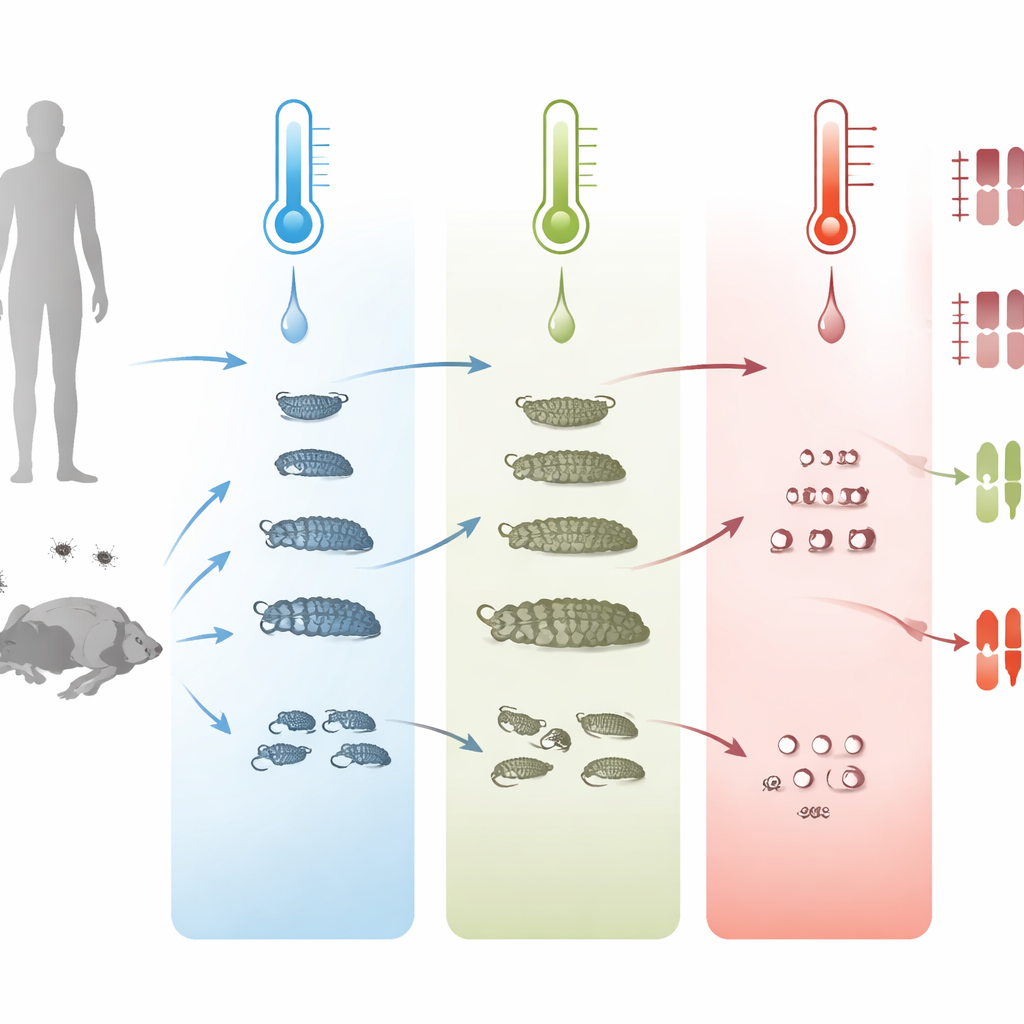
Dermestes maculatus is found worldwide and commonly appears on remains once soft tissues have begun to dry. That makes it particularly useful in cases involving mummified or skeletonized bodies, or when remains are indoors or in the desert. It is also a serious pest of stored animal products, such as dried fish and museum specimens, so understanding its biology has economic as well as forensic value. Before running experiments, the team carefully confirmed that the beetles they collected from a rabbit carcass near Riyadh were indeed D. maculatus, using both traditional microscope features and DNA testing.
How heat changes growth and survival
The researchers raised beetle eggs and larvae in the laboratory at three constant temperatures—cool (20 °C), warm (30 °C), and very hot (40 °C)—under controlled humidity and light. At 20 °C and 30 °C they followed individual larvae through their stages, measuring body length, head width, and weight. At 30 °C, development sped up dramatically: larvae finished in about 15 days compared with 28 days at 20 °C, and the pupal stage was nearly half as long. Larvae at the warmer setting were heavier and larger during the middle stages, and they reached adulthood after six molts instead of seven. At 40 °C, however, the story reversed—about 80% of eggs never hatched, and all larvae that did emerge died early, showing that this temperature is beyond the beetle’s upper limit under the tested conditions.
Tiny surface waxes as hidden timekeepers
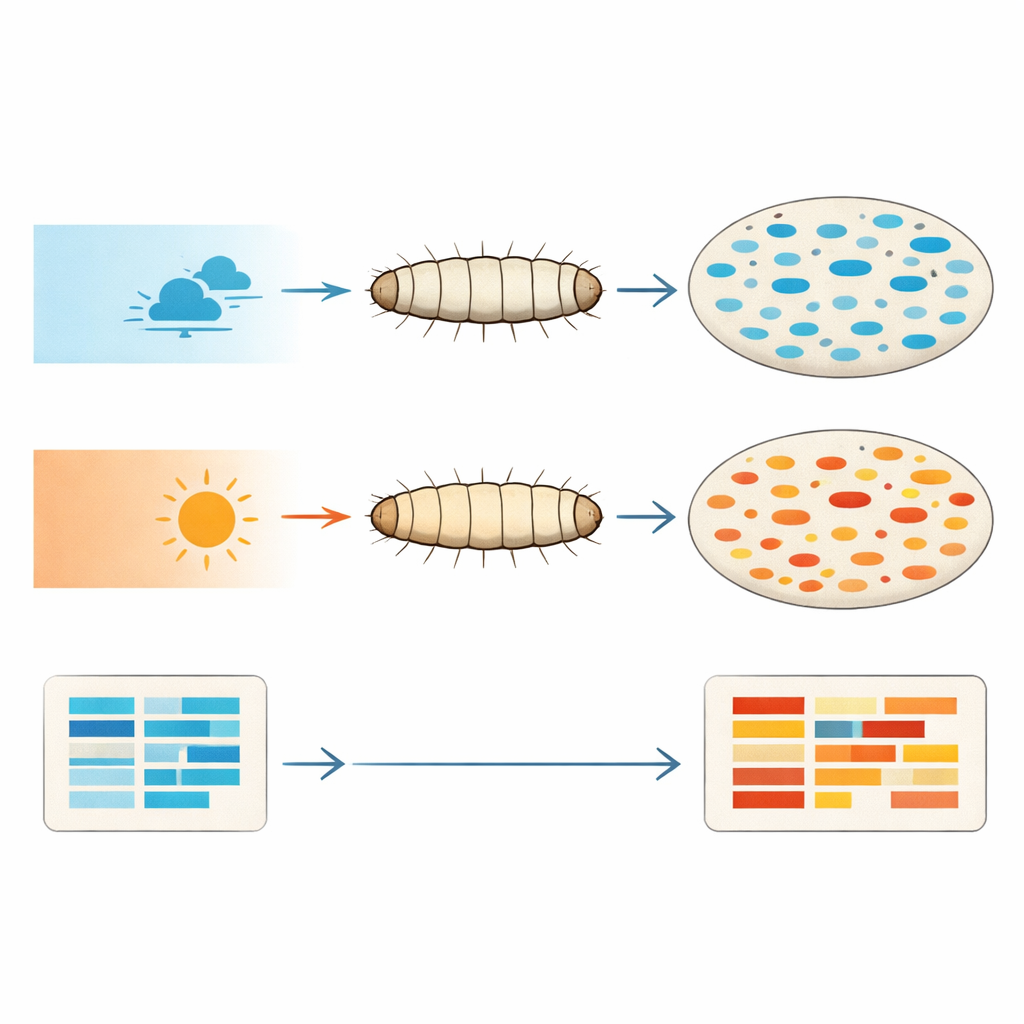
Beyond size and weight, the team looked at the thin oily layer that coats the larval body. This layer contains “cuticular hydrocarbons,” long‑chain waxy molecules that help keep the insect from drying out and can also play roles in communication. Using gas chromatography–mass spectrometry, they analyzed these surface chemicals in the 2nd, 4th, and 6th larval stages raised at 20 °C and 30 °C. They found around 40 different compounds, including straight‑chain and branched molecules with varying lengths. Some key hydrocarbons appeared in every stage and temperature, while others were present only at certain ages or only at one of the two temperatures. At the warmer setting, young larvae showed a greater variety of compounds, and older larvae had distinct sets of chemicals that did not appear in the cooler group.
Patterns that encode age and heat history
To see whether these chemical fingerprints could reliably separate ages and temperatures, the researchers used statistical tools that look at many compounds at once. The patterns clearly grouped samples by both larval stage and rearing temperature, meaning that the mix of surface waxes encodes information about how old the larvae are and how warm their environment has been. Notably, early stages showed only small differences in body measurements between 20 °C and 30 °C, but their chemical profiles were already distinct. In later stages, both body size and surface chemicals clearly reflected temperature, suggesting that physical and chemical clues are strongest at different times in development.
What this means for real‑world investigations
For forensic work, these findings point to a combined approach. In cooler or moderate conditions where D. maculatus can develop normally, investigators could use larval size and weight to help estimate age, especially in middle and late stages. For very young larvae, or when growth measures are uncertain, analyzing cuticular hydrocarbons could add precision by revealing both age and approximate temperature exposure. At extreme heat, where development fails, the absence of these beetles may itself be an important clue. While the study stresses that more work is needed under natural, fluctuating outdoor conditions, it shows that the growth patterns and body surface chemistry of this beetle can act as sensitive biological clocks, improving time‑since‑death estimates in challenging cases.
Citation: Alajmi, R., AlOufi, M., AlKuriji, M. et al. Temperature effects on development and cuticular hydrocarbons in forensically relevant Dermestes maculatus. Sci Rep 16, 13152 (2026). https://doi.org/10.1038/s41598-026-43051-4
Keywords: forensic entomology, Dermestes maculatus, postmortem interval, temperature effects, cuticular hydrocarbons