Clear Sky Science · en
Optimization of a hybrid solar still–HDH system via parametric study for lightweight desalination in remote areas
Turning Sunlight into Drinking Water
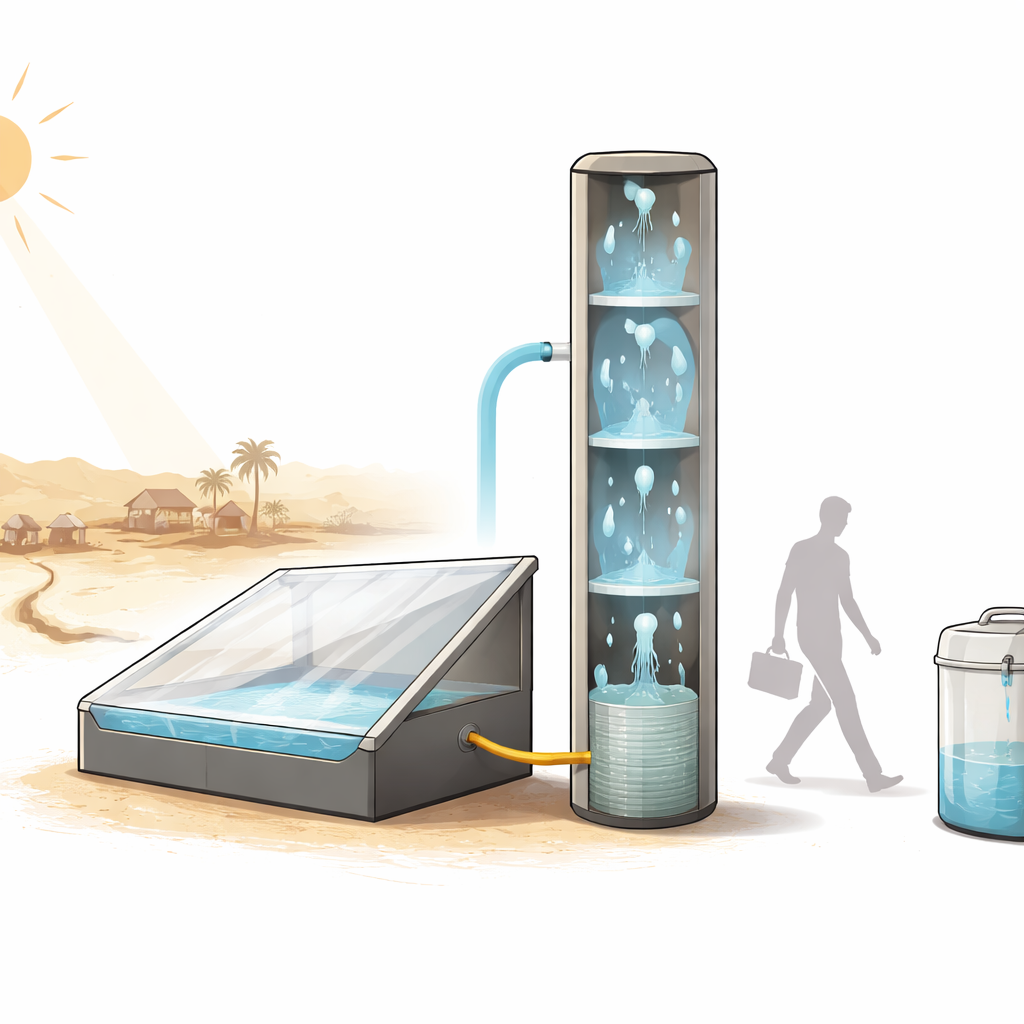
For many remote villages in hot, dry regions, clean drinking water is far harder to come by than sunshine. Large desalination plants are too expensive and complex, while simple solar stills are often heavy and not productive enough. This study explores how to redesign a compact solar-powered device so it can turn salty water into fresh water efficiently, while staying light enough to move, install, and maintain in off-grid communities.
A Smarter Way to Use the Sun
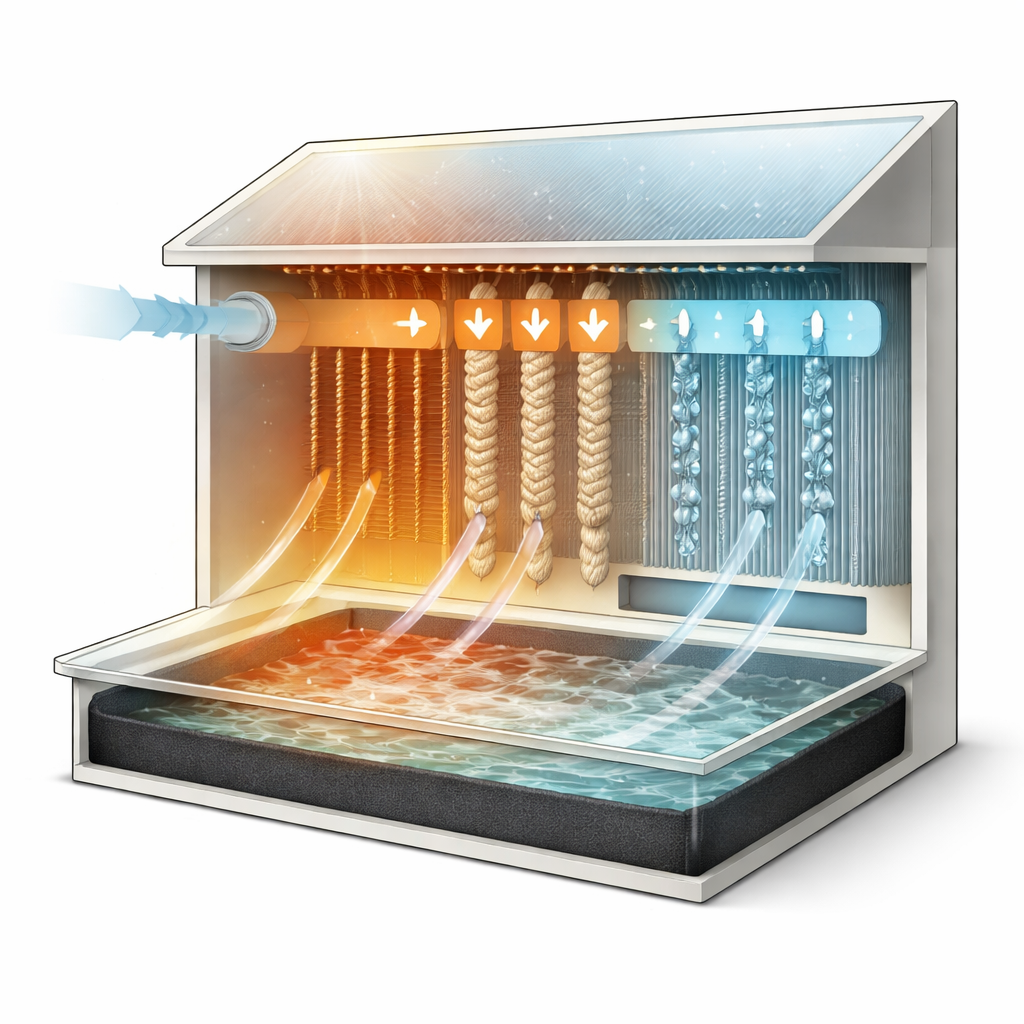
The researchers focus on a hybrid system that combines a traditional solar still with a process called humidification–dehumidification, which mimics the natural water cycle inside a small box. Sunlight heats a shallow pool of salty water, creating warm vapor that condenses on a cool glass cover as fresh water. At the same time, air is guided through channels and over special surfaces so it can pick up moisture and then release it again as extra distilled water. By recovering heat that would otherwise be wasted, this combined unit can produce up to about 50 liters of fresh water per day, enough to supply a small group of people.
Tuning Water Depth and Airflow
Although the device looks simple from the outside, its performance depends strongly on details such as how much water sits in the basin and how fast the air moves through it. Using a time-based computer model fed with real weather data from Abu Dhabi, the team tested different operating conditions for both winter and summer. They found that keeping the water in the basin very shallow—about half a centimeter—lets it heat up faster, boosting evaporation. Compared with a deeper three-centimeter layer, this shallow setting increased fresh water output by up to 15 percent in winter and about 7.5 percent in summer, while also reducing the weight of water that must be held by the structure. Slowing the air flow through the unit to around one tenth of a kilogram per second further raised productivity by roughly 11–12 percent. At these low flow rates, the system could even run on natural buoyancy without fans, reducing energy use and mechanical complexity.
Building Light Without Losing Performance
Beyond how the system is operated, the choice of materials makes a large difference to how heavy it is and how easily it can be installed in remote places. The authors compared standard stainless steel parts and thick glass with lighter alternatives such as cotton fabrics and thinner panes. Replacing the metal basin with a black-coated cotton liner dramatically cut the unit’s overall mass—from about 487 kilograms to roughly 132 kilograms—while leaving water production almost unchanged. Likewise, reducing both the basin and glass cover thickness from three millimeters to one millimeter saved considerable weight but did not noticeably affect how much water the still produced. These results suggest that, for many components, designers can safely choose the lightest practical version without sacrificing output.
When Lightness Comes at a Cost
Not every attempt to trim weight pays off. When the finned metal absorber that helps heat the air was replaced by cotton rope, the unit did become lighter, but in summer its water yield dropped by about 15 percent. Similarly, swapping conventional glass covers for plastic reduced the mass of the glazing but cut productivity by about 10–11 percent because less sunlight reached the water. In other words, some key parts must remain good heat and light conductors even if they are a bit heavier. The best compromise the team found keeps aluminum fins and glass covers while using cotton and thin layers where they do not harm performance.
A Portable Freshwater Maker for Remote Communities
By combining their most promising settings and materials, the researchers created an optimized design that produces 31 percent more water in winter and 26 percent more in summer than the reference setup, all while keeping the dry weight near 132 kilograms—about a quarter of the original. For people living far from centralized infrastructure, such a lightweight, self-contained solar desalination unit could offer a practical way to secure drinking water using only sunlight and seawater or brackish water. The study shows that careful tuning of depths, flow rates, and materials can turn an already green technology into one that is also far easier to ship, install, and sustain in the places that need it most.
Citation: Iqbal, M.M.M., Javed, M.S., Atabay, S. et al. Optimization of a hybrid solar still–HDH system via parametric study for lightweight desalination in remote areas. Sci Rep 16, 12816 (2026). https://doi.org/10.1038/s41598-026-43049-y
Keywords: solar desalination, humidification dehumidification, solar still design, lightweight water systems, off grid drinking water