Clear Sky Science · en
Drivers and influence of social conformity on decision making in human-AI teams
Why your future doctor might listen to AI colleagues
As hospitals adopt artificial intelligence to help diagnose and treat patients, doctors are increasingly working in mixed teams with both human and AI "colleagues." This raises a surprisingly human question: do people feel the same subtle social pressure to go along with AI advice as they do with advice from other people? Understanding when we follow machines, when we ignore them, and why, matters for the safety and fairness of decisions about our health, finances, and more.
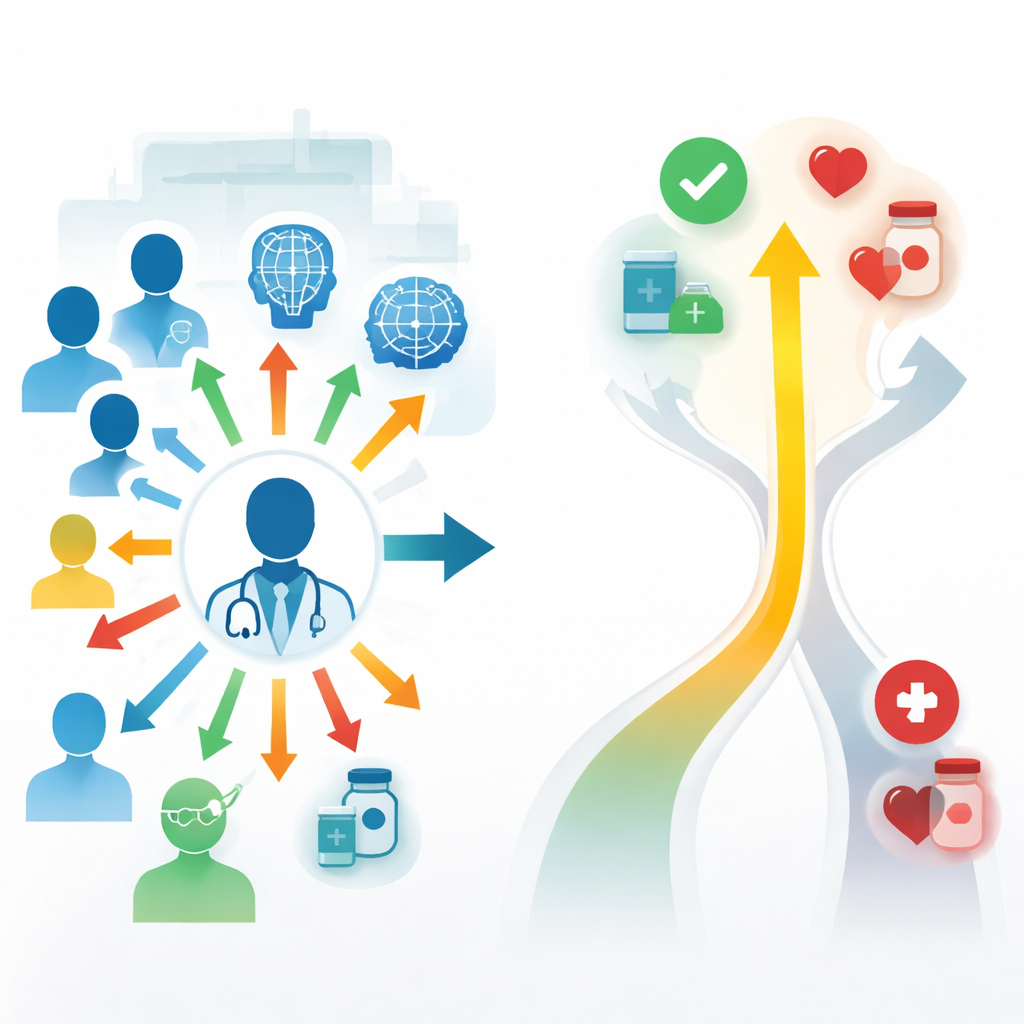
Two kinds of pressure: being right vs. fitting in
Decades of psychology show that people conform to others for two main reasons. One is informational influence: we look to others because they might know something we do not, especially when we are uncertain. The other is normative influence: we go along to gain approval or avoid standing out, even when we privately disagree. This study asked whether these same forces operate when our teammates include AI systems as well as humans. The authors focused on a realistic setting—medical diagnosis—where there is uncertainty and no obvious “correct at a glance” answer, making it ideal for teasing apart genuine information use from social pressure.
A simulated hospital where people and AI give advice
In two online experiments, volunteers took the role of junior doctors diagnosing patients with one of two abdominal illnesses. For each case, they received a private clue (a symptom) and public advice from several advisors labeled as either human clinicians or AI systems. All information was presented abstractly—no friendly robot faces or photos—to avoid simply reacting to appearance. In Study 1, every information source was equally accurate. In Study 2, accuracies varied: some advisors were more reliable than others, and bar charts showed this explicitly. After each case, participants chose a diagnosis and rated how confident they were. The researchers then compared those choices to what an ideal statistical rule (a Bayesian model) would recommend.
When AI feels as informative as people—but less socially compelling
Across both studies, participants behaved as if they were genuinely trying to make good decisions. As the combined evidence increasingly favored one disease, they were more likely to choose it and became more confident, whether that evidence came from humans or AI. Statistically, human and AI advisors exerted very similar informational influence: people treated both as useful sources of evidence. However, in Study 1—where all advisors were equally reliable—another pattern emerged. When human advisors agreed with participants’ own initial impression, people leaned more heavily on that shared view and felt more confident than when the same pattern of agreement came from AI. A detailed modeling approach showed that people gave slightly more weight to human advice than to AI advice, and more weight to their own private information than to any outside advice. This extra pull of human agreement, beyond what accuracy alone would justify, reflects normative influence: the subtle comfort of siding with fellow humans.
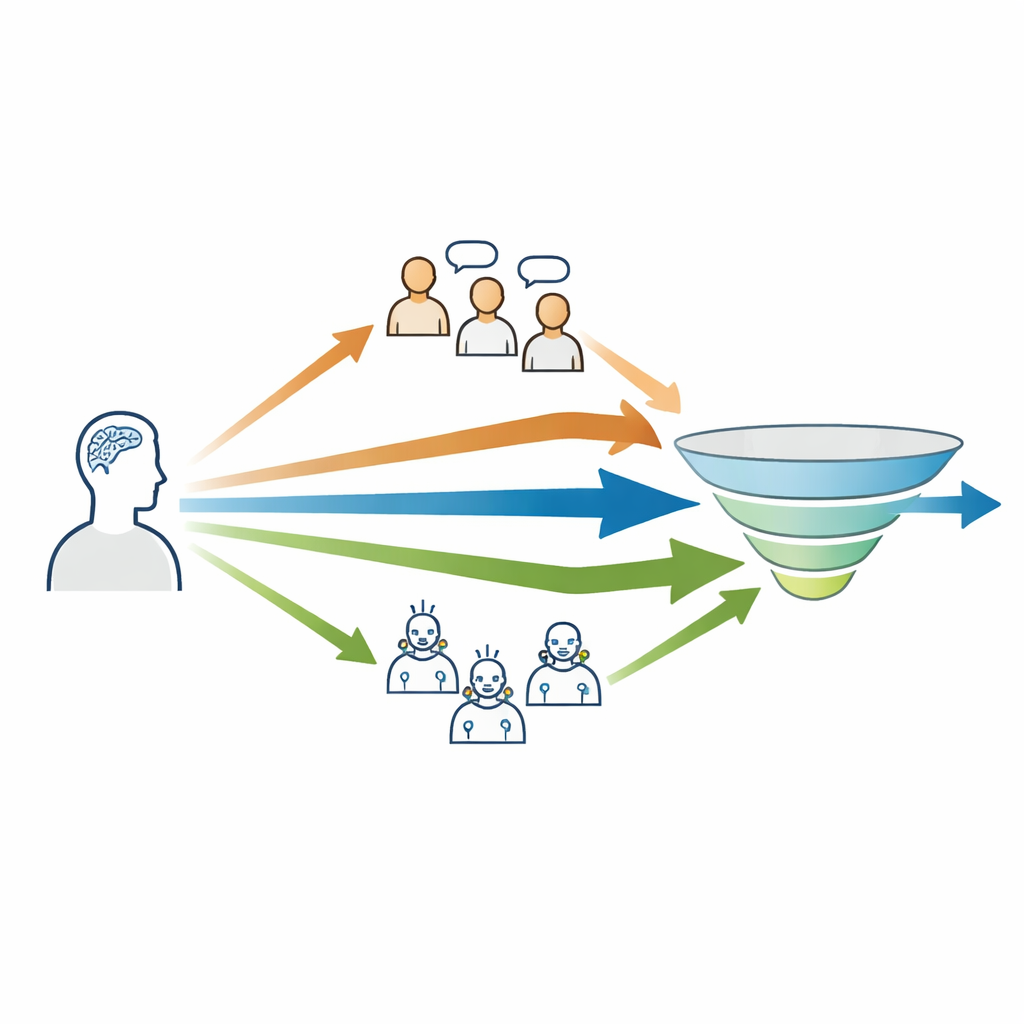
Complex accuracy signals can erase the human edge
Study 2 made the situation more realistic—and more mentally demanding—by varying how accurate each advisor was and displaying those probabilities. Under these richer conditions, the special advantage of human advice largely vanished. People still favored their own private information overall, but human and AI advisors now carried almost identical weight. Everyone’s advice—human and machine alike—was underused compared with the ideal Bayesian benchmark, suggesting that juggling multiple accuracy cues and majority opinions stretched participants’ cognitive resources. When many advisors spoke, participants did not blindly follow the crowd. They tended to follow the majority only when it aligned with the statistically more likely diagnosis and became much less willing to do so when the majority conflicted with the numbers. This indicates that people tried to integrate both how many advisors agreed and how reliable those advisors were.
What this means for real human-AI teams
The findings suggest that people are willing to trust AI as a source of information, but AI does not naturally evoke the same social pressure to conform as another human teammate. That human advantage is fragile: once advisors differ in how accurate they are and those differences are made explicit, people focus more on informational cues and less on who is speaking. Yet this added complexity can also lead to underuse of good advice from both humans and AI. For designers of decision-support systems, the lesson is to present accuracy information in ways that help rather than overwhelm, and to recognize that humans and AI may be best deployed for different roles—machines for precise, consistent evidence, and humans for the social influence that can motivate people to act on that evidence.
Citation: Zhong, H., McKinlay, J., Yoon, J. et al. Drivers and influence of social conformity on decision making in human-AI teams. Sci Rep 16, 13438 (2026). https://doi.org/10.1038/s41598-026-43042-5
Keywords: human-AI collaboration, social conformity, medical decision making, algorithm aversion, decision confidence