Clear Sky Science · en
Genome-wide association study of resistance to taro leaf blight and yield traits in taro (Colocasia esculenta (L.) Schott)
Why a humble root crop matters
Taro is a starchy root eaten by millions of people across Africa, Asia, and the Pacific. In Nigeria alone, it helps feed rural families and provides income for smallholder farmers. But a devastating leaf disease called taro leaf blight can wipe out most of a harvest, threatening food security and livelihoods. This study explores how reading taro’s DNA can help breeders develop taro varieties that stand up to disease while still producing abundant, nutritious tubers.
A dangerous disease on a vital food
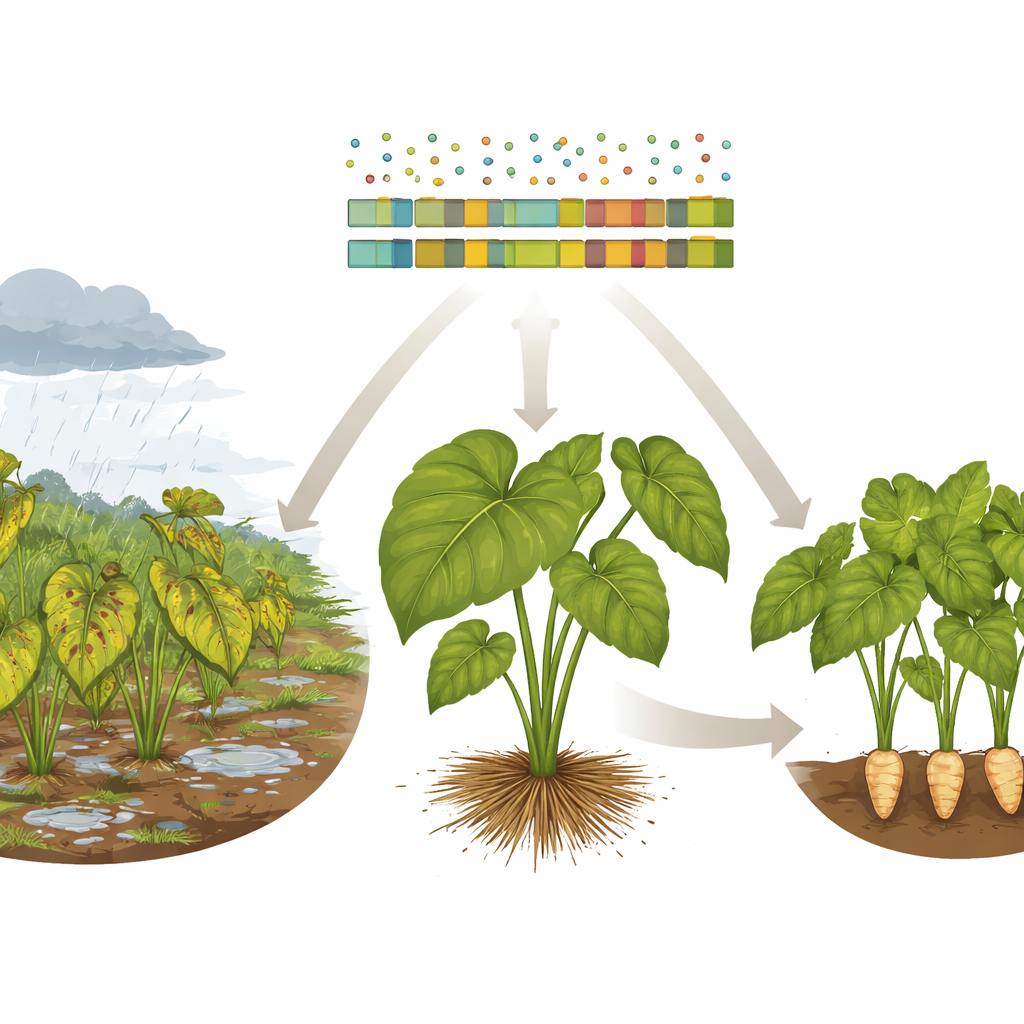
Taro leaf blight is caused by a water-loving microbe that thrives in warm, humid conditions. It attacks taro leaves and underground corms, causing them to rot and slashing yields by up to 70–100 percent. Farmers can prune leaves or spray fungicides, but these measures are costly, hard to sustain, and not always kind to the environment. The safest long-term solution is taro plants that are naturally resistant. Until recently, however, breeders had to rely on slow, trial‑and‑error field selection, which can take a decade or more to deliver a new variety.
Bringing DNA tools into the field
The researchers assembled a panel of 279 taro types bred or collected in Nigeria, Samoa, and Vanuatu. They planted 265 of these in a disease “hotspot” in southeastern Nigeria over two growing seasons, where taro leaf blight appears naturally each year. For every plot they recorded how badly the leaves were blighted, how tall and vigorous the plants were, how many side shoots (suckers) they produced, and how heavy the main corms, smaller cormels, and total tubers were at harvest. At the same time, they extracted DNA from each taro type and scanned the genome for thousands of small natural differences, called single nucleotide polymorphisms, or SNPs, that act as markers along the chromosomes.
Linking genes to disease resistance and yield
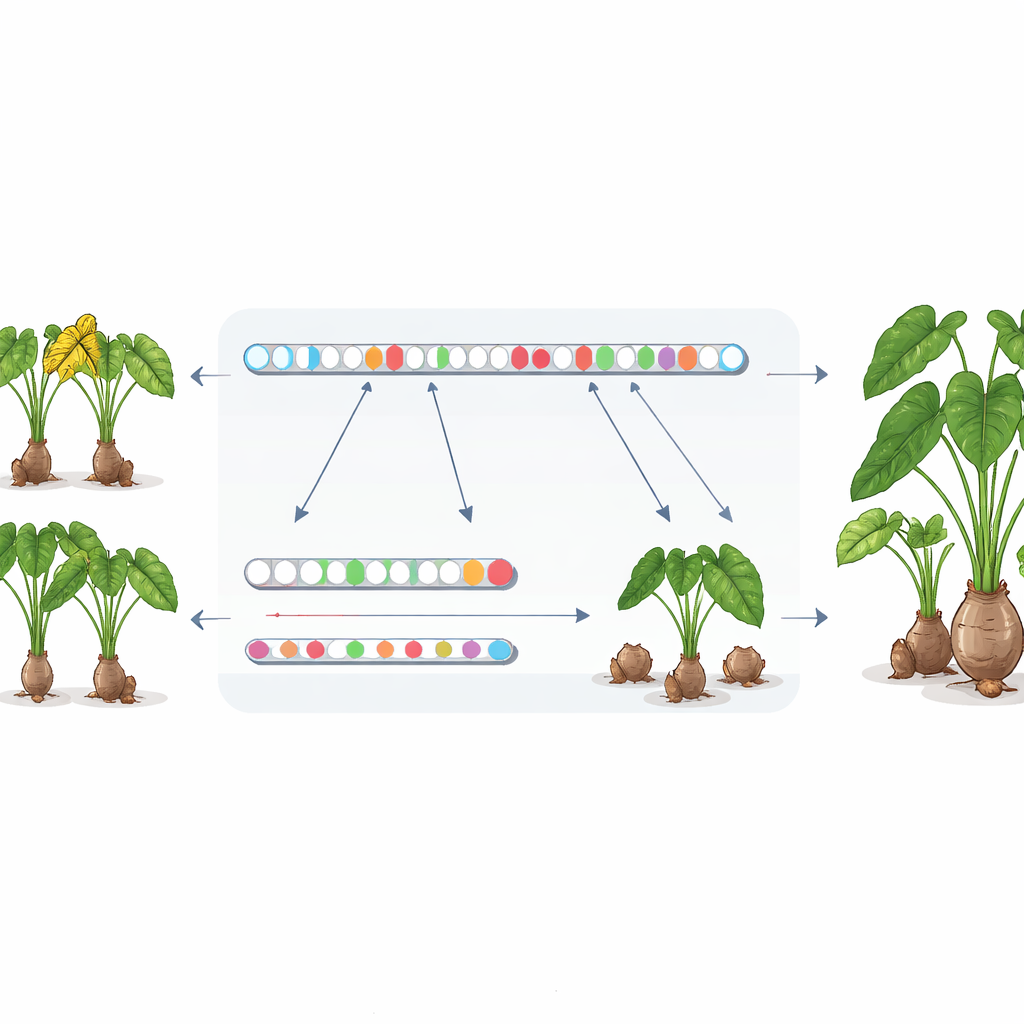
By combining field measurements with genome data in a technique called genome‑wide association study, the team searched the entire taro genome for markers that consistently appeared in plants with desirable traits. They found 18 DNA markers strongly associated with taro leaf blight resistance, number of suckers, corm weight, cormel weight, and total tuber weight. Ten of these markers were linked to how severely plants were blighted, spread across eight of taro’s chromosomes. Others were tied to how many suckers a plant produced, and to how large its corms and cormels grew. One particular marker on chromosome 11 was associated with both corm weight and total tuber weight, suggesting that the same genomic region influences several aspects of yield at once.
What the candidate genes suggest
Looking more closely around these key markers, the researchers identified eleven promising genes that may help taro cope with disease and manage growth. Several are involved in energy production, stress responses, or the way cells sense and respond to harmful conditions. Others help control how plants use nutrients, regulate growth and organ development, or respond to shortages of nitrogen, phosphorus, and potassium. Together, these genes form a network that likely affects how strongly taro can withstand infection by the leaf blight pathogen while still building large, well‑filled storage organs underground.
From genetic clues to healthier harvests
In everyday terms, this study has pinpointed stretches of taro DNA that go along with stronger plants, less disease damage, and better yields. Breeders can now use these DNA markers like barcodes, screening young seedlings in the lab instead of waiting years to see how they perform in the field. Although the work was done at a single location and yield remains strongly influenced by weather and environment, the findings lay a genetic roadmap for faster, more precise breeding. Over time, this should help deliver taro varieties that keep producing reliable harvests for smallholder farmers, even as taro leaf blight continues to threaten this ancient and important crop.
Citation: Jiwuba, L., Onyeka, J., Amadi, C. et al. Genome-wide association study of resistance to taro leaf blight and yield traits in taro (Colocasia esculenta (L.) Schott). Sci Rep 16, 13315 (2026). https://doi.org/10.1038/s41598-026-43034-5
Keywords: taro, leaf blight resistance, genome-wide association, root and tuber crops, plant breeding