Clear Sky Science · en
Recycling paper waste into structural cellulose composites with enhanced mechanical and thermal performance
Turning Old Newspapers into New Building Boards
Most of us toss old newspapers and cardboard into the recycling bin without thinking about what happens next. This study asks a bigger question: could that mountain of waste paper become part of the walls and partitions in our homes? By transforming discarded newsprint into sturdy, lightweight panels, the researchers explore a way to cut both construction emissions and landfill waste at the same time.
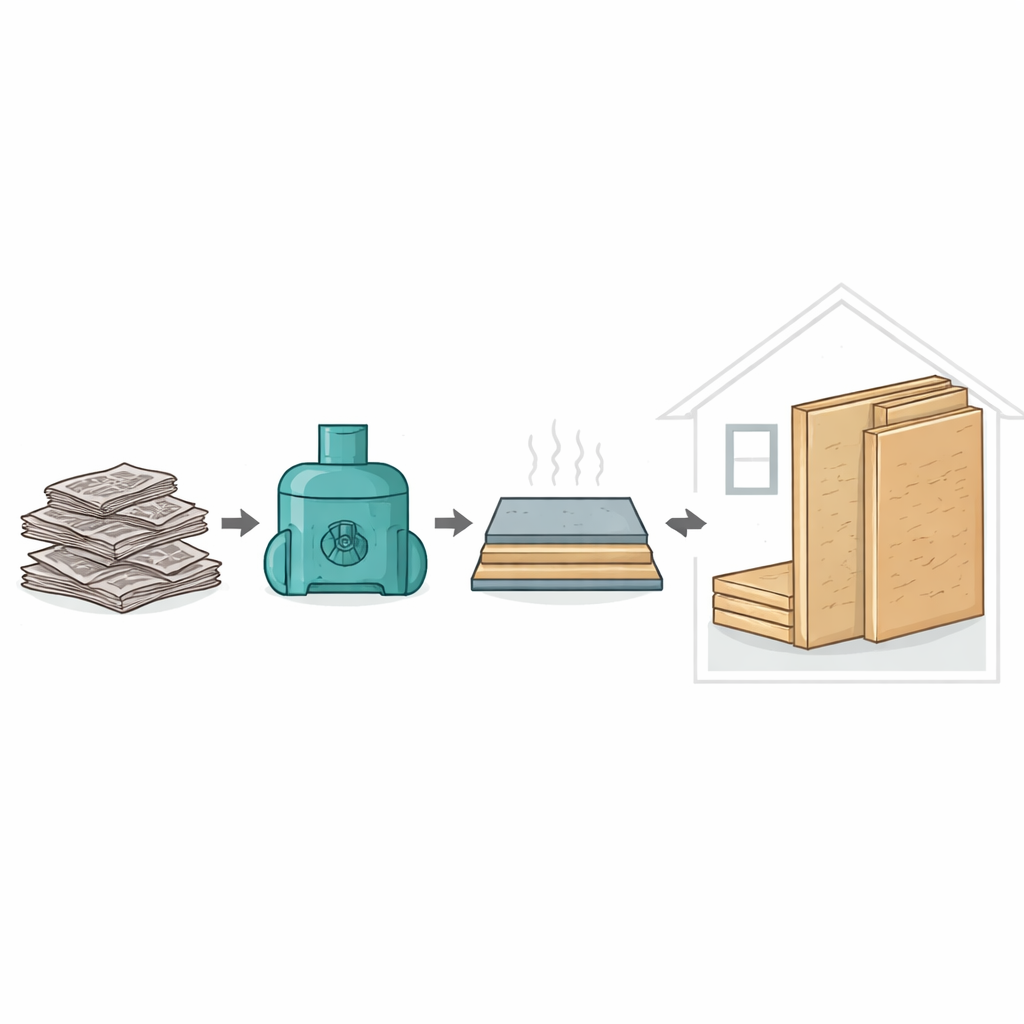
From Paper Bin to Solid Board
The team focused on one of the world’s most common garbage streams: cellulose-based paper, such as newspapers. Instead of making traditional wood panels, which require cutting down fresh trees, they ground up waste newspaper and mixed it with a polyurethane binder—a kind of plastic that can harden into a rigid foam-like solid. Importantly, they did not add chemical catalysts, keeping the recipe simpler and potentially cheaper. The mixture was poured into heated steel molds and pressed into flat boards about the size of a book cover and a centimeter thick, producing what they call polyurethane–cellulose boards.
Testing Strength and Toughness
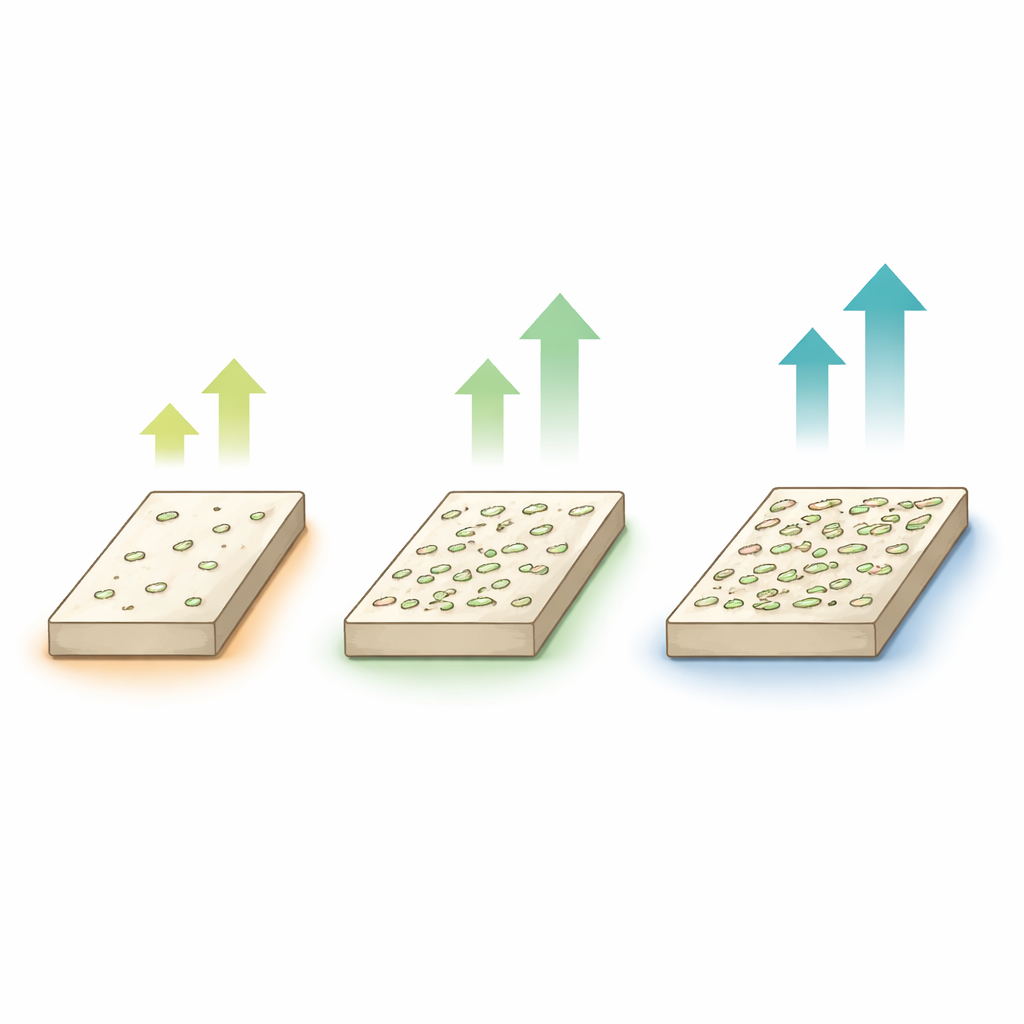
To see whether these recycled boards could stand up to real use, the researchers put them through a battery of standard engineering tests. They varied the share of ground newspaper from 10% to 50% of the board’s weight and then stretched, compressed, and hit the samples with a swinging hammer. As more paper was added, the boards generally became stiffer and stronger in tension (pulling), with the elastic stiffness rising to about three times its original value between the lowest and highest paper contents. Under compression (squeezing), strength peaked when the boards contained about 30% paper—too little paper made them weak, but pushing the content to 50% reduced compressive performance again. Surprisingly, impact resistance stayed almost the same regardless of paper content: all boards absorbed roughly similar energy when struck suddenly, though they were far less impact-tough than heavy-duty industrial laminates designed for extreme loads.
How Heat, Moisture, and Vibration Behave
Beyond simple strength, the study also examined how the boards respond to heat and water vapor, both crucial for building use. Heating tiny samples in a controlled furnace showed that higher paper content generally improved thermal stability: the peak decomposition temperature crept upward as more cellulose was added, indicating that the material could tolerate higher temperatures before breaking down. On the other hand, the more paper in the mix, the more easily water vapor passed through the boards. Compared with standard oriented strand board (OSB) and medium-density fiberboard (MDF), these recycled panels were about seven times more permeable to water vapor—potentially an advantage for breathable interior partitions but a drawback where strong moisture barriers are needed. Dynamic mechanical tests, which gently vibrate the material while changing temperature, revealed that boards with more paper not only became stiffer but also dissipated more energy, suggesting better vibration damping at everyday temperatures.
How They Compare with Familiar Wood Panels
To place their results in context, the authors compared their recycled boards with conventional OSB and MDF—mainstays of modern construction. In simple pulling and squeezing tests, the best-performing newspaper-based boards reached tensile and compressive strengths that match or even surpass some reported OSB values. However, the way the materials are built up is very different, and the number of test samples in this study was modest, so the authors are careful not to claim a one-to-one structural replacement. The new boards are more ductile, meaning they can undergo larger strains before failing, but they have lower impact resistance and behave differently under compression versus tension, reflecting an internal structure that is not the same in all directions.
What This Means for Future Buildings
For a general reader, the core message is that yesterday’s newspapers can become tomorrow’s interior walls. By hot-pressing shredded paper with a polyurethane binder, the researchers produced rigid, low-density boards that are strong in tension, reasonably strong in compression at around 30% paper content, more thermally stable at higher paper fractions, and highly permeable to water vapor. These properties make the material a promising candidate for non-load-bearing uses such as lightweight modular panels, interior partitions, and insulating elements where full structural capacity is not required. Because the process uses recycled waste and avoids extra catalysts, it fits well with circular-economy goals. The study concludes that while these boards should not yet replace structural wood panels in critical load-bearing roles, they already offer a viable, lower-carbon option for many everyday building components—and further optimization and scaling could push this concept even closer to mainstream construction.
Citation: Szczepanski, M., Manguri, A. Recycling paper waste into structural cellulose composites with enhanced mechanical and thermal performance. Sci Rep 16, 14384 (2026). https://doi.org/10.1038/s41598-026-43032-7
Keywords: recycled paper boards, cellulose composites, sustainable construction, polyurethane panels, low‑carbon building materials